Can the weak eye improve? In many cases it can. What results you see depends on the cause, age at diagnosis, degree of vision loss and how well you respond to care. Today’s Lazy Eye Treatment goes past covering which eye is which. We do what we can to give each eye the best picture and then get the brain to use the weak eye more which in turn improves it.
The term used in medicine is amblyopia which presents when the brain does not properly process visual info from one eye during early development. The eye may be healthy but the brain ends up relying more on the better seeing eye. Timely Amblyopia treatment can improve useful vision especially in children, also certain older patients may benefit from a personalized care plan.
What Is a Lazy Eye?
Amblyopia is reduced vision in one eye, or occasionally both eyes, that cannot be explained only by a visible structural abnormality. The brain may suppress an image that is blurred, poorly focused or misaligned. This is why Lazy Eye in Children can remain hidden: the stronger eye compensates, and the child may not realise that the other eye sees less clearly.
Effective Lazy Eye Treatment has 2 main components. First the ophthalmologist determines and corrects the cause of poor vision. Second, we apply treatment that gets the brain to use the weak eye instead of ignoring it.
Can Lazy Eye Be Treated?
Most children who are diagnosed early do well with their vision. In a report by India’s Ministry of Health and Family Welfare it is put forth that amblyopia which has caused visual loss may be either fully or partially reversed with early detection and proper intervention. The National Eye Institute reports that improvement may be seen within weeks though for the best results it may take months. Amblyopia Treatment may need to continue or be reduced gradually to lower the risk of recurrence.
Age is a factor which is very much present in the visual systems’ development phase at which point it has the greatest adaptability. Also, what we put forth as initial Lazy Eye Treatment is at its best response at this stage of life however that does not mean a full stop to care for older kids and adults. In Lazy Eye in Adult patients response is typically less and is also very inconsistent but we have that there is still a chance of success with use of corrective lenses, treatment of other present health issues and certain visual therapies.
What Causes Lazy Eye?
Strabismic amblyopia sets in when the eyes do not point in the same direction and the brain suppresses the input from one eye. Refractive amblyopia is when one eye is very different in degree of short sightedness, long sightedness or astigmatism. Deprivation amblyopia results from a cataract, a very droopy lid, a cloudy cornea or some other condition which blocks a clear image from reaching the retina. The right Lazy Eye Treatment must be tailored to the individual case instead of the same treatment being applied to all patients.
In many cases symptoms of Lazy Eye in Children may go unnoticed which is why it is usually detected during routine screenings. Signs may include covering one eye, head tilting, frequent squinting, an eye turn, difficulty in tracking objects and issues with reading, drawing and ball games.
How Is Amblyopia Diagnosed?
The ophthalmologist tests each eye separately, does a vision and spectacle power assessment, checks eye alignment and looks at the eye’s internal health. Dilation of the pupils may be done to get an accurate refraction and to better see the retina and optic nerve. Before starting Amblyopia treatment other causes of reduced vision must be ruled out which is what makes a diagnosis of amblyopia.
A very in depth exam is of great importance in the case of Lazy Eye in Adults also we must rule out that what may be diagnosed as long term amblyopia is in fact a result of new retinal, corneal, optic nerve or lens disease.
Main Lazy Eye Treatment Options
The following treatments may be used alone or in combination. The schedule is determined by the cause, age, visual difference between the eyes and response at follow-up.
| Treatment | How it helps | Common clinical role |
| Prescription glasses or contact lenses | Gives the weaker eye a clearer image by correcting refractive error | Often the first step for unequal spectacle power |
| Eye patching | Covers the stronger eye temporarily so the brain relies on the weaker eye | Used when vision remains unequal after optical correction |
| Atropine drops | Temporarily blurs near vision in the stronger eye | An alternative to patching for suitable children |
| Surgery for the underlying cause | Removes a visual obstruction or improves alignment | Considered for cataract, severe ptosis or selected strabismus |
| Supervised binocular or digital therapy | Uses structured tasks to train visual cooperation | May be considered as an adjunct for selected patients |
Glasses and Contact Lenses
For a large group of patients, accurate spectacles are the first step in Lazy Eye Treatment. If one eye is receiving a poor quality image constantly then through regular use of glasses we give the brain a better signal. Some children do very well with glasses alone which is why the specialist may try out a period of visual adaptation before turning to patching or drops.
This approach is very much so for Lazy Eye in Children which is a result of unequal refractive error. Glasses must be worn as per the doctor’s instruction which is not limited to school use. Contact lenses may be used when there is a large difference between the eyes, but age of the child, hygiene issues, corneal health and the family’s ability to handle lens care play a role in that decision.
Eye Patching
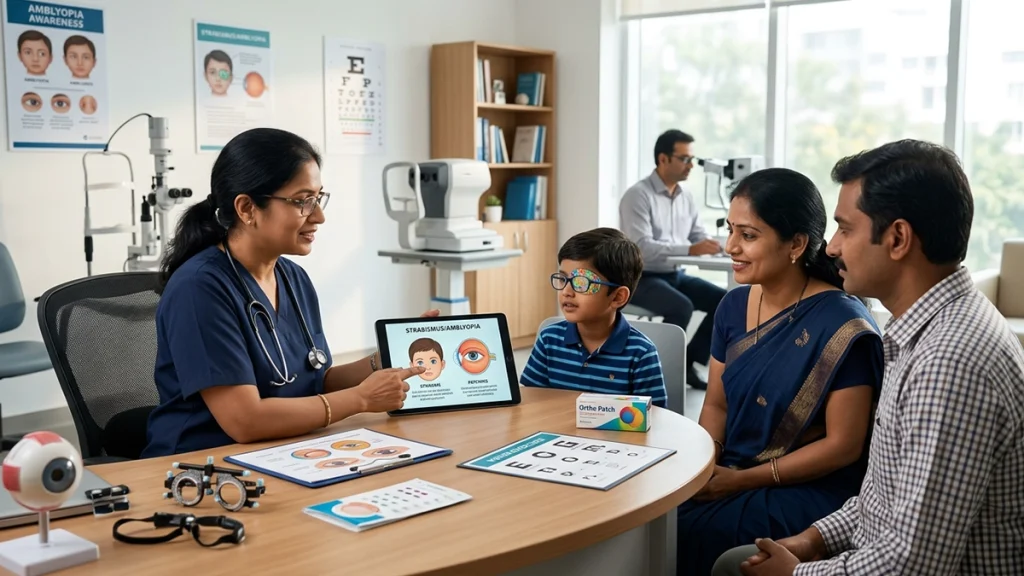
Patching which is a well established Amblyopia Treatment. We put a patch over the strong eye for a specified time which forces the brain to use the weak eye. The schedule of the regime varies with the degree of Amblyopia and also response.
Enjoy it when your child does close work like color by number, reading, or puzzles which will in turn get the weak eye more use. Also, leaving the patch on longer than what is recommended doesn’t necessarily mean you’ll see results faster and in some cases may damage the good eye. That’s why we stress out regular follow ups as a key element of Lazy Eye Treatment.
Parents managing childhood amblyopia may find the first few days difficult. A predictable routine and calm encouragement usually work better than treating therapy as punishment.
Atropine Eye Drops
Atropine is also an established Amblyopia Treatment. It is put in the strong eye to temporarily improve focus, especially for near objects which in turn encourages more use of the weaker eye. For some kids atropine may work as well as patching and also may be a better option when a child will not wear the patch.
Drops must be used only under medical supervision. The ophthalmologist decides the schedule and checks for temporary blur, light sensitivity or irritation. For a child, the choice between patching and atropine depends on age, prescription, severity, routine and previous response.
Is Surgery Needed?
Surgery is a tool which does not retrain the brain but may correct the cause of abnormal visual development. A congenital cataract, severe ptosis or dense corneal opacity may require timely surgery. For some cases of strabismus eye muscle surgery may improve alignment. While this may straighten the eyes it does not in itself restore vision which in the case of Lazy Eye treatment still requires glasses, patching or drops.
This is to say that surgery and Amblyopia treatment play different roles. The former corrects the issue of misalignment or obstruction; the latter improves the brain’s use of info from the weaker eye.
Lazy Eye Treatment for Children
The prognosis for Lazy Eye in children is very good when the issue is identified as their vision is still developing. At that stage the brain is receiving a clear image and has time to adjust. Health authorities recommend that childhood vision screening be done at regular intervals because early diagnosis increases the chance of visual improvement.
A child’s Lazy Eye treatment is an evolving process which takes place over many visits. Prescription of glasses may change, patching hours may be adjusted and treatment may be tapered when vision stabilizes. We also perform follow up to protect the strong eye from DSC that which is called penalization and at the same time we are able to identify any recurrence.
Parents must not wait for a report of the issue with Lazy Eye in Children as it may present without symptoms. A persistent eye turn, white pupil appearance in photos, drooping eyelid, atypical head position or strong reaction to covering one eye is a reason to seek evaluation right away.
Lazy Eye Treatment for Lazy Eye in Adults
Lazy Eye in Adults which in many cases is a presentation of amblyopia that developed in early age and went unaddressed or only partially treated. In the older patient the treatment is less of a sure thing after the visual development years and we can not promise normal vision. That said, a full evaluation is still very much worth doing.
Adults may start Lazy Eye treatment with new glasses or contact lenses and we also treat issues like cataracts, corneal disease or alignment problems. In some adults we may put them into a supervised perceptual or binocular training program. How well it works depends on the cause, the severity and also past treatment.
For Lazy Eye in Adults, a realistic goal may be improvement in visual acuity, contrast, comfort or functional use of the weaker eye. Online eye exercises should not replace medical diagnosis.
Children and Adults: Key Differences
| Factor | Children | Adults |
| Visual adaptability | Usually greater because vision is still developing | Lower and more variable in longstanding amblyopia |
| Typical starting point | Accurate glasses, followed when necessary by patching or atropine | Complete reassessment, updated correction and management of other eye conditions |
| Main goal | Support normal visual development and prevent lasting loss | Seek realistic functional improvement and protect overall eye health |
| Monitoring | Checks vision in both eyes, adherence and recurrence | Measures benefit, comfort and practical function |
| Expected response | Often favourable with early diagnosis and consistent care | Variable; improvement may occur but cannot be guaranteed |
This difference explains why Lazy Eye in Children requires prompt care, while Lazy Eye in Adults requires an individual discussion about realistic outcomes. Neither group should start patching without professional supervision.
How Long Does Lazy Eye Treatment Take?
There is no set timeline. Improvement may present itself after a few weeks, we may see best results in months or even years. Lazy Eye Treatment may consist of an initial phase with glasses which then may include the use of patching or drops. The plan is subject to change as vision improves and also may be slowly reduced.
Age, severity and compliance play a role in Amblyopia Treatment. Slow improvement is not always a sign that the therapy has failed, but also that regular reviews may have been missed which in turn may delay necessary changes.
Why Lazy Eye Treatment Follow-Up Is Essential
At each follow up the ophthalmologist looks at both eyes, assesses the spectacle prescription and reports that patching or drops are still appropriate. In terms of monitoring Lazy Eye in Children we look at how the developing visual system is doing. It may get better, stay the same, or get worse. Monitoring Lazy Eye in Adults helps determine whether treatment is producing a measurable, useful result.
Families should report missed patching or difficulty using drops. A practical Lazy Eye Treatment schedule is more useful than an unrealistic plan.
When Should You See an Eye Specialist?
Arrangements for an exam when a child reports an eye turn, reports closing one eye, is noted to be tilting the head, has a drooping eyelid, has difficulty with visually guided activities or does not pass a screen test. A white pupil reflex, sudden misalignment or sudden vision loss require prompt evaluation as they may indicate a condition other than amblyopia.
An adult that is diagnosed with poor vision in one eye should not assume it is untreatable Lazy Eye in Adults. An ophthalmologist may make the diagnosis, run tests for other diseases and explain whether Lazy Eye Treatment or rehabilitation has a reasonable role.
Frequently Asked Questions
1. Can lazy eye be completely cured?
Some kids achieve normal or almost normal vision, others see some improvement. What we see with Amblyopia Treatment is that it is based on age, cause, severity and adherence. An ophthalmologist can’t guarantee results until they examine the patient.
2. What is the best age to begin treatment?
Treatment should begin at the first sign of amblyopia. Lazy Eye in Children does best when the visual system is still developing but even older children may improve and should not be denied assessment just because they have outgrown a very common age limit.
3. Can glasses alone correct a lazy eye?
Yes. Correct glasses may substantially improve refractive amblyopia. Consistent spectacle wear is an important part of Lazy Eye Treatment, even when patching or drops are later added.
4. How many hours should an eye patch be worn?
The schedule varies with age, severity and response. Amblyopia Treatment must be prescribed and monitored; parents should not increase patching hours without medical advice.
5. Can an adult improve a lazy eye?
Some better outcomes may be achieved but Lazy Eye in Adults is less of a certain prognosis as compared to childhood amblyopia. The specialist will make the diagnosis, correct for refractive error and rule out other diseases before getting into training or rehabilitation.
6. Is a lazy eye the same as squint?
No. Squint is a term for misaligned eyes, and amblyopia is a condition of reduced visual development. A squint may cause amblyopia, but in some cases Lazy Eye in Children may also present itself when the eyes appear to be straight out of that which has different spectacle power.
7. Can lazy eyes return after successful treatment?
Yes at times recurrence does happen. The doctor may wean you off therapy slowly and do regular reviews. Follow up is a key element of Lazy Eye treatment.