Hyperopia which is also referred to as farsightedness or long sightedness is a refractive error which presents as difficulty in near vision for many. It is a result of light entering the eye which does not focus exactly on the retina. In mild cases may go by undetected as young eyes do in fact sometimes correct it. As that effort goes up a person may present with blur, eye strain and headaches. We also look at what the Hyperopia Symptoms are, Hyperopia causes it and what the Hyperopia treatment options are for Hyperopia. This information is put out there for patients to seek care before the problem starts to affect reading, work or learning.
For some individuals Farsightedness Treatment may present in the form of reading glasses. For others it may be full time glasses, contact lenses or evaluation for a refractive procedure. A full eye exam is the best place to start with Hyperopia Treatment.
What Is Hyperopia?
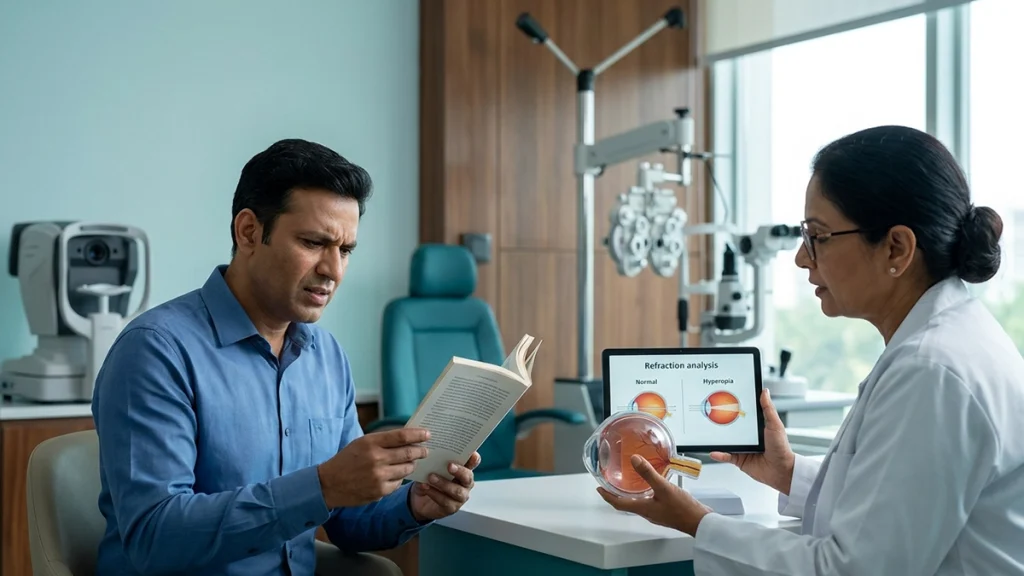
In a normal eye the cornea and natural lens will refract light that which lands on the retina at the back of the eye. In hyperopia light tends to focus behind the retina when the eye is at rest. This is very often due to the fact that the eye from front to back is of a shorter than average size. Also a flatter cornea or a reduced eye’s optical system’s focusing power may play a role. These structural issues are the main Hyperopia causes.
Young in age may at times out perform the accommodative aspect of the eye which is its natural near focus mechanism. That which they put through that system may at times delay the blur of print but in the end is tiring. Also what we see is that in the early stages of Hyperopia symptoms may present as a discomfort issue as opposed to a constant blur. In more severe hyperopia near and distance vision may be affected.
Hyperopia is a different condition from presbyopia. Hyperopia may present from early in life and is related to the eye’s shape or optical power. Presbyopia is an age related loss of near focus which becomes apparent in middle age. A person may have both at the same time which is why Farsightedness treatment should be based on the results of the exam and not the age of the patient.
Hyperopia Compared With Other Refractive Errors
| Condition | Where or why focus is disturbed | Common difficulty | Usual correction |
| Hyperopia | Light tends to focus behind the retina | Near vision is often difficult; strong cases may also blur distance | Plus-powered spectacles, contact lenses or selected procedures |
| Myopia | Light focuses in front of the retina | Distant objects appear blurred | Minus-powered spectacles, contact lenses or selected procedures |
| Astigmatism | Uneven curvature prevents one sharp focal point | Vision may be blurred or distorted at several distances | Cylindrical lenses or selected procedures |
| Presbyopia | The natural lens loses flexibility with age | Near focusing becomes difficult in middle age | Reading glasses, multifocals, contact lenses or selected procedures |
Hyperopia, myopia, astigmatism and presbyopia are of the refractive error group but they present with different symptoms. A detailed refraction test is used to diagnose between them and to determine the right prescription.
Common Hyperopia Symptoms
Typical Hyperopia Symptoms include blurred near vision, tired aching eyes, headaches after reading, and difficulty in maintaining focus during screen work. Symptoms may become more present after close work for long periods. Also dry eye, astigmatism and presbyopia may present with the same complaints which is why symptoms by itself can’t confirm hyperopia.
Mild hyperopia may go unnoticed for years as the eyes compensate. As we age and the focusing ability decreases, what was before under control appears more. At that stage Hyperopia Treatment may help reduce strain and improve performance of near tasks.
Hyperopia in Children
Children may not report that they see blurred because they do not have a point of reference. Their Hyperopia Symptoms may present as eye rubbing, headaches, avoidance of books, losing their place while reading, reduced attention to near work, closing one eye or fatigue during homework.
Some kids focus intently to produce a clear image. In some cases that effort may present as an inward eye turn which is known as accommodative esotropia. Large degree of hyperopia also at times which at the same point in which the 2 eyes have different prescriptions increases the chance of amblyopia or lazy eye. Early Hyperopia treatment may therefore support not only clear vision but also normal visual development.
A child with persistent squint, atypical head posture, recurrent headaches, difficulty with near work or a failed vision screening should have a full eye exam. The proper farsightedness treatment in a child must be determined by age appropriate testing and should not be a solution of ready made reading glasses. Routine testing is done because children may not be aware that they have a vision issue.
What Causes Hyperopia?
The primary Hyperopia causes are an eyeball which is shorter than average, a cornea that is too flat or an optical system which does not bend light sufficiently. Hyperopia is present at birth in many cases and also tends to run in families, which is a recognized Hyperopia causes .
Childhood eye growth changes the prescription which in turn requires that we reevaluate cases of Developmental Hyperopia causes. Some children do outgrow the issue as they grow while others do not improve and continue to require correction. Regular exams are a better gauge of how the child is doing as not all kids outgrow this condition.
Less commonly other eye and health issues may present; these atypicals Hyperopia causes require professional evaluation, also when vision changes acutely. A sudden loss of vision, severe pain, marked redness, new flashes, many new floaters, double vision or a curtain like shadow is not a typical presentation of farsightedness. Such symptoms require prompt assessment and should not be managed by a change in Farsightedness Treatment.
How Is Hyperopia Diagnosed?
Diagnosis is determined via eye exam. We do routine visual acuity testing, refraction to determine the lens power, assessment of eye movement and alignment, and health of the eye. Hyperopic prescriptions which are for far sightedness will have a plus sign, also the power may vary between each eye.
In some patients which may present with a masked picture of their true refractive error, the ophthalmologist may use atropine drops to temporarily paralyze accommodation. This is what we call cycloplegic refraction. It is a tool which helps to bring out the full degree of refraction and is very useful in Hyperopia treatment , also when strabismus or amblyopia is an issue.
Online assessments do not do well at identifying eye misalignment, uneven prescriptions or eye health issues. A full exam is required prior to beginning Farsightedness Treatment. Tailor made Hyperopia Treatment will base as much as is done in that exam.
Hyperopia Treatment Options
| Option | How it works | Who may consider it | Key considerations |
| Spectacles | Plus-powered lenses bring the focus forward onto the retina | Children and adults with mild to high hyperopia | Non-invasive, easy to update and available in different lens designs |
| Contact lenses | Lenses on the tear film provide optical correction | Suitable adults and selected older children | Professional fitting and careful hygiene are essential |
| Laser refractive surgery | Reshapes the cornea to change focusing power | Selected adults with stable prescriptions and suitable corneas | Benefits, limitations and risks require detailed assessment |
| Lens-based surgery | Replaces or supplements the eye’s internal focusing system | Selected adults depending on age, prescription and lens condition | It is an intraocular procedure and is not suitable for everyone |
| Monitoring | Regular review without immediate correction | Some symptom-free people with low hyperopia | Decisions depend on age, symptoms, eye alignment and visual needs |
Online assessments are poor at identifying eye misalignment, uneven prescriptions or eye health issues. A full exam is required before we start Farsightedness Treatment. Tailor made Hyperopia Treatment will base as much as is done in that exam.
Spectacles
Spectacles are the primary form of Hyperopia treatment . Convex, which are also known as plus powered, lenses which in turn alter the path of light to improve focus on the retina. As per the exam results which may include a full examination or a screening we may be prescribng full time wear, for near work or for certain activities.
For kids, glasses can reduce the stress on the eyes during focus, also they improve visual clarity and help in the management of strabismus. We advocate for consistent wear of glasses if the prescription is to support visual development. Also we see that this Farsightedness Treatment is non surgical in nature and as the eyes grow the treatment can be adjusted. Also we use positive powered lenses in the care of young patients with hyperopia.
Adults use single vision, bi-focals, progressive or occupational lenses which we see put to use when hyperopia is present with presbyopia. Right lens measurement and frame fitting reduce unsightly distortion and improve comfort. Proper correction often ameliorates Hyperopia Symptoms like brow ache and near blur.
Contact Lenses
Contact lens wear is a great Hyperopia Treatment which also gives you a larger field of view and freedom from wearing glasses. Soft, rigid, toric or multifocal options are available based on your prescription, corneal geometry, lifestyle and if you have astigmatism or presbyopia.
Safe fit by a professional and good hygiene is a must. Redness, pain, discharge, light sensitivity or sudden blur while in use should be brought to prompt attention. Safe care of your lenses is key to a successful contact-lens wear.
Refractive Surgery
Some grown ups may be good candidates for laser based Hyperopia Treatment which includes procedures that restructure the cornea. What is put forward is that prescription stability, corneal thickness and shape, tear film quality, age, general health and realistic expectations determine eligibility.
Surgery does not prevent presbyopia or other age related changes which may still see the use of glasses for some tasks. As for results they may bring dry eye, glare, halos or residual prescription. A detailed assessment is required before going ahead with vision correction surgery.
Lens based procedures may be suited to certain adults when corneal laser surgery is not an option. As intraocular procedures these do require in depth consideration of benefits and risks. There is no one Hyperopia treatment that is right for all patients or which will definitely eliminate the use of glasses.
Hyperopia Treatment for Children
A child’s plan depends on prescription strength, visual acuity, symptoms, eye alignment and the difference between the eyes. Some children with low hyperopia and normal visual development may only need monitoring. Others require full-time glasses. When amblyopia is present, spectacles may be combined with patching or another treatment directed by a paediatric eye-care professional.
Timely Hyperopia treatment gives better results for the growing visual system. Do not reduce wear time because your child seems to see well without glasses. They may strain to focus which may not be obvious.
In addition to the Farsightedness treatment we also consider comfort and school activities. Follow up visits to check the prescription, visual acuity and eye alignment as the child grows is very important. Also regular review is a part of the Hyperopia Treatment.
Can Hyperopia Be Prevented?
The typical structural Hyperopia causes can not be prevented by eye exercises, diet or by the amount of time spent on screens. Healthy habits may improve over all comfort but do not affect the size of the eyeball or bring about permanent cornea remodeling.
Good lighting and rest periods may reduce fatigue which in turn is not a substitute for prescribed care. For Effective Hyperopia Treatment we start with accurate refraction and we follow up with reviews when symptoms or visual needs change.
When Should You See an Eye Doctor?
Arrange for an eye exam when you notice that reading is very blurred or uncomfortable, that you get headaches from close work, a child is avoiding near tasks or reports that an existing prescription no longer works. These may be Hyperopia Symptoms but testing is required to rule out other issues.
If you experience sudden vision loss, severe eye pain, a large injury, new flashes or floaters, a dark curtain in your field of vision, marked redness and light sensitivity or sudden double vision. This is not a reason to change your routine Farsightedness treatment.
At our ASG Eye Hospital we do an assessment of refraction, eye alignment and eye health which in turn allows us to recommend Hyperopia Treatment that we tailor to each patient’s routine. Also on ASG Eye Hospital’s site you may look up which hospitals we have, meet our doctors and book in for an eye exam.
Frequently Asked Questions
1. Is hyperopia the same as farsightedness?
Yes. Hyperopia, farsightedness and long sightedness are the terms for the same refractive error. For near vision which is often more difficult although in some cases of severe hyperopia distance vision is also affected. The appropriate Hyperopia treatment depends on the prescription, age and symptoms.
2. What are the early signs of hyperopia?
Early Hyperopia Symptoms may present as tired eyes, headaches after reading, intermittent near blur, difficulty with sustained screen work and the child will hold reading material at a greater distance. Also kids may rub their eyes, avoid close work or develop an introverted eye.
3. What are the main causes?
Common Hyperopia causes include an eyeball that is shorter than average, a cornea which is flatter than usual, or the eye’s optical system which does not focus properly. Also family history and how the eyes develop play a role in the prescription.
4. Can hyperopia become more noticeable with age?
Yes. With age we see a decrease in the eye’s ability to compensate which in turn causes previously undetected Hyperopia symptoms to present themselves which in turn increases the need for Farsightedness treatment.
5. Do glasses permanently cure hyperopia?
No. Glasses change how light enters the eye during wear; they do not permanently change eye length or cornea shape. They are a safe and effective Hyperopia treatment in many patients.
6. Is laser surgery available?
Laser surgery which may be used for some adults that have a stable prescription and suitable eye measures is one type of Farsightedness treatment. But first you must go in for refraction, corneal mapping, tear-film assessment and a full eye exam.
7. Does every farsighted child need glasses?
No. The choice is based on the prescription, symptoms, visual acuity, eye alignment and difference between the eyes. A child presenting with severeHyperopia Symptom, amblyopia risk or a squint may require early correction and regular follow up.
8. Can eye exercises remove hyperopia?
Eye exercises do not change the structure of Hyperopia Causes and also do not remove a refractive prescription. They may be recommended for specific eye coordination issues, but are not a Hyperopia treatment.