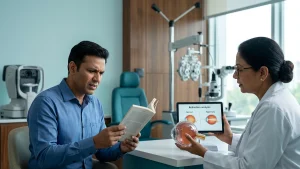
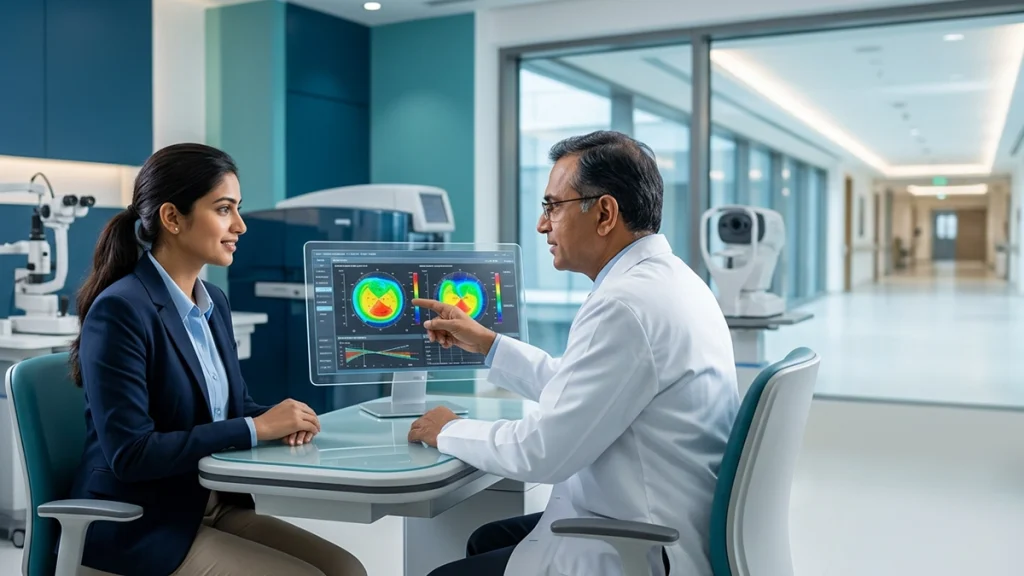
Hyperopia is also referred to as farsightedness or long sightedness which in turn makes reading, mobile phone use and other close-in tasks a challenge. As for Hyperopia treatment it depends on age, degree of refractive error, eye health, corneal dimensions and daily visual requirements. In the case of adult patients LASIK for Hyperopia is an option which may reduce dependency on glasses by means of cornea remodeling which in turn improves light focus on the retina. It is important to note that not everyone is a candidate for this procedure which is why a through eye exam is a must before any decision is made.
What Is Hyperopia?
In a condition of hyperopia light rays focus behind the retina instead of on it. This may be due to an average size which is small in length or that the cornea and natural lens do not have sufficient focus. In younger eyes this may still be compensated for by accommodation but also that may bring on headaches, eye strain, tired eyes or difficulty in maintaining clear near vision.
The National Eye Institute reports that farsightedness is a condition which is brought to notice during a full eye exam and is treated with the use of glasses, contact lenses or surgery in adults. A personalized Hyperopia Treatment plan begins with a precise measurement of the eye’s refractive power as well as an assessment of the eye’s health.
Hyperopia is different from presbyopia. Hyperopia is a result of the eye’s optical shape and may present from a young age. Presbyopia is an age related issue which sees the natural lens’ ability to focus at near reduce. A person may have both which is why Farsightedness correction for a younger hyperopic patient may differ from that of a person who also needs reading support.
Can LASIK Correct Hyperopia?
Yes, in some cases we seem to perform LASIK for Hyperopia. During the procedure a thin corneal flap is made and an excimer laser which rescales the underlying tissue is used. In a hyperopic correction what we do is we make the central cornea more steep which in turn increases its focusing power. The flap is then put back in place.
The FDA reports that LASIK is a refractive procedure which through the use of controlled removal of corneal tissue changes the cornea’s focusing power. Also they report on which laser systems are approved for hyperopic indications which in turn means that some farsighted prescriptions do in fact fall within the recognized treatment ranges.
The degree of accuracy in Laser Vision Correction is based on the degree of hyperopia, the presence of astigmatism, corneal shape, tissue thickness, tear film quality and prescription stability. Also the surgeon has to determine if the eye’s focusing muscles are playing a role in what may appear to be a false prescription.
Successful Hyperopia treatment is not a matter of what is written on a spectacle prescription. For some patients we use dilating drops which break the accommodative spasm and bring out the true power. Also we use corneal mapping, pachymetry and ocular surface evaluation which in turn help us to determine if LASIK is appropriate for the patient or if some other form of Farsightedness Correction will give a better risk to benefit ratio.
Common Symptoms and Diagnosis
A person who has hyperopia may note that their near vision is blurred, they have difficulty with small print, experience eye fatigue after screen use, forehead discomfort or frequent headaches. Some people squint in an attempt to improve focus. With high degrees of hyperopia, distance vision also may become an issue.
These also are symptoms of dry eye, astigmatism, binocular vision issues, early cataract or presbyopia. Before we recommend Hyperopia treatment we will confirm the diagnosis and rule out other causes. A full Hyperopia Treatment assessment may include distance and near vision testing, cycloplegic refraction, eye pressure measurement, corneal evaluation and a dilated exam.
Treatment Options for Hyperopia
Globally the World Health Organization reports that refractive errors may be corrected by use of proper glasses, contact lenses or through laser procedures. Glasses are still the non invasive choice but it is after an individual assessment that we turn to surgical options.
| Treatment option | How it helps | Who may consider it | Key consideration |
| Prescription glasses | Uses plus-powered lenses to focus light correctly | Children and adults seeking a non-surgical option | Prescription may change over time |
| Contact lenses | Places correction directly on the eye | People wanting a wider field of vision | Requires careful hygiene and a healthy tear film |
| LASIK | Reshapes the cornea beneath a flap | Eligible adults with stable power | Dryness, glare or residual power may occur |
| PRK | Reshapes the corneal surface without a flap | Selected patients suited to surface treatment | Recovery is usually slower than LASIK |
| Lens-based surgery | Replaces or supplements the eye’s focusing lens | Selected older adults or high prescriptions | It is an intraocular procedure |
Glasses are a basic Hyperopia Treatment which also includes in them cases of children, people with variable power needs and adults that do not wish to go into surgery. Contact lenses do indeed provide a Farsightedness correction but they do require a proper fit and care.
For adults that wish to reduce their need for glasses Laser Vision Correction which we see in ASG Eye Hospital includes options of LASIK and a surface procedure like PRK. We note that PRK at ASG Eye Hospital is put forth as a flap free procedure which corrects hyperopia along with other refractive errors and which is determined to be appropriate for the patient through corneal assessment and a personal plan.
In some older adults which is when presbyopia or early lens changes are present we may discuss a lens based approach. A full consultation is key to matching Hyperopia treatment to the patient’s age, anatomy and what they expect.
Who Is Eligible for LASIK?
A large majority of successful candidates are adults who have had stable prescriptions for a while, also they must have healthy corneas and realistic expectations. We find that the refractive power has to be in the laser platform’s treatment range. Also the cornea must be of adequate thickness and have a regular shape, and the ocular surface must be in good health to support healing.
An in depth evaluation for LASIK of Hyperopia includes refraction which may or may not use cycloplegic drops, corneal topography or tomography, corneal thickness measurement, pupil assessment, tear film testing and a dilated eye exam. This evaluation determines if Laser Vision Correction is a safe option for the patient without producing an unacceptable structural or visual risk.
| Eligibility factor | Why it matters |
| Stable prescription | Reduces the chance that changing power will alter the result |
| Age and accommodation | Helps reveal hidden hyperopia and age-related near-focus loss |
| Corneal thickness and shape | Determines whether reshaping can remain within safe limits |
| Healthy tear film | Supports comfort, healing and stable vision |
| No active eye disease | Reduces avoidable surgical and healing risks |
| Realistic expectations | LASIK may reduce glasses use but cannot guarantee perfect vision |
| Suitable medical history | Some health conditions and medicines can affect healing |
The FDA reports that which is a recent prescription to watch out for. Pregnancy, breast feeding, hormonal changes, some drugs and certain diseases may play a role in refractive instability. Also severe dry eye, insufficient corneal thickness and corneal thinning disorders may make a person a poor candidate.
In each case of Hyperopia Treatment we go to clinical evaluation first, not an online quiz. Even if the prescription seems like a fit for treatment, corneal and tear film results may indicate a different approach to Farsightedness Correction. This is what makes Hyperopia Treatment a very personal process.
When LASIK May Not Be Recommended
LASIK can be delayed or in fact not proceed at times that your prescription is changing, if you are pregnant or breastfeeding, or if you have active inflammation or infection of the eye. In case of severe dry eye you should have that treated and return for reevaluation as there may be an increase in your ocular surface symptoms with LASIK. Also if you have keratoconus, suspicious cornea maps, low cornea thickness, and some autoimmune or connective tissue diseases that rules out this option.
Very high hyperopia is a challenge to correct predictively with corneal surgery. As adults approach the age of presbyopia they should also know that correction of distance power does not stop the natural lens aging. After LASIK for hyperopia it may still be necessary to wear reading glasses. Particularly when both eyes are done for distance vision.
A responsible Hyperopia treatment discussion will go over occupation, night driving issues, participation in contact sports, past surgeries and tolerance to possible visual side effects. When LASIK is not recommended we still have glasses, contact lenses, PRK or a lens based procedure which may be useful for farsightedness correction.
What Happens Before Surgery?
Before the advent of Laser Vision Correction contact lens users may have to go without their lenses for a while which is because they may change the natural cornea. Health history, drug usage, past ocular issues and patient’s expectations will be discussed.
The Hyperopia Treatment evaluation consists of vision, refraction, eye pressure, corneal imaging, tears, the lens and retina. The plan also presents benefits, limitations and alternatives.
Patients should ask what a Hyperopia Treatment will do for their particular measurement picture. What to expect from the results is also a question to ask. As for Informed Consent it should cover undercorrection, overcorrection, regression and also that which may not turn out to be a medical option for enhancement.
Recovery and Expected Results
Many report improved vision post-LASIK which may change in the early stages of recovery. There is report of watering, irritation, light sensitivity, halos, glare and dryness which may happen. We put in the prescribed drops and we follow up often. The FDA says to have that first check up as soon as you can and also to report to your doctor right away if you have very bad pain or your symptoms get worse.
The goal of Laser Vision Correction is to improve refractive error and reduce glasses dependency, we do not promise perfect spectacle free in all cases. Age related increase in hyperopic power and natural lens changes. Some patients may at a later date require to use glasses for reading, night time driving or for residual power.
The quality of Farsightedness Correction is a function of healing and pre existing eye issues. A good Hyperopia Treatment plan may improve vision but results will differ by prescription, age and visual demand.
Risks and Limitations
Potential issues of dryness, fluctuating vision, glare, halos, starbursts, reduced contrast, infection, inflammation, flap related problems, undercorrection and overcorrection. We see that vision may in fact be worse than with the best glasses in some cases. The FDA says that patients should thoughtfully go over the pros and cons for themselves instead of counting on what worked for someone else.
Regression is a key issue post LASIK for Hyperopia which may see some initial correction to fade over time. Not all enhancements are a given we have to reevaluate corneal depth, shape and eye health. Thus responsible Laser Vision Correction also means setting long term expectations beyond that of early recovery.
LASIK does not prevent cataract, glaucoma, retinal disease or presbyopia. For that which is surgical Farsightedness Correction you still must have routine eye exams. This ongoing care is a part of a total Hyperopia Treatment plan.
Choosing Treatment at ASG Eye Hospital
At ASG Eye Hospital, Hyperopia Treatment should start with a full refractive evaluation, not a set procedure. This includes corneal mapping, power measurement, and tear-film testing to compare glasses, contact lenses, PRK, LASIK, and lens-based options.
A patient will come in for a LASIK for Hyperopia consultation which in the end may be referred to a different Hyperopia Treatment. Our goal is to determine what is the best option that also suits the eye’s anatomy and the patient抰 expectations. At ASG Eye Hospital we present the LASIK service with the use of in depth corneal mapping and personalized vision plan as part of our refractive care.
Frequently Asked Questions
1. Can hyperopia be permanently corrected?
Surgery is a solution for long term Farsightedness Correction, but also know that no treatment puts an end to age related eye changes. At a later date glasses may still be required for reading, residual power or another condition. The results of Hyperopia Treatment do vary with age, prescription and healing.
2. What level of hyperopia can LASIK treat?
The treatable range is based on the laser platform, corneal health, astigmatism and eye health. For LASIK for Hyperopia we see low to moderate prescriptions as a fit, but eligibility is a result of the test results.
3. Is hyperopic LASIK different from myopic LASIK?
Yes. Myopic treatments which tend to flatten the central cornea, on the other hand hyperopic Laser Vision Correction uses a pattern which is meant to steepen the central optical zone. Both require accurate measurements and eye tracking.
4. Can someone over 40 have LASIK?
Age is not the only factor in determining suitability, but we do discuss presbyopia. For LASIK for Hyperopia may improve distance vision which may still require reading glasses. Some patients may instead be evaluated for monovision or lens based Hyperopia Treatment.
5. Is LASIK painful?
Numbing drops are used during the procedure which means that most patients report pressure or a brief uncomfortable sensation instead of pain. Mild irritation may follow. In the event of severe pain or a change in vision after Laser Vision Correction it is required to seek medical attention right away.
6. What if the cornea is too thin?
A thin or atypical cornea may also be a reason against LASIK. In the office we may talk about your options for treatment which include glasses, contact lenses, PRK or a different method of Farsightedness Correction. The best approach to Hyperopia Treatment is that which is based on exact measurements.
7. Will glasses be needed after surgery?
Some patients report useful unaided vision, in other cases there is a small prescription which is left or they require glasses for certain tasks. As we age reading glasses may become a requirement. For LASIK for Hyperopia the goal is to reduce dependence on corrective lenses which is not to say that glasses will be completely eliminated.
8. How long does recovery take?
Functional vision often within the first few days however dry eyes and fluctuations may remain into the 4th week. Follow up is required to evaluate the healing process after Laser Vision Correction and make sure that vision has stabilized.