
The vast majority of people who have had Lasik surgery never think about themselves again. The procedure works, glasses disappear, and life moves on. But a smaller group — perhaps ten years later, perhaps sooner — finds their vision gradually softening. They are not back to the thick prescription they had before, but something has shifted. They start wondering whether the procedure that worked once can simply be repeated.
The answer is sometimes yes. But the conditions under which it is safe to say yes are more specific than most patients expect.
Can LASIK Be Done Twice?
Yes, LASIK can be done twice in some patients if enough corneal thickness remains and the eye is healthy. A second LASIK procedure, also called LASIK enhancement surgery, may help treat vision regression or incomplete correction after the first surgery. Before recommending another procedure, ophthalmologists evaluate corneal thickness, eye stability, and overall eye health to ensure safety.
Why Vision Changes After Lasik Surgery
Lasik Surgery corrects the refractive error present at the time of the procedure. It is not possible to stop the normal biological changes that happen in the eye over time. Myopic regression — a gradual return of some degree of short-sightedness — occurs in a portion of patients, particularly those who had higher prescriptions corrected in the original procedure. Age-related changes, including the onset of presbyopia in the early-to-mid forties, can also alter how clearly a patient sees even after a successful Lasik outcome.
In some cases, the original procedure itself is the reason for the enhancement. If the laser correction was slightly underdone or overdone — which happens even in well-executed procedures — a second treatment can address what the first did not fully resolve. This is a different clinical situation from regression, and a Lasik specialist will distinguish between the two before recommending any further intervention.
LASIK Enhancement Procedure Overview
| Factor | Details |
|---|---|
| Procedure Name | LASIK Enhancement / Repeat LASIK |
| Main Purpose | Correct vision regression or residual error |
| Eligibility | Adequate corneal thickness & stable vision |
| Common Tests | Corneal Topography, OCT, Eye Examination |
| Main Risk | Corneal ectasia |
| Alternative Procedures | PRK, LASEK, ICL |
| Recovery Time | Usually faster than first LASIK |
| Suitable For | Mild regression after LASIK |
| Specialist Required | LASIK Specialist / Ophthalmologist |
| Success Rate | High in properly selected patients |
The Critical Variable — How Much Cornea Remains
Every Lasik procedure removes a calculated amount of corneal tissue. The cornea has a finite thickness. A second Lasik procedure removes more of that tissue, and the question an eye doctor or Lasik specialist asks before approving any enhancement is whether sufficient corneal thickness remains to perform the additional ablation safely.
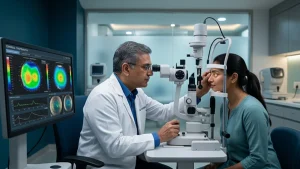
This is not a conservative precaution — it is a structural necessity. When the cornea is too thin, a degenerative disease called ectasia can happen. In this condition, the surface of the eye starts to bulge in strange ways when intracranial pressure is high. Ectasia is difficult to manage and can result in vision deterioration that neither glasses nor contact lenses fully correct. An eye clinic with proper pre-operative measurement equipment — corneal topography, optical coherence tomography, Scheimpflug imaging — can assess residual stromal bed thickness accurately and make the enhancement decision on actual data rather than estimation.
Patients who had their original Lasik done at facilities that did not retain precise records of the original ablation depth face a more complex assessment. Reputable centres maintain this data specifically because it becomes critical if an enhancement is ever considered years later.
When a Second Procedure Is Recommended and When It Is Not
A second Lasik Surgery is most straightforward when regression is mild, the time since the original procedure is sufficient for stability, and corneal measurements confirm adequate tissue reserve. Usually, enlargement surgeries work better and help people heal faster than the first treatment did in these cases.
Lasik specialists usually suggest other options when the corneal thickness is close to being undetectable or when the topography shows any irregularities that weren’t there before. Other than creating a new flap, surface ablation methods like PRK or LASEK remove tissue from the ocular surface. This may be a good option for people who don’t need a second flap. ICL — implantable collamer lens — is an entirely different category of correction that does not touch corneal tissue at all and is increasingly used for patients who are not candidates for further laser treatment.
Lasik Surgery cost for enhancement procedures varies depending on whether the original treating centre considers it an enhancement within their programme or whether it is a fresh procedure at a different facility. Some eye hospitals include a defined enhancement window in their original procedure pricing — worth confirming before the first procedure is ever done.
The Role of the Right Eye Hospital
At ASG Eye Hospital, patients enquiring about second Lasik procedures undergo the same thorough pre-operative workup as first-time candidates — there are no assumptions based on the original outcome. The Lasik specialist reviewing the case looks at current corneal maps, residual bed estimates based on original records, and the nature of the current refractive complaint before any recommendation is made.
Lasik Surgery done twice on appropriate candidates at a well-equipped eye hospital carries a reasonable success profile. The critical protection is the pre-operative assessment that confirms the eye can safely support what is being proposed.
ASG Eye Hospital’s approach to this question is the same as its approach to any refractive decision — the eye’s data drives the answer, not the patient’s preference or the surgeon’s schedule.
FAQ Section
1. Can LASIK surgery be repeated?
Yes, LASIK surgery can sometimes be repeated as an enhancement procedure if the cornea has enough remaining thickness and the eyes are healthy.
2. Why does vision change after LASIK?
Vision may change due to myopic regression, aging, presbyopia, or incomplete correction during the original LASIK procedure.
3. Is second LASIK surgery safe?
Second LASIK surgery can be safe when performed after proper corneal evaluation by an experienced LASIK specialist.
4. What is LASIK enhancement surgery?
LASIK enhancement surgery is a follow-up laser procedure used to improve vision after the original LASIK treatment.
5. How long should I wait before getting LASIK again?
Doctors usually recommend waiting until vision stabilizes completely, which may take several months after the first surgery.
6. What are the risks of repeat LASIK surgery?
Potential risks include dry eyes, glare, halos, infection, and corneal ectasia if insufficient corneal tissue remains.
7. What if I am not eligible for a second LASIK?
Alternative treatments like PRK, LASEK, or ICL surgery may be recommended if repeat LASIK is unsafe.
8. How do doctors decide if LASIK can be done twice?
Eye specialists evaluate corneal thickness, corneal maps, refractive stability, and previous LASIK records before approval.