
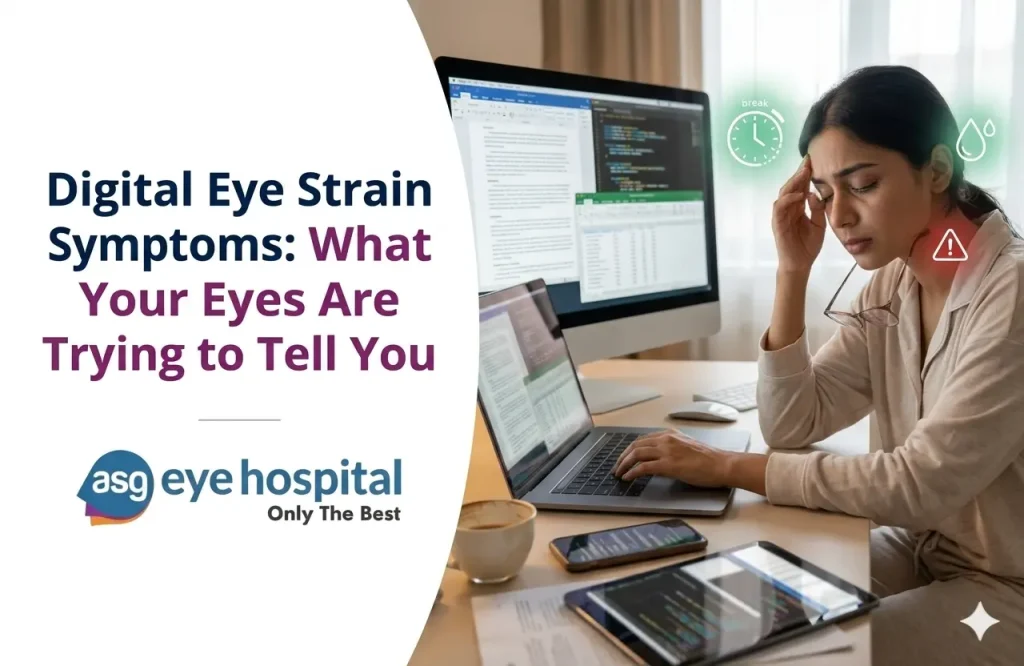
Screen use has become so routine that most people do not think twice about it. A full day of work, an evening of scrolling, a few hours of television. By 9 pm, the eyes feel heavy. There is a dull ache somewhere behind them. Nothing is obviously wrong, but something is not right either.
Digital eye strain symptoms are easy to miss precisely because they feel minor and temporary. The problem is that for many people, temporary has quietly become daily.
Digital eye strain symptoms that go unnoticed
The early signs are easy to brush aside. They do not feel like a condition, just something that will settle overnight.
Common digital eye strain symptoms include dryness, a burning sensation, intermittent blurring, and a dull ache around the eyes. Some people notice they blink less without realising it. Blink rate drops naturally during focused screen use, which means the tear film breaks down faster than it can recover. By the end of the day, the surface of the eye is essentially running low on lubrication.
There is a pattern patients describe often: eyes feel fine during the day, but by early evening, the discomfort has built noticeably. It is not that anything changed, it is that fatigue has been accumulating since morning.
A question that comes up often: Why do my eyes feel tired even when I have not done anything physically demanding?
In most cases, it is the sustained, uninterrupted focus rather than the effort involved. The eye muscles responsible for near vision hold a fixed position for hours. That is the strain.
Also read: Blue Light and Digital Eye Strain: Protecting Your Eyes in the Digital Age
Screen time, eye damage, and what is actually happening
The phrase screen time eye damage sounds more alarming than the clinical reality. What is happening in most cases is strain rather than structural damage, but that does not make it irrelevant.
When the eye holds focus at a single fixed distance for a long period, the muscles involved do not get a chance to relax. Lighting inconsistencies, a bright screen in a dim room, and glare from overhead lights add to the load. Blue light from screens is often cited as a primary cause of damage, but current evidence does not strongly support this. What the evidence does support is that reduced blink rate, sustained accommodation, and poor ergonomics are the main contributors to digital eye strain symptoms.
Eye strain from computer use
Eye strain from computer use tends to follow a recognisable pattern. It is not just the screen, it is how the screen is used.
Long stretches without breaks, screens positioned above eye level, brightness set too high for the ambient light, and fonts that require more effort than they should. These accumulate. People working in air-conditioned spaces tend to report worse dryness as well, since low humidity accelerates tear evaporation.
Questions that are frequently asked in consultations: Is eye strain from computer use something I should worry about long-term?
In most cases, no – provided habits change. But when the same pattern repeats daily without any adjustment, what starts as occasional discomfort becomes a consistent complaint that affects both work and sleep.
How to reduce eye strain without overcomplicating it
Most solutions are simple. The challenge is consistency rather than complexity.
Practical adjustments for how to reduce eye strain:
• 20-20-20 rule – every 20 minutes, look at something 20 feet away for 20 seconds to let the focusing muscles relax
• Screen slightly below eye level – this reduces the exposed eye surface and slows tear evaporation
• Match screen brightness to the room – a screen significantly brighter than its surroundings makes the eyes continuously readjust
• Blink deliberately and fully – partial blinks during screen use leave the tear film unevenly spread
• Preservative-free lubricating drops for persistent dryness – these support the tear film without causing rebound redness
Eye drops alone do not fix the problem. They address the symptom. Habits drive the outcome.
Computer vision syndrome treatment and when it becomes relevant
When digital eye strain symptoms do not settle with basic adjustments, the condition may be diagnosed as computer vision syndrome. Computer vision syndrome treatment starts with understanding what is actually driving the discomfort, which is why an eye examination is a useful first step.
Some patients need lubricating drops used consistently. Others are found to have a small uncorrected refractive error they were not aware of, a mild prescription that causes the eyes to strain continuously at screen distance. Correcting even a modest power often produces a noticeable improvement. Lenses designed specifically for intermediate viewing distance are another option for those whose work keeps them at a screen for most of the day.
Eye pain after screen use and when to pay attention
Occasional discomfort after a long day is common. Eye pain after screen use that persists through rest, worsens over time, or does not respond to basic adjustments is a different situation.
It is worth getting checked if:
• Discomfort does not settle after a proper night of rest
• Vision stays blurry even after stepping away from screens for a while
• Headaches are becoming more frequent and seem connected to screen time
• One eye consistently feels more affected than the other
• Symptoms have been present for several weeks without any improvement
A concern people often hesitate to raise: Should I just wait and see if it settles on its own?
If it has been building for weeks and is now affecting daily work, waiting tends to extend the problem rather than resolve it.
Final thoughts on digital eye strain symptoms
Managing digital eye strain symptoms usually comes down to awareness and small adjustments rather than major changes. The eyes respond fairly quickly when given consistent breaks and better conditions. The difficulty is recognising the pattern before it becomes something you have simply learned to live with.
ASG Eye Hospital, with centres in Varanasi, Kanpur, Raipur, Amritsar, and more, sees a steady number of patients with screen-related complaints. The evaluation covers refractive status, tear film quality, and screen ergonomics together, a combination that most patients have not had assessed before.
Screen use is not going away. Understanding what it does to the eyes makes it considerably easier to handle.
FAQs
1. What are digital eye strain symptoms?
Dryness, burning, intermittent blurring, a dull ache around the eyes, and headaches that build throughout the day are the most common. Many people also notice increased sensitivity to light after extended screen use.
2. Can screen time cause permanent eye damage?
In most cases, screen use causes strain rather than lasting damage. However, chronic dry eye that goes untreated can cause ongoing surface problems. Early attention and habit changes matter more than most people realise.
3. How can I reduce eye strain from computer use quickly?
The 20-20-20 rule, deliberate blinking, matching screen brightness to the room, and positioning the screen slightly below eye level all help. Consistency across these adjustments makes the real difference.
4. What is computer vision syndrome?
It is the clinical term for eye and vision problems caused by prolonged screen use, ranging from dryness and blurring to headaches and neck strain. Treatment follows from identifying the specific driver through examination.
5. When should I see a doctor for eye pain after screen use?
If pain persists after rest, affects one eye more than the other, includes worsening blur, or has continued for several weeks, an eye examination is the right step. A small uncorrected refractive error often explains complaints that do not respond to basic adjustments.