Many people who wear glasses or contact lenses are suitable candidates for laser eye surgery and do not know it. Laser vision correction has been performed for over three decades, with consistent evidence that outcomes are safe and predictable for appropriate patients.
The hesitation is understandable -but it is often driven by questions that have clear answers.
This guide covers the types of eye laser treatment available in India today, what the procedure involves, who it is suitable for, what the risks are, and what drives the variation in laser surgery cost.
Types of Laser Eye Surgery: LASIK, PRK, and SMILE
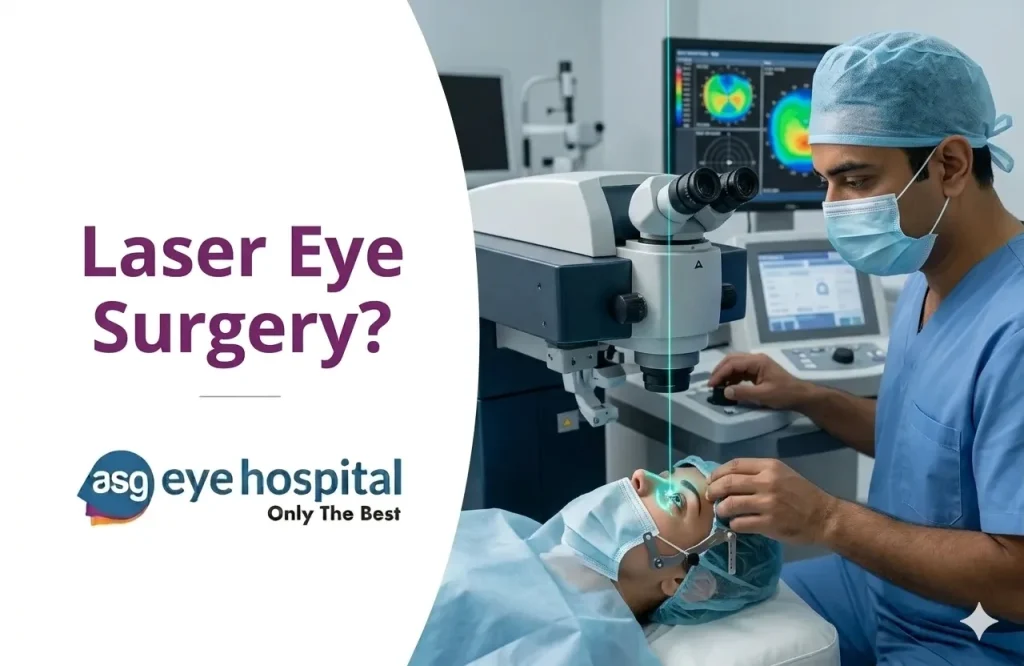
LASIK is the most widely performed refractive procedure worldwide. A femtosecond laser creates a thin corneal flap, an excimer laser reshapes the underlying stroma, and the flap is repositioned. Vision stabilises within 24 to 48 hours. LASIK corrects short-sightedness, long-sightedness, and astigmatism.
PRK surgery removes the corneal surface epithelium before laser ablation, without creating a flap. Recovery takes longer, around five to seven days for functional vision, but PRK is preferred for patients with thinner corneas or borderline corneal thickness. Long-term outcomes are equivalent to LASIK.
SMILE uses a femtosecond laser to carve a small disc of corneal tissue, extracted through a tiny incision without any flap. It carries a lower incidence of post-operative dry eye than LASIK and is well-suited for higher myopia. Clinical outcomes are equivalent to LASIK for the conditions it treats.
Laser Eye Surgery Benefits: What Patients Actually Gain
The most significant laser eye surgery benefits are freedom from glasses and contact lenses. Most LASIK and SMILE patients achieve 20/20 vision or better. According to large outcomes studies, 99.5% of LASIK-treated eyes achieve 20/40 or better -the standard required to drive without glasses.
Beyond acuity, patients gain no fogging in humidity, unrestricted sports and activities, no contact lens hygiene requirements, and improved peripheral vision compared to high-prescription glasses. For patients with demanding occupational vision requirements, laser correction often outperforms any corrective lens option.
Is LASIK Safe? The Honest Answer
Laser eye surgery is among the most extensively studied elective procedures in medicine. Serious complications are rare. The most common side effect is temporary dry eye in the weeks following LASIK, which resolves in most patients within six months. Glare and haloes are more likely with older laser platforms and are significantly reduced with current-generation technology.
What makes someone a poor candidate for laser eye surgery?
Thin or irregular corneas, keratoconus, very dry eyes, an unstable prescription, active autoimmune conditions, and significant pre-existing corneal disease. A comprehensive pre-operative assessment screens for these contraindications. The evaluation is as important as the surgery itself -the best outcomes come from appropriate patient selection, not just good surgical technique.
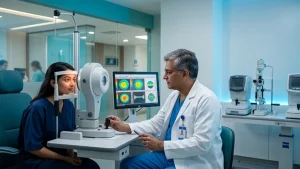
Not every patient is a candidate, and a clinician who recommends laser eye surgery to everyone should be treated with caution. The pre-operative assessment -including corneal topography, pachymetry, and dry eye evaluation determines candidacy. Patients unsuitable for LASIK may be candidates for PRK, SMILE, or implantable collamer lenses.
Laser Surgery Cost in India: What Drives the Variation
LASIK surgery cost in India varies primarily by laser platform and procedure type. Bladeless all-laser LASIK costs more than microkeratome-assisted. SMILE costs more than standard LASIK. Wavefront-guided or topography-guided customised ablation adds to the base cost of any procedure.
The facility, surgeon experience, and what is included -pre-operative assessment, post-operative drops, follow-up visits -all affect the final figure. A quoted price excluding follow-up is not comparable to one that includes it. Always compare on like-for-like terms: same platform, same procedure type, same inclusion list.
Final Thoughts on Laser Eye Surgery
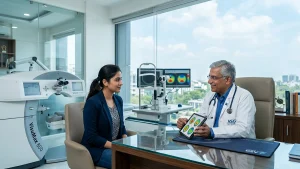
Laser eye surgery is safe, well-evidenced, and highly effective for suitable candidates. The appropriate starting point is a thorough pre-operative assessment that establishes whether you are a candidate, which procedure is best suited to your corneal anatomy and prescription, and what outcome is realistically achievable.
ASG Eye Hospital, with centres in Patna, Ahmedabad, Surat, Indore, and more, offers LASIK, PRK, and SMILE on current-generation laser platforms. Pre-operative candidacy assessment, transparent LASIK surgery cost breakdown, and post-operative follow-up are included as standard at every centre.
FAQs
1. What is the difference between LASIK, PRK, and SMILE?
LASIK creates a corneal flap before laser ablation. PRK removes the surface epithelium without a flap, with slower recovery but equivalent long-term outcomes. SMILE removes a disc of corneal tissue through a small incision with no flap, resulting in lower dry eye rates.
2. Is laser eye surgery permanent?
The corneal reshaping is permanent. However, the eyes continue to age naturally, and reading glasses become necessary with presbyopia after 40, regardless of the procedure. Some patients need a touch-up procedure if a small residual prescription remains.
3. Is LASIK safe for long-term use?
Yes. Long-term studies consistently show stable, safe outcomes for the vast majority of patients. Serious complications are rare. The most important safety factor is appropriate patient selection through a thorough pre-operative assessment.
4. What is the recovery time for laser eye surgery?
LASIK and SMILE: functional vision within 24 to 48 hours, with full stabilisation over two to four weeks. PRK: functional vision within five to seven days, full stabilisation over four to six weeks. Driving is typically resumed within two to three days for LASIK and SMILE.
5. What affects LASIK surgery cost in India?
The laser platform (femtosecond all-laser vs. microkeratome), the procedure type (standard vs. wavefront-guided), the facility, and what is included in the quoted price. Always confirm whether pre-operative assessment, post-operative drops, and follow-up visits are included.