Vision correction often comes up only when glasses start to feel limiting. Some people do fine with daily lenses for years, while others find them to be a pain after a while. That’s when people usually start talking about PRK and LASIK.
Both are laser surgeries that fix refractive errors like myopia, hyperopia, and astigmatism. But comparing PRK and LASIK isn’t just about the technique; it also includes recovery time, comfort, cost, and how well each one works with your eye structure.
Understanding the difference between PRK and LASIK
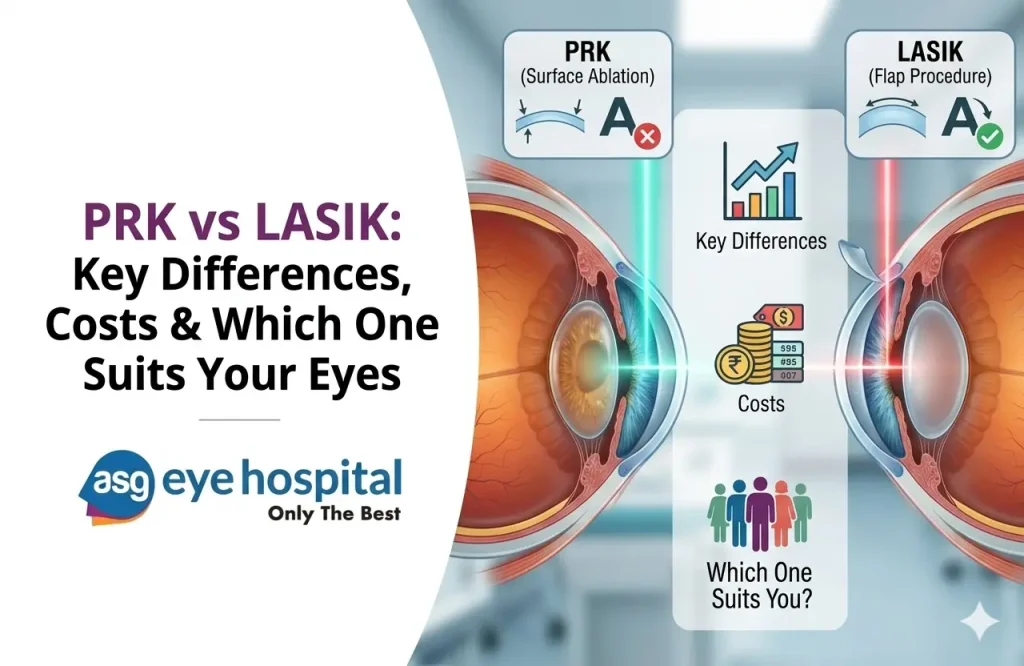
Both procedures use an excimer laser to change the shape of the cornea. The difference is in how the surgeon gets to the cornea.
A thin flap is made in the cornea during LASIK, lifted, and then put back in place after the laser correction. There is no flap in PRK. Instead of removing the outermost layer (epithelium), the laser is applied directly to the corneal surface.
This may seem like a small change, but it has a big effect on how people recover. So what does this mean for you as a patient?
- LASIK tends to offer quicker visual recovery
- PRK avoids flap-related complications
- PRK is often preferred for thinner corneas
When people ask about the difference between PRK and LASIK, they are usually trying to understand which one will interfere less with daily life—and that depends on their priorities.
PRK vs LASIK benefits and side effects
Every surgical option comes with trade-offs. The PRK vs LASIK benefits are best understood when you look at lifestyle and eye anatomy together.
LASIK is popular because vision improves within 24–48 hours in most cases. Many patients return to work quickly. However, since a corneal flap is created, there’s a small risk of flap displacement, especially in contact sports.
PRK, on the other hand, avoids this entirely. That’s why it is often recommended for people in physically demanding professions.
But recovery takes longer. Vision may remain blurry for a few days, and mild discomfort is common during the initial healing phase.
Some commonly discussed PRK vs LASIK side effects include:
- Temporary dry eyes (more frequent with LASIK)
- Light sensitivity during early recovery (more noticeable in PRK)
- Halos or glare at night, usually settling over time
Most patients don’t focus on side effects until after surgery is scheduled. In clinic settings, this tends to be one of the first things they ask once the procedure is explained in detail.
PRK vs LASIK cost in India
Cost is often part of the decision, though it shouldn’t be the only factor.
The PRK vs LASIK cost difference is usually not dramatic, but LASIK can be slightly more expensive due to the technology used for flap creation (such as femtosecond lasers).
In India, typical ranges may look like:
- PRK: ₹20,000 – ₹40,000 per eye
- LASIK: ₹30,000 – ₹70,000 per eye
These figures can vary depending on the clinic, technology, and pre-operative tests included.
At centres like ASG Eye Care, evaluations often include corneal topography and pachymetry to assess thickness. These tests play a role in deciding whether LASIK is even advisable.
So while comparing PRK vs LASIK cost, the more relevant question becomes: what is safe for your eyes?
Who should choose PRK over LASIK?
Not everyone is an ideal candidate for LASIK. This is where PRK becomes more than just an alternative.
You may be advised PRK if:
- You have a thinner cornea
- You are involved in sports or physically active work
- There are mild irregularities in corneal shape
This ties directly into the question many patients ask: who should choose PRK over LASIK?
In most cases, it’s not about preference alone. Eye measurements guide the decision. Corneal thickness, measured through pachymetry, is often the deciding factor.
There’s also a practical angle. Some patients are comfortable waiting longer for visual recovery if it means avoiding flap-related risks.
PRK vs LASIK success rate and outcomes
Both procedures have high success rates when performed on suitable candidates.
The PRK vs LASIK success rate is often comparable, with most patients achieving 20/20 or near 20/20 vision. Long-term stability is also similar.
Where they differ is in the recovery timeline:
- LASIK: faster visual clarity
- PRK: gradual improvement over weeks
Some people worry—will my vision fluctuate after PRK? That’s a fair concern. In early recovery, vision can vary slightly, but it typically stabilizes as the epithelium heals.
In most clinical settings, outcomes depend less on the procedure and more on correct patient selection and adherence to post-operative care.
Making sense of PRK vs LASIK for your eyes
Deciding between the two isn’t always straightforward. What works well for one person may not be suitable for another.
A detailed eye check usually includes:
- Refraction testing
- Corneal mapping (topography)
- Tear film evaluation
These help determine whether LASIK is feasible or if PRK is the safer route.
Most people walk into an eye clinic expecting a quick answer, but the discussion often takes longer. That’s because eye structure varies more than people assume.
At ASG Eye Care, consultations are typically structured around these measurements rather than preference alone.
Conclusion
The PRK vs LASIK decision comes down to eye anatomy, lifestyle, and recovery expectations. Both procedures are well-established and widely performed.
If you are considering vision correction, a proper evaluation is the starting point. Clinics like ASG Eye Hospital in Parel, Dadar, Jaipur, Jodhpur, Ahmedabad and Udaipur routinely assess candidates for both procedures before recommending one.
The choice between PRK and LASIK tends to become clearer once you understand what your eyes can safely support.
FAQs
1. Is PRK safer than LASIK?
PRK avoids flap-related risks, which can make it safer for certain patients. However, both are considered safe when done on suitable candidates.
2. How long does PRK recovery take?
It takes about 3 to 5 days for the initial healing to happen, but it may take a few weeks for vision to fully stabilize.
3. Does LASIK hurt more than PRK?
Most of the time, LASIK doesn’t hurt during or after the surgery. After PRK, there may be some mild pain for a few days.
4. Which is more affordable: PRK or LASIK?
PRK is usually a little cheaper, but the difference isn’t always big.
5. Can everyone choose between PRK and LASIK?
No. Eye structure, especially corneal thickness, often determines which procedure is suitable.