ASG Eye Hospital

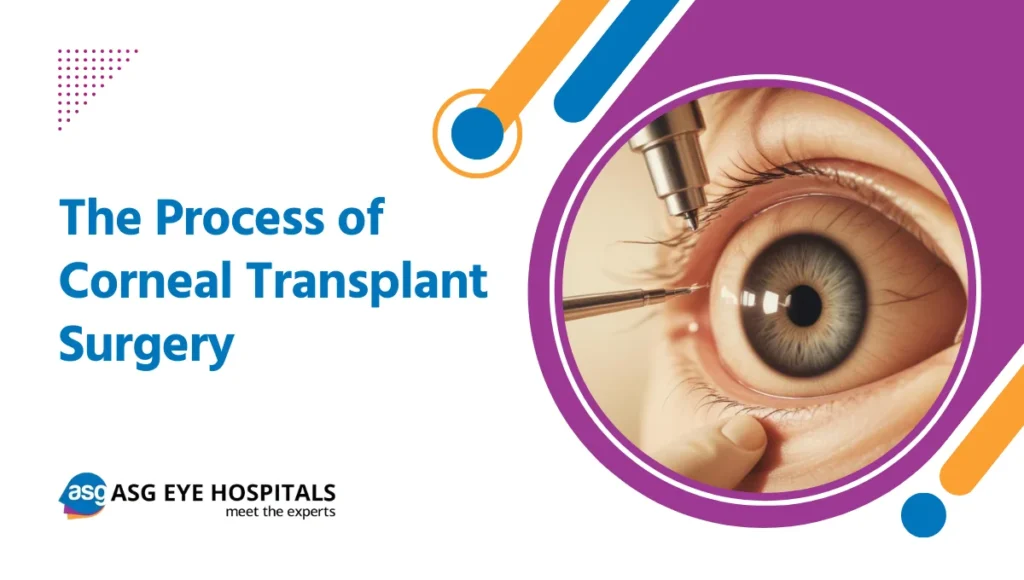
The Process of Corneal Transplant Surgery

Corneal transplant surgery or Keratoplasty, is a surgical process that involves the replacement of pathological or damaged cornea tissue with donor corneal tissue. The cornea plays an important role in focusing the vision and seeing clearly, it is a transparent, dome-shaped surface of the eye. When the corneal surface becomes cloudy (opaque) or scarred it can result in severe vision impairment.


A corneal transplant is a vision correction surgery, done to restore the vision of the person, with a damaged or distorted cornea. Corneal transplant surgery can reduce pain and other symptoms related to corneal damage or disorder.


This blog highlights the corneal transplant procedure, its types, risks and complications, and post-operative care.


What are the Indications for Corneal Transplant Surgery?


If someone has the following conditions, an eye specialist may suggest a cornea transplant:
Cornea damage caused by earlier eye injury or surgery.


  • Swelling, infection, and injuries of the cornea (Bullous Keratopathy)
  • Tearing or thinning of cornea
  • Corneal ulcers
  • Keratoconus treatment (a condition in which the cornea shape becomes like a cone rather than a dome shape).
  • Fuchs’ dystrophy (a condition in which endothelium cells of the cornea die off, which results in corneal swelling with fluid).
  • Corneal Dystrophies: Genetic conditions affecting the clarity of the cornea.


Types of Corneal Transplant Surgery

The types of corneal transplant surgeries are based on the results regarding the pathology of the cornea. There are different types of corneal transplant surgeries, each matched to the specific condition of the cornea:


Penetrating Keratoplasty (PK): This full-thickness corneal transplant replaces the entire cornea.
This type is typically used for conditions that affect all layers of the cornea, such as advanced keratoconus, serious corneal scarring, and some forms of corneal dystrophies.


Endothelial Keratoplasty (EK)
This type involves the replacement of just the innermost layer of the cornea, that is, the endothelium.
It is further divided into Descemet’s Stripping Endothelial Keratoplasty and Descemet’s Membrane Endothelial Keratoplasty.

It is used for conditions like bullous keratopathy and Fuchs’ endothelial dystrophy.


Anterior Lamellar Keratoplasty
This type of surgery replaces only the front or anterior layers of the cornea and the healthy endothelium layer is left intact.
It has two types: Superficial Anterior Lamellar Keratoplasty and Deep Anterior Lamellar Keratoplasty.
It is used for anterior corneal diseases like superficial scars and keratoconus without endothelial involvement.


The Surgical Process of Corneal Transplant Eye Surgery


1. Pre-Operative Preparation

• Evaluation: Detailed eye examination is carried out and includes measurement of the eye, checking the overall health of the eye.
• Donor Matching: The donor cornea is matched for size and compatibility.
• Informed Consent: The patient is informed about the procedure, risks, and post-operative care.


2. The Procedure:
• Anesthesia: The surgery is almost always done under local anesthesia with sedation, but general anesthesia can be employed in some cases.
• Incision: A definite circular incision is made in the damaged cornea.
Donor Tissue: The donor cornea is prepared and carefully placed.
• Suturing: Fine sutures are placed to hold or secure the donor cornea in place.


3. Corneal Transplant Recovery and Post-Operative Care:
• Medications: Antibiotics along with steroid eye drops are prescribed to the patients to prevent infection and reduce inflammation.
• Follow-up Visits: Regular follow-up visits after discharge are essential to assess healing and to identify and treat any developing complications.
• Activity Restrictions: Patients should not engage in any strenuous activities, heavy lifting, or swimming for several weeks.


Corneal Transplant Risks and Complications


While corneal transplant surgery is generally considered relatively safe, risks may include the following:

  • Rejection: The immune system may recognize that the donated cornea is ‘foreign’ and attempt to reject it.
  • Infection: While uncommon, infection is still a possibility after surgical intervention, just like with any other surgical operation.
  • Astigmatism: Irregular curvature in the cornea might occur that would need corrective lenses later on.
  • Graft Failure: The transplanted cornea can occasionally not even turn out to be functional; these cases may require further surgery.


Success Rates and Outcomes


The success rate of corneal transplants depends on the type of surgery and underlying condition. Most of the patients will usually show considerable improvement in vision. For instance, endothelial keratoplasty surgery has a very high success rate compared to penetrating keratoplasty and has less recovery time. The average cost of corneal transplant surgery is approx. 40,000 to 60,000 per eye. Enhanced surgical techniques and post-operative care across the board ensure that patients going for corneal transplant operations get to enjoy ever-improving outcomes.


For instance, endothelial keratoplasty represents a high success rate and has a quicker time to recover compared to penetrating keratoplasty. The continuing enhancement of the surgical techniques together with the post-operative care, continues to bring out a better result among patients who undergo corneal transplant procedures.


Conclusion

Corneal transplant surgery will change life generally in cases of corneal diseases and injuries. The different types of transplants, details of the surgical procedure, and post-operative care should be known to the patients and their families. The future of corneal transplantation is bright, with continuous improvement in medical technology and surgical techniques.

If someone is considering having a corneal transplant, seek an appointment with an experienced ophthalmologist to discuss the best options in your case.

Overview

Job Title: Consultant Ophthalmologist

Location: Pan India
Job Category: Medical Healthcare

Work Employment:  Full time

What you work:

  • Diagnose and treat patients with a focus on Ophthalmologist.
  • Collaborate with senior doctors and multidisciplinary teams.
  • Ensure patient-centric care and follow clinical protocols.
  • Contribute to research, training, or hospital initiatives (if applicable).

Mandatory skills:

  • Relevant medical degree / certification.
  • Strong knowledge of ophthalmology practices / healthcare protocols.
  • Excellent communication and patient-handling skills.
  • Ability to work in fast-paced healthcare environments.

Preferred Qualifications:

  • Experience: 3 to 6 years of experience
  • Prior experience in eye care / multi-speciality hospitals.
  • Fellowship or advanced training in Ophthalmologist.
  • Familiarity with advanced diagnostic tools and surgical techniques.
  • Passion for innovation, patient care, and continuous learning.

Apply For This Positions

This will close in 0 seconds

Overview

Job Title: Optometrist

Location: Amritsar, Punjab 

Job Category: Optometry

Work Employment:  Full time

What you work:

  • Conduct comprehensive eye examinations and vision assessments for patients of all ages.
  • Prescribe and fit spectacles, contact lenses, and low-vision aids.
  • Perform diagnostic tests including refraction, tonometry, perimetry, and OCT imaging.
  • Support consultant ophthalmologists in pre-operative and post-operative patient workups.
  • Counsel patients on eye care, lens hygiene, and follow-up schedules.
  • Maintain accurate clinical records and adhere to hospital protocols.

Mandatory skills:

  • Bachelor’s or Master’s degree in Optometry (B.Optom / M.Optom) from a recognised institution.
  • Valid registration with the relevant state or national optometry council.
  • Proficiency in refraction, slit-lamp examination, and contact lens fitting.
  • Working knowledge of autorefractors, tonometers, fundus cameras, and OCT equipment.
  • Strong communication skills in English, Hindi, and Punjabi.
  • Ability to manage high patient volumes in a fast-paced clinical setting.

Preferred Qualifications:

  • Experience: 1 to 5 years of clinical optometry experience.
  • Prior experience in an eye care or multi-speciality hospital in Punjab.
  • Exposure to paediatric optometry, binocular vision, or low-vision rehabilitation.
  • Familiarity with advanced diagnostic imaging and dry-eye management.
  • Passion for patient care, community eye-health camps, and continuous learning.

Apply For This Positions

This will close in 0 seconds

Overview

Job Title: Optical In-charge 

Location: Panjim, Goa / Mumbai-Worli (Lower Parel) 

Job Category: Optical

Work Employment:  Full time

What you work:

  • Manage day-to-day operations of the optical outlet, including sales, dispensing, and inventory.
  • Guide customers on frame selection, lens options, and coatings based on their prescription and lifestyle.
  • Take accurate frame measurements and ensure precise fitting, adjustments, and after-sales service.
  • Drive optical sales targets and monitor daily, weekly, and monthly business performance.
  • Maintain optimum stock levels, coordinate with vendors, and control shrinkage through periodic audits.
  • Supervise and train optical staff on product knowledge, dispensing standards, and customer service.
  • Coordinate with optometrists and consultants to ensure smooth prescription-to-delivery flow.
  • Ensure visual merchandising, display hygiene, and adherence to brand and hospital standards.

Mandatory skills:

  • Diploma or Bachelor’s degree in Optometry (D.Optom / B.Optom) or equivalent optical dispensing qualification.
  • Minimum 3 years of experience in optical supervisory or in-charge role.
  • Sound knowledge of lens types, coatings, frame materials, and dispensing principles.
  • Hands-on experience with edging, fitting, and basic optical workshop equipment.
  • Proven ability to achieve sales targets and manage inventory and billing systems.
  • Strong communication and interpersonal skills in English, Hindi, and Konkani or Marathi.
  • Working knowledge of POS / retail software and MS Office.

Preferred Qualifications:

  • Experience: 3 to 7 years in optical retail or an eye care hospital optical division.
  • Prior experience managing an optical outlet in Goa or the western region.
  • Exposure to premium and progressive lens brands and specialty eyewear.
  • Familiarity with contact lens dispensing and after-care support.
  • Team leadership, customer relationship management, and continuous learning mindset.

Apply For This Positions

This will close in 0 seconds

Overview

Job Title: Optometrist

Location: Pan India 


Job Category: Optometry

Work Employment:  Full time

What you work:

  • Conduct comprehensive eye examinations and vision assessments for patients of all ages.
  • Prescribe and fit spectacles, contact lenses, and low-vision aids.
  • Perform diagnostic tests including refraction, tonometry, perimetry, and OCT imaging.
  • Support consultant ophthalmologists in pre-operative and post-operative patient workups.
  • Counsel patients on eye care, lens hygiene, and follow-up schedules.
  • Maintain accurate clinical records and adhere to hospital protocols.

Mandatory skills:

  • Diploma / Bachelor’s or Master’s degree in Optometry (D.Optom / B.Optom / M.Optom) from a recognised institution.
  • Valid registration with the relevant state or national optometry council.
  • Proficiency in refraction, slit-lamp examination, and contact lens fitting.
  • Working knowledge of autorefractors, tonometers, fundus cameras, and OCT equipment.
  • Ability to manage high patient volumes in a fast-paced clinical setting.

Preferred Qualifications:

  • Experience: 1 to 5 years of clinical optometry experience.
  • Exposure to paediatric optometry, binocular vision, or low-vision rehabilitation.
  • Passion for patient care, community eye-health camps, and continuous learning.

Apply For This Positions

This will close in 20 seconds