A child does not always have the ability to express that there is a problem with their vision. Many kids do not realize that the way they see the world is at all abnormal even while they are dealing with blurry vision, eye strain, frequent headaches, or poor performance in the classroom. That is why it is important for parents to be aware of the early signs of eye diseases in children and to seek help before the issue impacts on their child’s learning, confidence, and also long term vision.
It is of great importance that eye diseases in children are identified early. Some do well with only the use of glasses or eye drops, others may require patching therapy, doing eye exercises or even surgery. What we at ASG Eye Care have set out to do is to go beyond just treating the eyes of the child, we also to help parents to know what to look for in terms of symptoms, when to bring in the professional help, and how to protect their child’s vision as it develops.
Why Children’s Eye Health Needs Early Attention
Reading, writing, playing, face recognition, in class we notice the child is watching the board, and development of hand eye coordination. If eye problems in children go undetected the child may present with issues in vision which in turn may cause poor attention, delayed reading, lack of coordination, or poor academic performance.
Parents usually think when a child isn’t complaining the issue must be that their eyes are fine. That is not always the case. Many pediatric eye problems don’t present with pain in the early stage. A child with blurred vision may just move in for the TV, copy slowly from the black board, avoid reading, or close one eye when looking at something. These small signs shouldn’t be ignored because early intervention is key in preventing childhood vision problems from turning into long term problems.
Common Eye Diseases in Children
There is a range of eye diseases children should be aware of. Some are very common and easy to manage, while others require prompt medical care. The table below provides a simple guide.
| Eye Condition | What Parents May Notice | Why It Matters |
| Refractive errors | Blurred vision, sitting close to screens, headaches, poor school performance | Glasses can usually correct the problem and improve learning |
| Amblyopia | One eye weaker than the other, poor depth perception, child may favor one eye | Early treatment is important to prevent permanent weak vision |
| Strabismus | Eyes not looking in the same direction | Can affect depth perception and may lead to amblyopia |
| Allergic conjunctivitis | Itching, redness, watering, rubbing eyes often | Repeated rubbing may worsen irritation and affect comfort |
| Eye infections | Redness, discharge, swelling, sticky eyelids | Needs proper diagnosis to avoid spread or complications |
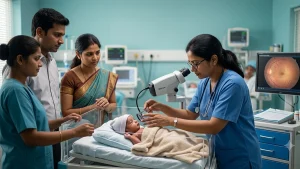
| Congenital cataract | White reflex in the pupil, poor visual response in infants | Early treatment is important to protect visual development |
| Ptosis | Drooping eyelid covering part of the eye | May block vision and increase risk of amblyopia |
Refractive Errors: The Most Common Vision Issue
In children one of the most common eye diseases in children is error which is a problem with the eye’s ability to focus light which results in blurred vision. They may have nearsightedness, farsightedness, or astigmatism. These are not infections or injuries but rather focus issues which we may correct with the use of glasses.
Parents may note that the child sits very near the TV, reports that books which are held up close to the face are what they can see best, that which is written on the board is hard for them to copy, they report headaches, or that they have lost interest in reading. Also it is at school that many pediatric eye problems present themselves. A child may be labeled as careless or behind in class work when in fact the issue is that the child does not see very well.
Regular check ups for the eyes are important as some undiagnosed refractive errors may cause additional childhood vision problems, at times even leading to amblyopia. The positive news is that once the right glasses are put on there is an early see which shows that many kids’ improved health, confidence and performance in school.
Lazy Eye or Amblyopia
Lazy eye is a very common issue in childhood health which we see to be because it results in permanent vision damage if left untreated early. In amblyopia what happens is that the brain begins to favor the stronger eye and the development of normal vision in the weaker eye is impaired. Also the affected eye may appear to be normal at first which means that parents do not see any early signs of a problem.
A child that has lazy eye may present with poor depth perception, has trouble catching objects, reports frequent eye strain, or a tendency to close one eye. Also it is known that a lazy eye may be a result of a difference in power between the two eyes, cataract, drooping eyelid, or squint. Treatment may consist of glasses, patching the dominant eye, eye drops, or addressing the base cause.
As soon as you notice issues with the eye which may be related to what is called a lazy eye, the better the chance of seeing an improvement. This is why we put so much stock in eye screening at the very young age of a child. By waiting we may see that treatments are not as effective by the time we do act because during childhood the brain’s visual development is at its most flexible stage.
Squint or Strabismus
A squint which is also known as strabismus is a condition where the eyes do not focus on the same point at the same time. One eye may turn in, out, up, or down. Some kids have a constant squint, others only see it when they are tired, sick or are focused on near objects.
A squint isn’t limited to a cosmetic concern. It also affects depth perception and may cause the brain to dismiss the input from one eye which in turn may lead to lazy eye. Parents may see that the child is tilting his head, closing one eye in bright light, having frequent accidents with objects, or that the eyes appear to be misaligned in photos.
In terms of eye diseases in children, issues strabismus requires a careful evaluation which we do for each individual case. Some kids will require glasses, some will benefit from patching therapy and in some we will have to do surgery to get the eyes aligned. Early intervention also improves results in terms of how the eyes look and how well they see.
Eye Allergies and Frequent Eye Rubbing
Eye allergies also are a very common pediatric eye problem, in particular we see it in kids that have dust allergies, asthma, skin allergies, or seasonal allergies. The child may report itchy, watery, red, burning, or a foreign body in the eye. Also many kids will report to rubbing which in turn may worsen the irritation.
Although we may tend to dismiss them as of little import, issues of eye rubbing due to allergies should not be put on the backburner. It causes inflammation to worsen and in some kids may play a role in changing the cornea over time. Early diagnosis and treatment is key to relief and also in protecting the eye’s surface. Also do away with the use of any random over the counter drops without a doctor’s say go ahead, in particular steroid eye drops which if misused may cause issues.
Eye Infections in Children
Eye issues are what we see most in terms of eye disease in children. Redness, sticky discharge, swelling, watery eyes, and crusty eyelids are tell tale signs. Infections may be viral, bacterial, or allergic in nature which in turn will change the treatment.
If a child presents with symptoms such as eye discharge, pain, swelling, light sensitivity, or reduced vision, they should be seen by an eye doctor. Also it is important that we teach children to avoid rubbing their eyes and to not share towels, napkins or handkerchiefs in the case of an infection. Good hygiene practices, appropriate treatment, and early care play a key role in the prevention of infection spread and in avoiding complications.
Congenital Cataract and Serious Childhood Eye Conditions
If a child presents with symptoms such as eye diseases in children, pain, swelling, light sensitivity, or reduced vision, they should be seen by an eye doctor. Also it is important that we teach children to avoid rubbing their eyes and to not share towels, napkins or handkerchiefs in the case of an infection. Good hygiene practices, appropriate treatment, and early care play a key role in the prevention of infection spread and in avoiding complications.
Other types of serious childhood vision problems include childhood glaucoma, retinal disorders, eye injuries, and eye tumors. While these may be less in number they can have serious results if go unnoticed. Warning signs include a white pupil, an enlarged eye, constant watering, extreme light sensitivity, sudden vision loss, or an eye that does not look the same as the other. These symptoms require immediate evaluation at an eye hospital.
Warning Signs Parents Should Not Ignore
Many of the early signs of eye disease in children are subtle which may indicate something more serious later on. The table below is to help parents recognize when it is time to take a child in for an eye check up.
| Warning Sign | Possible Concern | When to See an Eye Doctor |
| Sitting too close to TV or books | Refractive error | If it happens regularly |
| Frequent headaches after reading | Eye strain or uncorrected power | If repeated over several days |
| One eye turning in or out | Squint | As soon as noticed |
| Covering one eye while seeing | Lazy eye, double vision, or squint | Early evaluation is important |
| Constant eye rubbing | Allergy or surface irritation | If frequent or severe |
| White reflex in the pupil | Cataract or retinal concern | Urgent eye examination |
| Poor school performance | Blurred vision or focusing issue | If linked with reading or board work |
| Redness with discharge | Infection | If discharge, pain, or swelling is present |
How Pediatric Eye Problems Are Diagnosed
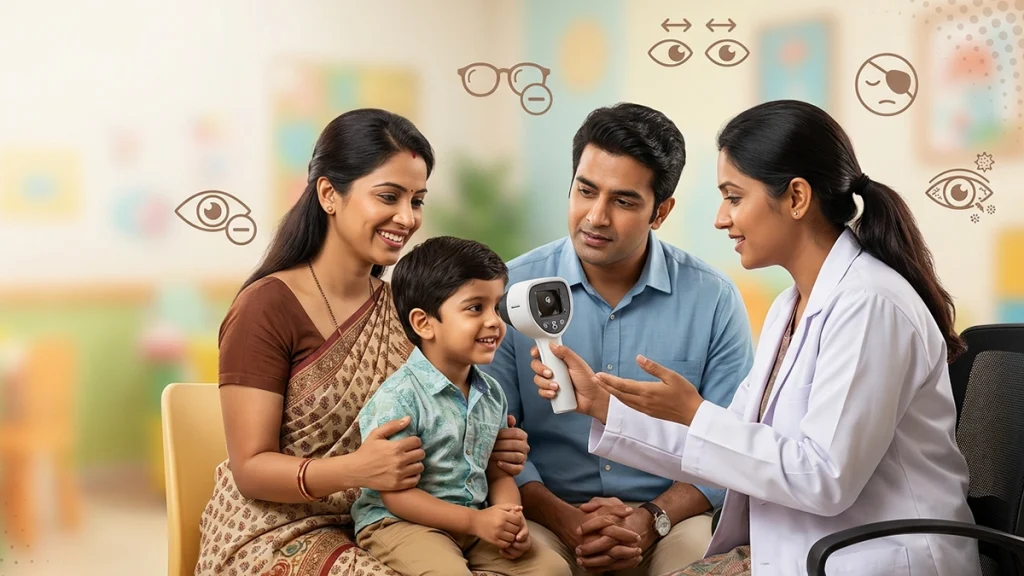
A proper eye exam for kids is different from what adults go through. We do visual acuity, eye alignment, check on focusing ability, eye movement, pupil response, and the health of the front and back of the eye. For younger kids which don’t read letters we use special charts, pictures, lights and also we employ child friendly testing methods.
In pediatric eye problems, the doctor may also dilate the pupils in order to determine the exact power of the eyes and to study the retina. This is true in a case of a child which has headaches, poor vision, is a candidate for lazy eye, has a suspected case of squint, or which has a family history of eye disease. A thorough check up which goes to the root of the issue is performed instead of just the symptom.
Treatment Options for Eye Diseases in Children
Treatment of eye diseases in children based on what we are dealing with. We see that refractive errors are usually corrected with glasses. Also for lazy eye we may use glasses, patching which is a form of therapy, or other options to get the weaker eye to work better. As for squints we may use glasses, do eye exercises, apply patching or go as far as surgery which will be based on the type and severity of the issue.
Eye allergies can be treated with eye drops that are to help lubricate, antihistamine medications, cold compresses, and by avoiding your triggers. For eye infections we may use antibiotics or antivirals as appropriate. Also present at birth cataracts, severe ptosis, glaucoma and some retinal conditions may require surgery or specialized care. What is most important is timing of the treatment, delayed care may damage visual development.
How Parents Can Help Protect Children’s Vision
Parents also play a key role in the detection and childhood vision problems. It is recommended that a child have a routine eye check up also before entering school and through the years of school. Also, children who do wear glasses should have their prescriptions checked as the doctor advises for that may have changed as the child grows.
Healthy practices for the eyes also play a role. Kids should break from screen time, read in well lit rooms, avoid excessive eye rub, wear protective gear during sports when required, and see to it that they follow up on treatments if they have allergies or infections. If there is a history of eye diseases in children, family early screening is even more so.
Eye Care for Children at ASG Eye Care
At ASG Eye Care what we do is we evaluate your child with care, patience and we take into account their age and comfort. We aim to identify eye diseases in children at an early stage and to put together a treatment plan that supports healthy vision development. If it is blurred vision, pediatric eye problems, lazy eye, squint, allergy, infection or any other childhood vision problems, we will do a timely diagnosis which in turn makes a great difference.
Parents must not wait for a child to fully report on poor vision. If there is anything out of the ordinary, if academic performance changes, or if the child reports of repeated eye strain, in that case an eye exam is the best step. Many eye diseases in children do better when caught at an early stage.
Key Takeaway
In children the most common eye diseases in children are refractive errors, lazy eye, squint, eye allergies, eye infections, congenital cataract, and other developmental eye conditions. Some are mild and easy to manage, while others can lead to permanent damage if left untreated. It is important for parents to be aware of pediatric eye health issues which may be signs of a vision problem in their child’s life.
Good eyesight is a component of how a child learns, moves, builds confidence, and grows in general. With routine eye care and early intervention in eye diseases in children conditions in children may be put into remission which in turn gives the best chance for our young ones to have free from trouble vision.
Frequently Asked Questions
1. What are the most common eye diseases in children?
The most common ocular issues in pediatrics are refractive errors, amblyopia which is also known as lazy eye, strabismus also known as squint, eye allergies, infections, congenital cataract, and certain retinal and developmental eye conditions. Some of these are easy to treat but others require early specialist care.
2. How do I know if my child has vision problems?
Signs of childhood vision problems may present as sitting very near the TV, holding books at a very close range, frequent headaches, eye rub, poor performance in school, poor eye tracking or if the eyes do not appear to work together. If these signs are noticed repeatedly the child should be taken in for an eye exam.
3. Is lazy eye curable in children?
Lazy eye does in fact improve when caught at an early age. Treatment may consist of glasses, patching which is putting a patch over the good eye to strengthen the weak one, eye drops, or treatment of the cause which may be a cataract or squint. Early treatment does produce better results because the visual system is still developing at that time.
4. Is squint only a cosmetic problem?
No. A squint is also a cosmetic issue. It affects depth perception and at times results in lazy eye which is when the brain begins to ignore input from one eye. Children with a suspected squint should see an eye specialist at an early age.
5. When should parents take a child for an eye checkup?
Parents should bring their child in for an eye exam if they see signs of pediatric eye problems, like blurred vision, eye rubbing, headaches, misaligned eyes, white reflex in the pupil, redness, discharge, or difficulty with reading and school work. Also, it is a good idea for even asymptomatic kids to have routine eye screening which helps in the eye diseases in children early.
6. Can screen time cause eye diseases in children?
Screen time is a rare cause of serious eye disease in children, instead we see that too much of it plays a role in eye strain, dryness, headaches, and development of poor visual habits. We see that by introducing regular breaks, improving light quality, encouraging outdoor play, and making routine eye check ups a practice we can do a lot to protect a child’s visual health.