The average person picks up their phone over 150 times a day, first thing in the morning, last thing at night, and dozens of times in between. The screen is closer to the eyes than a book or monitor, the text is smaller, and the ambient light is often lower. By evening, the ocular surface has paid for all of it.
Mobile screen effects on eyes are not confined to discomfort. The patterns of use that have become normal are producing real, measurable changes in eye health across all age groups. Understanding what is actually happening and separating it from myth is the starting point for doing something about it.
What happens to the eyes during prolonged phone use
When the eyes fixate on a phone at close range, two things happen. First, the blink rate drops from a normal 15-17 blinks per minute to as few as 5-7 blinks during concentrated screen use. Each blink spreads the tear film; when blinks become infrequent, the tear film breaks up between blinks, exposing the corneal surface to drying. Second, the ciliary muscle sustains contraction for as long as the near task continues. Extended contraction causes fatigue – the symptom is the blurred, slow-to-refocus vision many people notice after a long phone session.
Proximity matters. A phone is typically held 20 to 30 cm from the face, closer than a computer monitor or printed page. The closer the object, the greater the ciliary effort required. This is why phone use is more fatiguing per unit of time than other near tasks.
Digital eye strain symptoms: what to recognise
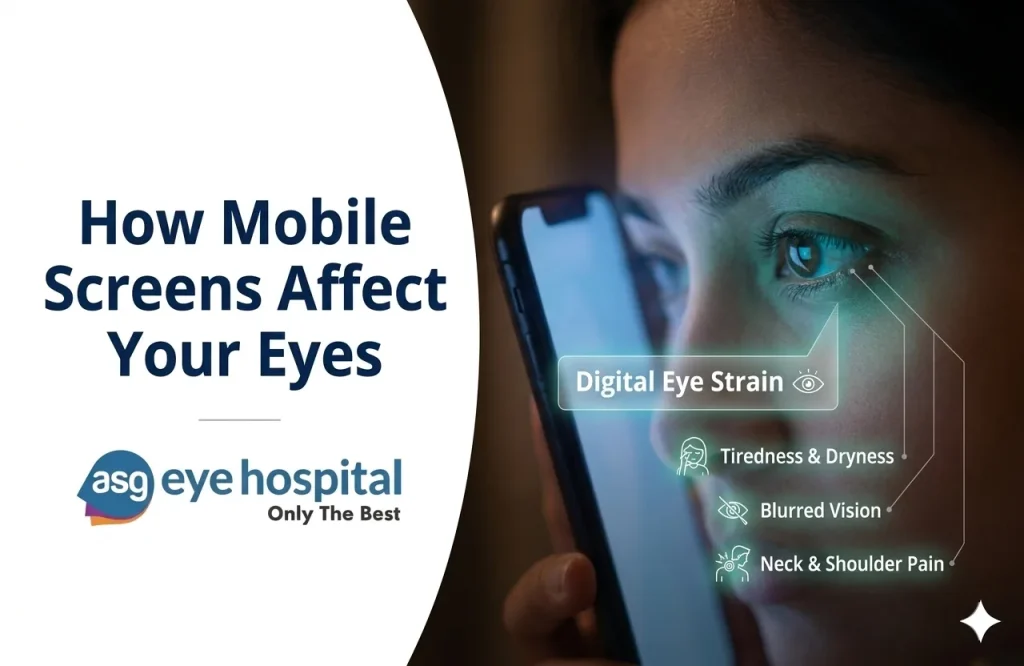
Screen time eye damage presents in a consistent and recognisable pattern. Digital eye strain symptoms include:
- Dry, gritty, or burning eyes – caused by reduced blink rate and tear film instability
- Blurred or slow-to-focus vision after extended screen use – from ciliary muscle fatigue
- Headaches, typically frontal or behind the eyes, appear during or after screen sessions
- Eye redness – from dryness and increased exposure of the ocular surface
- Difficulty shifting focus from near to far – a sign of accommodative spasm
- Increased sensitivity to light and difficulty tolerating bright environments
- Neck and shoulder tension, which frequently accompanies sustained downward gaze at a phone
Most of these symptoms resolve with rest and do not indicate structural damage. The concern is cumulative: people who experience digital eye strain daily over years are sustaining chronic ocular surface stress, and in younger people, the near work load is associated with faster myopia progression.
Blue light effects on eyes: fact versus overclaim
Blue light has become one of the most commercially exploited topics in eye care. The blue light effects on eyes from phone screens deserve a balanced account rather than an alarming one.
What is true: blue light from phone screens has higher energy than longer wavelengths and penetrates to the retina. In very high doses, such as arc welding or industrial UV sources, short-wavelength light causes retinal photochemical damage. Laboratory studies confirm this in isolated retinal cell cultures.
What is not established: no peer-reviewed clinical evidence shows that blue light at the intensity of normal phone use causes permanent retinal damage in adults. The American Academy of Ophthalmology does not recommend blue light-filtering glasses for screen use due to insufficient evidence. The more clinically supported mechanism of screen harm is reduced blinking and accommodative stress, not blue light toxicity.
What blue light does is meaningfully affect sleep. Short-wavelength light suppresses melatonin secretion, delaying the onset of sleep when screens are used in the hour before bedtime. Enabling night mode or warm-tone screen settings after sunset is well-supported for sleep quality, even if its direct retinal protective benefit is uncertain.
Eye problems caused by mobile phones: the serious end
Beyond daily discomfort, the eye problems caused by mobile phones that warrant clinical attention include:
- Myopia progression in children and adolescents – multiple studies link high near-work screen load, especially at close distances indoors, with faster elongation of the eye and accelerating short-sightedness. This is the most significant public health consequence of childhood screen use.
- Chronic dry eye – sustained screen use that consistently reduces blink rate produces cumulative ocular surface stress. In people with pre-existing dry eye tendencies, this accelerates the progression from subclinical to symptomatic disease.
- Accommodative spasm – in younger users, the ciliary muscle can become locked in near-focus mode after prolonged phone use, causing temporary blurred distance vision that takes minutes to hours to resolve. This is usually benign but can be distressing and is a signal that near work patterns need to change.
- Contact lens complications – phone use worsens dry eye, and dry eye worsens contact lens tolerance. People who wear lenses while using phones for extended periods have higher rates of lens-related dryness, redness, and early lens removal.
Also read: Digital Eye Strain Symptoms: What Your Eyes Are Trying to Tell You
How to protect eyes from screen: what actually works
The most effective approach to how to protect eyes from screen damage addresses the mechanisms rather than the symptoms:
- 20-20-20 rule – every 20 minutes, look at something 20 feet away for 20 seconds. This relaxes the ciliary muscle and allows the blink rate to normalise. Set a phone reminder if necessary.
- Conscious blinking – during screen use, make a deliberate effort to blink fully. A full blink spreads the tear film completely; incomplete blinks, which are common during screen use, leave the lower cornea exposed.
- Lubricating eye drops – preservative-free lubricating drops used mid-session or at the first sign of dryness, replenish the tear film before symptoms escalate. They are available over the counter and carry no significant side effects with regular use.
- Screen distance and font size – hold the phone at 40 to 45 cm rather than 20 to 25 cm. Increase font size to reduce the focusing demand. Both changes reduce the ciliary effort required to sustain near focus.
- Reduce screen time in the hour before sleep – for sleep quality and to reduce sustained near work before the ciliary muscle has an opportunity to rest overnight.
- Outdoor time for children – exposure to natural light and far-distance viewing is associated with reduced myopia progression in children. Two hours per day of outdoor activity is a consistent finding across myopia prevention studies.
Do blue light glasses help with digital eye strain symptoms?
The evidence does not support blue light glasses specifically for eye strain. The primary causes of digital eye strain are reduced blink rate and ciliary muscle fatigue – neither addressed by a filter. Behaviour change, like frequent breaks, intentional blinking, drops, and distance, is more effective. Blue light filters are reasonable for sleep quality in the evening.
Final thoughts on mobile screen effects on eyes
The eyes were not designed for close focus, sustained near work, reduced blinking, and high daily screen hours. The symptoms are common enough that many people have normalised them. They should not. Screen time eye damage is real, progressive with time, and largely preventable with straightforward habit changes.
ASG Eye Hospital, with centres in Mumbai, Delhi, Pune, Jaipur, and more, provides comprehensive eye examinations, including dry eye assessment and myopia management for children. If digital eye strain symptoms are a regular part of your day, or if a child’s screen habits are a concern, a structured evaluation is the right place to start.
FAQs
1. What are the main mobile screen effects on eyes?
Reduced blink rate, tear film instability, ciliary muscle fatigue, dry eye, and accommodative spasm are the primary effects. In children, high near-work screen load is associated with faster myopia progression.
2. What are the digital eye strain symptoms I should watch for?
Dry, burning, or gritty eyes; blurred or slow-to-focus vision; frontal headaches; eye redness; difficulty shifting focus from near to far; and light sensitivity. These typically appear during or after extended screen sessions.
3. Are blue light effects on eyes dangerous?
At the intensity emitted by phone screens during normal use, there is no established clinical evidence of retinal damage. Blue light does meaningfully suppress melatonin and affect sleep quality, making night mode settings a reasonable evening habit.
4. How do I protect my eyes from screen damage effectively?
The 20-20-20 rule, conscious blinking, lubricating eye drops, increasing screen distance to 40–45 cm, and reducing phone use in the hour before sleep. For children, outdoor time is one of the most evidence-supported interventions for myopia prevention.
5. Can screen time cause permanent eye damage?
In adults, the current evidence points to reversible functional changes – dryness, strain, and accommodative fatigue – rather than permanent structural damage from screen use alone. In children, myopia progression driven by high near-work loads may cause permanent refractive change that cannot be reversed.