Most eye damage is rarely sudden or obvious. It accumulates quietly, driven by habits that feel ordinary because everyone around you does them too. The effects of screen time on eyes, years without sunglasses, chronic dehydration, and poor sleep add up across decades before a problem becomes visible.
These are the ten daily habits harming eyesight that an eye specialist sees most often, and what to do instead.
1. Staring at screens without breaks
The average Indian professional spends eight to ten hours per day looking at screens. The effects of screen time on eyes are well-documented: blink rate drops from 15-17 times per minute to as few as 5-7 during screen use, the tear film destabilises, and the ciliary muscle fatigues from sustained near focus. The result is digital eye strain – burning, gritty, fatigued eyes by evening.
The fix is structural, not motivational. The 20-20-20 rule: every 20 minutes, look at something 20 feet away for 20 seconds. This relaxes the ciliary muscle and allows the blink rate to recover. Lubricating drops used mid-afternoon on heavy screen days replenish the tear film before dryness becomes symptomatic.
2. Rubbing your eyes
Eye rubbing feels instinctive when eyes are tired or itchy. The problem is that vigorous rubbing raises intraocular pressure transiently, introduces bacteria from the hands into the conjunctival sac, and, in people with underlying corneal thinning, progressively distorts corneal shape over the years, contributing to keratoconus.
When itching is the trigger, the itch is usually from an allergy or dryness. Antihistamine drops, or lubricating drops, address the source. Rubbing addresses nothing and makes the underlying condition worse.
3. Skipping sunglasses outdoors
UV exposure is one of the most consistent habits that damages your eyes at a population level, and is almost entirely preventable. Cumulative UV exposure accelerates cataract formation, contributes to macular degeneration, causes photokeratitis (corneal sunburn), and is linked to pterygium. In India, where the UV index regularly exceeds 10 – classified as extreme – going outdoors without UV-protective eyewear is a daily incremental cost to long-term vision.
Sunglasses need to block 99-100% of both UVA and UVB. Polarisation reduces glare but does not inherently provide UV protection – check the UV rating, not just the darkness of the lens. Wide-frame or wraparound designs provide better coverage than small fashion frames.
4. Reading or using a phone in the dark
Using a bright screen in a dark room creates a high-contrast environment that requires the pupil to work harder and the ciliary muscle to strain without the ambient light that normally supports it. This accelerates fatigue and headaches. In younger people, prolonged near work in low light is associated with faster myopia progression.
Keep the ambient light in a room at a reasonable level when using screens. At night, enable night mode or reduce screen brightness, but do not use screens in complete darkness.
Also read: 10 Best Juices for Eye Health: Natural Drinks to Support Better Vision
5. Not drinking enough water
Dehydration reduces tear film quality and volume. The eyes are among the first places where inadequate hydration becomes symptomatic – dryness, gritty sensation, and redness that worsens through the day. Many people who report end-of-day eye fatigue are simply underhydrated. The periorbital tissue also shows dehydration visibly as hollowness under the eyes.
Eight to ten glasses of water a day is the standard recommendation, adjusted for body weight and climate. In India’s hot months, the requirement is higher. This is one of the simplest eye care tips for healthy vision and one of the most consistently neglected.
6. Sleeping in contact lenses
Contact lens wear reduces oxygen to the cornea. During sleep, with the eye closed, this is compounded, creating conditions for bacterial and fungal overgrowth on the lens surface. Sleeping in daily wear lenses is one of the daily habits harming eyesight with the highest risk of serious consequences: microbial keratitis risk increases six to eightfold with overnight wear.
Microbial keratitis can cause permanent corneal scarring and vision loss. The habit that prevents it requires about sixty seconds: remove the lenses before sleep, every time.
7. Ignoring a deteriorating prescription
Wearing an outdated prescription means the eye constantly compensates for the mismatch, driving headaches, eye strain, and fatigue. In children, an outdated prescription allows uncorrected myopia to progress faster. The standard recommendation is a refraction update every one to two years, or sooner when symptoms appear.
8. A diet low in eye-protective nutrients
The nutrients most directly relevant to eye health are lutein and zeaxanthin (dark leafy greens and eggs) which accumulate in the macula and reduce macular degeneration risk; omega-3 fatty acids (oily fish, flaxseed, walnuts) which support the tear film lipid layer and reduce dry eye; and vitamin A (carrots, sweet potato, dairy) which is essential for rhodopsin production and night vision.
How to improve eyesight naturally starts with diet. Nutritional interventions do not reverse established refractive error, but they meaningfully reduce the risk of age-related degeneration and surface dryness.
9. Chronic poor sleep
Sleep is when the eyes rest, repair, and replenish the tear film. Chronic sleep deprivation causes persistent redness, reduced tear production, slower corneal cell regeneration, and increased photosensitivity. It also accelerates periorbital changes – dark circles and hollowness under the eyes. Seven to eight hours of quality sleep is one of the most effective and cost-free eye care tips for healthy vision.
Also read: Eye Health Tips for Kids and Adults: Complete Guide for Better Vision
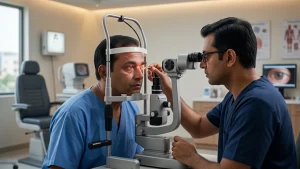
10. Skipping annual eye examinations
Most conditions that cause serious irreversible vision loss – glaucoma, diabetic retinopathy, and early macular degeneration- produce no symptoms in their early stages. By the time something is noticed, significant damage has occurred. An annual dilated eye examination detects these conditions when treatment is still effective. Waiting until symptoms appear is, functionally, the most damaging of all the habits that damage your eyes.
Can the damage from these habits be reversed?
Some of it can. Screen-related dryness, dehydration, and nutritional deficiencies improve when the cause is addressed. UV-related cataract and macular changes are cumulative and structural – they do not reverse, but their progression slows when the exposure stops. This is why the earlier these habits are corrected, the more of the benefit is preserved.
Final thoughts: eye care tips for healthy vision
None of these ten habits requires significant effort or expense to change. The 20-20-20 rule, adequate hydration, sunglasses outdoors, removing lenses before sleep, eating well, and booking an annual examination – these are the practical backbone of how to protect your eyes from screen damage and the slower accumulation of everyday harm.
ASG Eye Hospital, with centres in Noida, Kolkata, Guwahati, Patna, and more, provides comprehensive eye examinations for patients of all ages. If you have been deferring an eye check or if any of these habits feel familiar, a scheduled appointment is a straightforward place to start.
FAQs
1. What are the most common habits that damage your eyes?
Extended screen use without breaks, rubbing the eyes, skipping sunglasses outdoors, and sleeping in contact lenses are among the most frequent. Chronic dehydration, poor sleep, and skipping annual eye examinations also cause cumulative damage that is easy to overlook.
2. How do I protect my eyes from screen damage?
Apply the 20-20-20 rule: every 20 minutes, look 20 feet away for 20 seconds. Use lubricating drops on heavy screen days. Keep ambient room lighting on rather than using screens in the dark. Reduce screen brightness in the evening.
3. What are the effects of screen time on the eyes?
Reduced blink rate, tear film instability, surface dryness, ciliary muscle fatigue, and digital eye strain. In younger patients, prolonged near work is associated with faster myopia progression.
4. How to improve eyesight naturally?
Natural improvement applies to lifestyle-driven deterioration, not to established refractive error. Adequate sleep, a diet rich in lutein, zeaxanthin, omega-3s, and vitamin A, sufficient hydration, and UV protection all support long-term ocular health and reduce the risk of age-related conditions.
5. How often should I have an eye examination?
Every one to two years for healthy adults with no risk factors. Annually, for people over 40, diabetics, those with a family history of glaucoma, and high myopes. Children should be examined before starting school and whenever a visual concern arises.