Keratoconus is a progressive eye disorder which sees the cornea become thin and take on a conical shape from its normal round structure. This irregular shape which the disease instills in the cornea causes issues with how light is received by the eye thus producing blurry, distorted, or double vision. At first frames may correct the issue but as the cornea’s shape becomes more irregular many patients will require special keratoconus contact lenses for better and more stable vision.
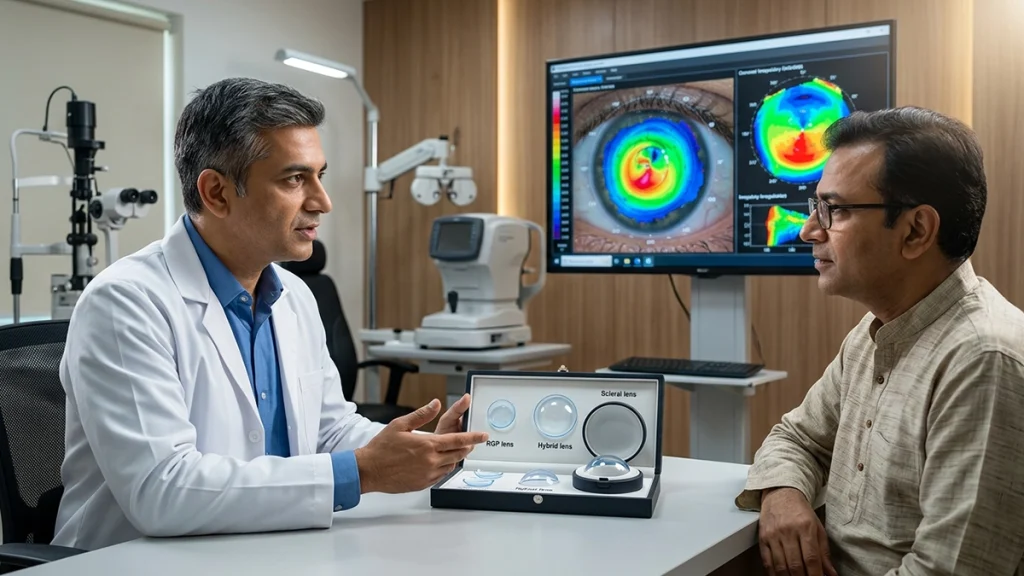
At ASG Eye Care we take a very careful approach in the assessment of patients before we choose which contact lenses to fit for their keratoconus contact lenses. Some patients do well with basic soft lenses, while others require RGP lenses, hybrids, or sclerals. What we choose is based on the stage of the keratoconus, the patient’s corneal topography, comfort issues, tear film quality and their daily visual requirements.
What Are Keratoconus Contact Lenses?
Keratoconus contact lenses are specially designed lenses used to improve vision when glasses are no longer able to correct the irregular shape of the cornea. With Keratoconus the cornea does not maintain a smooth focus which is why normal spectacles may not provide clear vision. These lenses we put in create a more regular surface over the cornea which in turn allows for better focus of light on the retina.
The role of keratoconus contact lenses is to improve vision correction and report better function in day to day activities which include reading, using computers, driving, recognizing faces, and seeing in various lighting conditions. In patients that are still seeing progress of their keratoconus we may also recommend at the same time they use contact lenses to try other treatments like corneal cross linking.
Why Are Contact Lenses Needed in Keratoconus?
In a healthy eye light is bent evenly. In keratoconus the cornea is non uniform which causes light to scatter before it reaches the retina. This results in blurred vision, multiple images, glare, halos, and frequent changes in glasses prescription. With keratoconus contact lenses we do see some success as they cover up the irregular surface and in turn produce a more even focus.
For many patients, keratoconus contact lenses provide sharper vision than glasses. They are very useful in case of irregular astigmatism, advanced corneal steepening, or poor quality of vision with specs. The best lenses for keratoconus are a result of a in depth eye exam and corneal mapping.
| Lens Type | Best Suited For | Main Benefit |
| Soft toric lenses | Very early keratoconus | Better comfort with mild correction |
| Rigid gas permeable lenses | Mild to moderate keratoconus | Sharp vision by creating a smooth front surface |
| Hybrid lenses | Patients needing clarity and comfort | Rigid center with soft outer skirt |
| Scleral lenses | Moderate to advanced keratoconus | Vaults over the cornea and rests on the white part of the eye |
| Piggyback lenses | Patients who cannot tolerate rigid lenses alone | Soft lens underneath with RGP lens above |
Types of Keratoconus Contact Lenses
Soft in early stages of keratoconus soft contact lenses may be used when the cornea is only slightly affected. As the disease progresses though soft lenses may not provide the same clarity. In such cases, keratoconus contact lenses with a rigid design are usually considered.
RGP lenses which are what we also term as rigid gas permeable are used for keratoconus very often. They maintain their shape once on the eye. Also they produce a smooth optical surface and may provide great vision correction in mild to moderate cases. But some patients may find them uncomfortable at times when the cornea is very steep or sensitive.
Hybrid lenses present a core of rigid material surrounded by a soft edge. They are for the use of patients which require the clarity from rigid lenses but prefer better comfort. For many people with moderate to advanced keratoconus, scleral lenses are often among the best lenses for keratoconus because they do not rest directly on the cone-shaped cornea.
Scleral lenses are of a larger size which go over the cornea and sit on the white part of the eye which is the sclera. We fill the space between the lens and cornea with sterile saline which in turn creates a smooth optical surface and often improves comfort. For patients with advanced irregularity, dry eye, or poor tolerance to smaller lenses, scleral lens fitting may provide excellent results.
What Is Scleral Lens Fitting?
Scleral lens fitting is a complex process which has the eye care professional measure the cornea and sclera to choose a lens which will vault the cornea safely. The lens must not press on the globe, must permit enough tear exchange, and must stay in place during blink cycles. That is which the scleral lens fitting takes great patience, we have trial lenses, and follow up visits.
During the course of the fit we evaluate visual clarity, comfort, movement, central clearance, edge alignment, and the health of the ocular surface. If required we make small changes to improve comfort and vision. A proper scleral lens fitting can make a major difference for patients who struggled with other keratoconus contact lenses.
Benefits of Keratoconus Contact Lenses
The primary benefit of keratoconus contact lenses is improved visual quality. Many patients which report distorted images through the use of glasses do see better and more clearly with properly fit contact lenses. This improves performance in education, at work, while driving, reading, and in turn improves overall independence.
Another issue is that keratoconus contact lenses do so delay or reduce the need for corneal transplant in some patients by improving vision. It is also reported that the lenses do not put a stop to progression of the disease. If the disease is active the doctor may suggest cross linking which in turn strengthens the cornea.
| Benefit | How It Helps Patients |
| Clearer vision | Reduces distortion caused by irregular corneal shape |
| Better daily function | Helps with reading, driving, screens, and outdoor activities |
| Non-surgical option | Improves vision without immediately moving to transplant surgery |
| Custom fit | Designed according to the patient’s corneal shape |
| Comfort in advanced cases | Scleral lenses may feel more stable for irregular corneas |
How Are Keratoconus Contact Lenses Fitted?
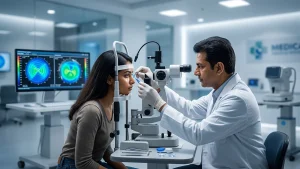
The process begins with a thorough eye exam. At the exam the doctor will test vision, refraction, corneal topography, corneal thickness, tear film, and eye surface health. These tests are to determine if keratoconus contact lenses are right for you and what design will work best. We put a trial lens on the eye and evaluate the fit with a slit-lamp microscope.
We also check your vision in the trial lens and make adjustments. In some cases it takes more than one visit as the best lenses for keratoconus must balance between clear vision, comfort, safety, and wear time.
Once we have the right lens we will teach the patients on how to put in, take out, clean, and put their lenses away. Great care is key which is why we stress proper lens care as it plays a role in reducing the risk of irritation or infection. Also we do follow up visits which are important to see how the keratoconus contacts lenses are doing as the corneal shape changes over time.
Keratoconus Contact Lenses at ASG Eye Care
At ASG Eye Care we tailor our care to the stage of the patient’s keratoconus and their lifestyle. We don’t just fit lenses, we are dedicated to full vision correction which also includes eye safety in the long term. Patients may be put into glasses, given keratoconus contact lenses, referred for cross-linking or a surgical option whichever is most suitable based on the degree of the condition.
In the early stages of the disease soft or GP lenses may work. For moderate to advanced cases we see that scleral lenses give better clarity and comfort. The best lenses for keratoconus are not the same for every patient, which is why individualized assessment is essential. At ASG Eye Care we focus on precise diagnosis, careful fit, patient education, and regular monitoring in our mission to preserve vision over time.
Caring for Your Keratoconus Contact Lenses
Proper lens care is key to successful treatment. Before handling keratoconus contact lenses patients should always wash their hands, use only the recommended cleaning solution, avoid sleeping in the lenses unless advised by a professional, and never to use tap water to rinse the lenses. Should redness, pain, discharge, sudden blurring, or light sensitivity present itself the lenses should be removed and medical attention sought.
Even if vision is at its best, follow up visits are a must. Keratoconus does indeed progress at a gradual rate, also what may fit well today may require adjustment in time. Regular monitoring also helps to maintain safe use of the lenses and to get optimal vision correction.
Key Takeaway
Keratoconus contact lenses are at present the best solution for patients that do not see well enough with glasses. From RGP to hybrid and scleral lenses each type has a different role. The right lens may improve clarity, comfort, and daily wear experience. With the right evaluation, expert fitting and regular follow up care keratoconus contact lenses may stabilize and restore function to many patients’ vision.
Also Read : Which Contact Lenses for Keratoconus Are Best? Expert Guide for Patients
Frequently Asked Questions
1 Which contact lenses are best for keratoconus?
The best lenses for keratoconus which also is a matter of the stage of the disease, corneal shape, how the patient feels in the lens and what is required for best vision. In early stages patients may be fit for soft or RGP, in moderate to late stages we prefer to use scleral lenses.
2 Do keratoconus contact lenses cure keratoconus?
No. Keratoconus contact lenses improve vision but also do not cure keratoconus or stop its progression. If the disease is progressing then treatments like corneal cross-linking may be recommended by the doctor.
3 Is scleral lens fitting painful?
No. The fit process is pain free although it may take time. During scleral lens fitting, the specialist checks comfort, clearance and vision to make sure the lens fits safely and properly.
4 Can I wear keratoconus contact lenses all day?
Many patients do wear keratoconus contact lenses for several hours a day but wear time is variable. It depends on the type of lens, degree of dryness of the eye, level of comfort, and what the doctor advises.
5 Are scleral lenses better than RGP lenses?
For very late stage keratoconus, irregular corneas, and poor fit with RGP lenses, sclerals may be a better option. But in the end the decision is based on the outcome of the eye exam and how the patient does with the fit.