Choosing which type of lens after cataract surgery is a key decision in the cataract treatment process. Many patients pay great attention to the surgery itself, but the artificial lens which we put in the eye is very much a factor in how well they see post op. Once the natural cloudy lens is out, it goes to the intra ocular lens also known as an IOL.
The best lens after cataract surgery is not the same for each patient. What you do most in a day reading, writing, using a mobile phone, driving at night, working outdoors will play a role in which lens you should get. That is why it is important to understand the different IOL lens types beforehand. While some people do very well with a monofocal lens, others may do better with a multifocal lens or other premium lenses which suit their lifestyle and eye health.
At ASG Eye Care we perform a full eye evaluation which is what we base our decision on. Our doctor assesses the cataract, cornea, retina, eye pressure, lifestyle requirements and expectations of the patient before we put forward the best solution for the lens after cataract surgery. We do not only focus on removal of the cataract but also in helping the patient to achieve comfortable and useful vision in their day to day lives.
What Does the Lens Do After Cataract Surgery?
During cataract surgery we remove the natural lens which has become cloudy. We then implant an artificial intraocular lens. This lens after cataract surgery helps to focus light properly on the retina which in turn allows the patient to see clearly again
After cataract surgery the natural lens does not regrow. In most cases the implanted lens stays in forever. That makes the choice at the time of the procedure very important. A good IOL choice will reduce dependence on glasses, improve clarity and in turn support better quality of life.
Before choosing between different IOL lens types, options patients should know that each lens has its pros and cons. A monofocal lens typically provides clear vision at one set distance, which is usually distance vision. A multifocal lens is designed to improve vision in more than one range of which may include distance and near. But what is best depends on the patient’s eye health and visual goals.
Main IOL Lens Types Used After Cataract Surgery
Over the years we have seen great improvement in IOL lens types. In the past most patients got a basic single focus lens. Now doctors are able to choose from a variety of options which fit the patient’s needs, profession, budget and eye health.
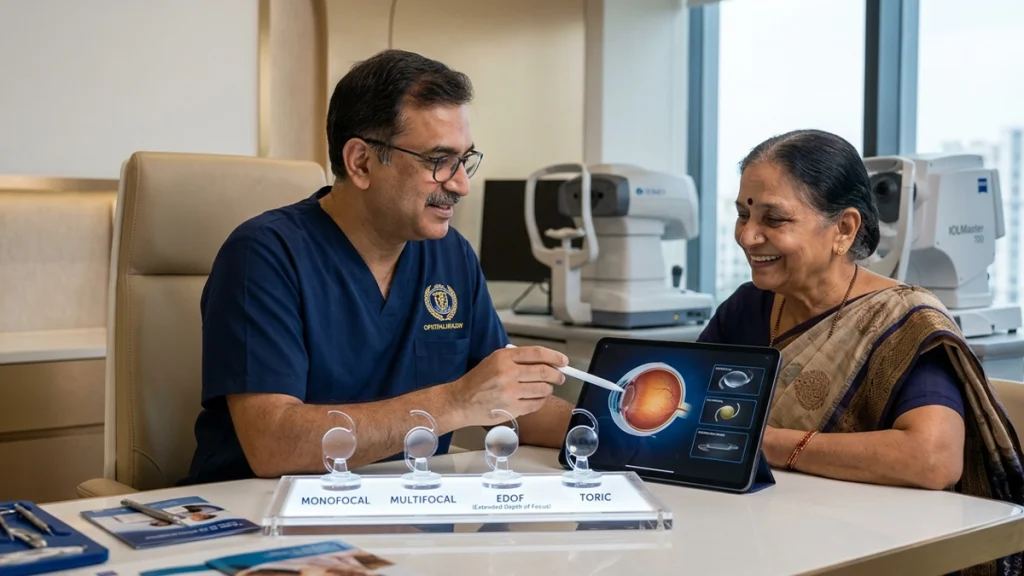
| Lens Option | How It Works | Best Suited For | Important Point |
| Monofocal lens | Focuses vision at one distance, usually far vision | Patients who are comfortable using reading glasses | Reliable, commonly used, and suitable for many patients |
| Multifocal lens | Provides vision at multiple distances | Patients who want less dependence on glasses | May cause glare or halos in some patients |
| Toric IOL | Corrects cataract and astigmatism | Patients with significant cylindrical power | Helps improve distance clarity when astigmatism is present |
| EDOF IOL | Extends range of focus, especially distance and intermediate | Patients who use computers often | May still require reading glasses for very small print |
| Premium lenses | Advanced lens category designed for added visual benefits | Patients with specific lifestyle goals | Selection should be done carefully after eye evaluation |
This table is a simple breakdown, but we also ask that you discuss all IOL lens types with your ophthalmologist before coming to a decision. What works for one patient may not for another.
How Doctors Choose the Right Lens
The most appropriate lens after cataract surgery is selected by which the patient’s visual requirements are matched to the lens features. First the doctor performs biometry and other scans on the eye. From these measurements the lens power is determined. Also the health of the cornea, retina, optic nerve, and tear film is assessed before we recommend which lens is right for you.
In patients with healthy eyes and high visual demands we may present them to premium lenses. For patients that are looking for a predictable and stable result we will put forward a monofocal lens.. If what they want is to reduce their dependence on glasses for distance and near work we will evaluate them for a multifocal lens. The doc’s role is to go over the benefits and limitations which in turn will set realistic expectations.
| Patient Need | Lens Usually Considered | Reason |
| Clear distance vision with simple correction | Monofocal lens | Gives good distance clarity and is widely accepted |
| Less dependence on glasses for near and far work | Multifocal lens | Designed to support multiple focusing distances |
| Lifestyle-based advanced visual needs | Premium lenses | May offer added benefits such as better intermediate vision or astigmatism correction |
| Budget-sensitive treatment choice | Monofocal lens | Practical option for many patients |
| Need to compare options before surgery | IOL lens types discussion | Helps patient understand what to expect after surgery |
When it comes to choosing between IOL lens types, patients should look beyond what is the most advanced. They should see which lens best fits their eyes.
Monofocal Lens After Cataract Surgery
A single focus IOL is what we see the most of in the field of cataract surgery. What it does is present a single point of clear focus. In most cases what the doctor will do is set it for distance vision which in turn gives patients clear vision at a distance post op. For near work reading glasses may still be required.
For a large number of patients the monofocal lens is a good and practical choice. It is put forth for patients who do not mind using glasses for reading or close work. Also it may be the choice when the patient has other eye issues in which advanced lens designs do not perform as expected.
A lens after cataract surgery which reports stable, comfortable, and safe vision. In this regard a monofocal lens is still seen as a very good option for many patients which in turn is true especially when the issue is of clarity and predictability. Although we have the new IOL lens types the traditional single focus lens still has a large role to play in cataract care.
Multifocal Lens After Cataract Surgery
A multifocal lens which is a solution for patients to see clearly at multiple distances. It also may reduce the use of glasses for things like reading, using a phone, watching TV, and going about your day. Many patients that are tired of depending on their glasses ask about this during consultation.
However in some cases we do not recommend a multifocal lens. Some patients report glare, halos, and reduced visual contrast which in turn may also affect night time driving. Also we see that patients with retinal disease, advanced glaucoma, irregular cornea, or severe dry eye do not do well with it. That is why we stress on a thorough eye check up before we go ahead and choose this lens after cataract surgery.
Among premium lenses, multifocal lenses are a hit for their wide range of vision. That said the choice should be based on eye health, lifestyle, and expectations. A patient that drives at night for a living may require a different recommendation than someone who does mostly indoor reading.
Premium Lenses: Are They Always Better?
Many of our patients assume that premium lenses are the best option. That is not always the case. What we do see is that premium lenses which have advanced features do present the best solution for some, but they have to be a match for the patient’s eye health and lifestyle. We may find that a patient with healthy retinas and normal cornea does in fact benefit from premium lenses, whereas a patient with an eye disease may see better results from a more basic solution.
Premium lenses may include multifocal, toric, EDOF, or any other type of high end lens design. These lenses may reduce your dependency on wearing glasses, can correct for astigmatism or improve in what is the 2nd plane of vision that people frequently use. That said, they will also generally be a more expensive option and may not be right for each medical case.
The top choice of lens after cataract surgery is not always the most expensive one. We find what works best for that individual patient in terms of safety and use is what really matters. For some people a monofocal lens may be the best option, for others a multifocal lens will be. That is why it is more useful to discussIOL lens types with your doctor rather than to base your decision only on price or what ads tell you.
Can the Lens Be Changed Later?
In most of the cases the lens after cataract surgery is for life. We do have the option of exchange in some cases but it is not a common or casual procedure. We may look at it if the power of the lens is very much out of place, if the patient is reporting severe visual symptoms, or there is another health issue.
Because it’s a complex process, we see that pre-operative planning is key. The surgeon will use eye measurement results, medical history, and input on visual goals to choose the right lens after cataract surgery. That is why we ask that patients open up to us about their daily routines, work requirements, night time driving, screen use, and what they expect out of the procedure.
A full review of IOL lens types prior to surgery which in turn reduces post op confusion. What the lens is designed for in terms of vision range and if glasses will still be required should be made clear to patients.
Lens Selection at ASG Eye Care
At ASG Eye Care we take a patient first approach to cataract treatment. Our doctors do a thorough evaluation of the eye before we put forth the best lens after cataract surgery. We discuss your occupation, reading habits, time spent on screens, night time driving needs and what you expect out of the surgery.
Some patients may have a prescription for premium lenses if their health and visual lifestyles fit that choice. Also we see that some patients do just as well with a monofocal lens. In some cases a multifocal lens can reduce dependency on reading and distance glasses. We try to pick the best option after cataract surgery which in turn is based out of safety, clarity, comfort and practicality.
At our ASG Eye Hospital we also go over with patients what to expect in terms of recovery, follow up visits, and results after we implant the lens after cataract surgery This we do to reduce anxiety and also to help patients in making an informed decision.
Key Takeaway
Which is the best lens after cataract surgery is a very individual issue based on a patient’s health of eyes, lifestyle, budget, and what they expect out of vision. We do not have a one size fits all type of lens. Monofocal lenses are a very reliable and very common choice, we also have monofocal lens options which do in some cases reduce dependence on glasses in appropriate patients.
Before choosing a lens after cataract surgery, patients should be aware of what each option has to offer in terms of benefit and limitation. A thorough consultation which includes premium lenses, standard lenses and other available choices in which to compare them is very important. The right lens after cataract surgery can greatly improve long term visual comfort and quality of life.
Frequently Asked Questions
1. Which lens is best after cataract surgery?
Which is the best lens for you depends on your eye health and every day vision requirements. Some patients do well with a standard single focus IOL, others may do better with advanced options which include near, intermediate, or astigmatism correction. Your ophthalmologist will determine the best option for you after a thorough eye exam.
2. Are advanced cataract lenses suitable for everyone?
No. Advanced lenses do apply to some patients’ needs, but they are not for all eyes. In some cases we see better results when we take a more careful approach in patients with retinal disease, corneal irregularity, glaucoma, or severe dry eye. It is also at the ophthalmologist’s discretion which is best for each individual.
3. Will I need glasses after cataract surgery?
Some patients post cataract surgery may still require glasses which is true for reading and fine near work. The requirement for glasses is a result of the type of IOL used, the power calculation, and the overall health of the eye.
4. Is cataract lens selection permanent?
In most of the cases the IOL put in at the time of cataract surgery is a permanent fixture. In some special situations we do lens exchange which is not a routine procedure. That is why it is very important to choose carefully beforehand.
5. Can both eyes have different lens choices?
Yes, in some instances the doctor will put forth a different plan for each eye for a patient’s specific vision issues. But that decision is made after a great deal of study and talk before surgery.