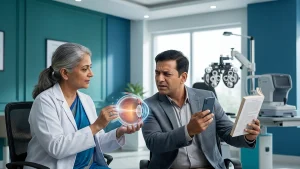
Reading in general may become a challenge once you start receiving phone messages, going through menus or using laptop screens which require you to put on your reading glasses. This typically appears around age 40 as the natural lens loses some of its flexibility and the eye’s ability to focus at close range goes down. Known out to be a normal age related change and not an infection or acute disease. byopia What also has changed is the treatment options for it.
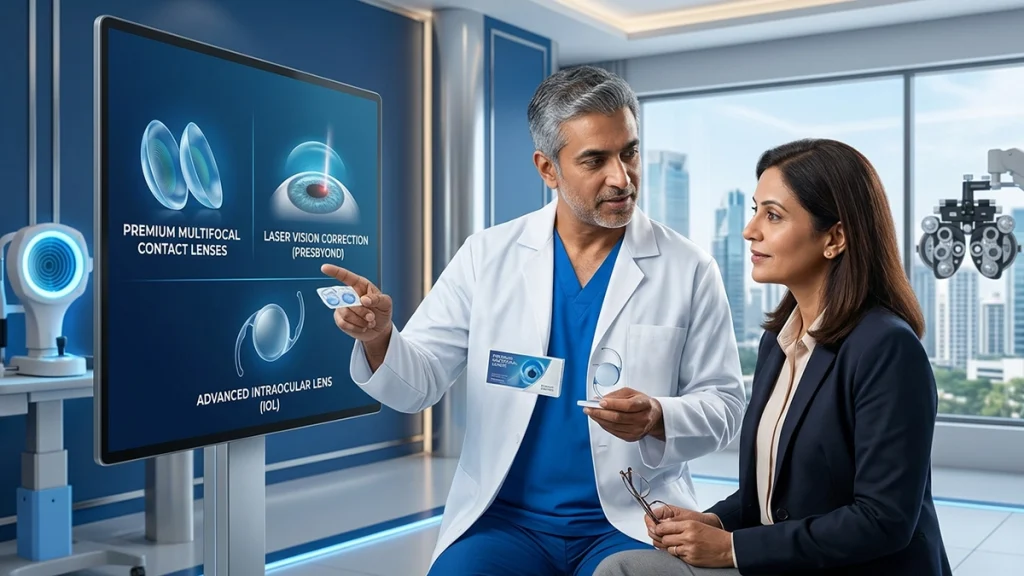
At present we are no longer stuck to the use of readers. As per age, eye power, corneal health, lens clarity, retinal health, occupation and what you expect out of life options may include multifocal or monovision contacts, Presbyopia Eye Drops, laser based Near Vision Correction or Presbyopia Surgery. These may reduce your dependence on glasses but no responsible specialist can promise that you will not need them at all again. The best safety plan for your Presbyopia Treatment must be based on a full eye exam.
What Happens to Near Vision With Age?
A young eye changes the which is its natural lens’ function in shifting the focus from an out of focus far object to a near one. This is what we see as accommodation. With age that lens becomes less flexible and so the range that we can focus on decreases. Signs at this are blurred vision with small print, a need to hold things out at arm’s length for reading, difficulty seeing in dim lighting, eye strain, and headaches which present after doing close work.
It is important at this stage for the eye doctor to perform a full exam to diagnose Presbyopia Treatment which can present the same as that of hyperopia, astigmatism, dry eye, cataract, that of the changes related to diabetes or retinal disease. The ophthalmologist will check distance and near vision, do a refraction, check out the intraocular pressure, the cornea, its tear film health, the lens for any clouding and the retina. This eval does also help us determine if we can safely do Near Vision Correction.
Can Presbyopia Be Corrected Without Reading Glasses?
Yes. Many people may instead of reading glasses opt for contact lenses, prescription eye drops, laser treatment or implantable lenses. Also what works best for Presbyopia Treatment varies for the person that just reads a little, a daily computer worker, and the individual that does lots of close up work.
Current treatments are for the most part what you get to use when your focusing ability has gone down or we increase what’s called the depth of focus; we aren’t yet able to make natural lenses young again. Post procedure still may require the use of glasses for fine print, long reading sessions, in dim light or for very distant work. What we see as the real goal of Presbyopia Treatment is to achieve greater freedom of vision which in turn leads to less dependence on glasses.
Contact Lenses for Presbyopia
Multifocal lenses have areas for distance, intermediate and near vision. The brain uses out of those which is the best for each task. They provide a reversible for Presbyopia treatment as it adapts over time some people report issues like glare, dryness, and reduced contrast in low light. Also which eye is mainly used for distance and which for near is determined. The brain in turn puts the two together to present a large-scale functional range. A trial with the contact lenses is usually recommended as some people do experience reduced depth perception and night time visual quality. Also it is a way to see how your body tolerates them before going permanent for Near Vision Correction. I also put in place this to see how the patient does before fully committing.
Contact lenses also do well for Near Vision Correction and are a great option for Presbyopia Treatment which is great news if you’re looking for a reversible solution. But also practice good hygiene, in time replace them and in for regular eye check ups. There are some that have very serious dry eye issues, get recurrent infections or just have trouble handling the lenses which may point to a different option being what you should go with.
Prescription Eye Drops for Near Vision
Prescription for Presbyopia Eye Drops which is a non surgical option for some adults. Certain drugs which cause the pupil to shrink produce a pinhole effect that increases depth of focus. The U.S. Food and Drug Administration has given the ok to pilocarpine based products for adult presbyopia and in 2025 to aceclidine ophthalmic solution. What is put out there and what is approved varies by country. These do not reverse lens stiffness, and their results are only temporary. For the right patients Presbyopia Eye Drops may make phone use, reading tags or every day near work easier at times during the day. They appeal to people who are against surgery or who prefer a treatment which you can stop.
Possible results of these medications may include headache, redness, brow ache, temporary dimness or difficulty seeing in low light. FDA prescribing info for miotic drops also reports on issues with night time driving and includes retinal warnings which is why it is important to have a retinal exam for patients at risk. Do not use someone else’s drops or non prescribed drops. As Presbyopia Eye Drops are prescription drugs dose and follow up should be with your ophthalmologist. The results of Presbyopia Eye Drops may be affected by age, pupil size, lighting, existing power and other eye conditions. An ophthalmologist must determine the appropriate treatment and the safe use of this Presbyopia Treatment.
Laser Vision Correction and Monovision
Laser treatments which change the cornea thus changing light focus. In the case of LASIK we see correction of refractive errors but not restoration of natural accommodation. For presbyopia we may use laser based Near Vision Correction which includes monovision or blended vision; the dominant eye is for distance and the other for near ranges.
The National Eye Institute reports that refractive surgery changes corneal shape; also the NHS notes we use laser and lens procedures to correct focusing issues. For contact-lens simulation to be useful in Monovision Presbyopia Surgery it is often a good idea before hand. Also we must check your corneal thickness, shape, prescription stability, tear-film quality and what you expect out of the treatment. It may not be a go ahead with some corneal diseases, uncontrolled dry eye, unstable power or active eye disease.
This Presbyopia Treatment may decrease your daily need for glasses and does not include your natural lens. What is included is that it may produce dryness, glare, halos, reduced night time contrast, incomplete near vision or difficulty in adaptation to different focus levels. Presbyopia may progress so you may still require glasses or further treatments at a later date.
Lens-Based Surgical Options
Lens out Presbyopia Surgery which involves removing the natural lens and putting in an artificial intraocular lens. Also we see the same approach in cataract surgery. When a clear lens is replaced mostly to improve vision that is called refractive lens exchange. It is a more invasive procedure as compared to corneal laser treatment because the surgery takes place within the eye.
Multifocal, trifocal and extended depth of focus lenses are designed to improve upon the narrow field of view which is the standard of monofocal lenses. Some patients report that they achieve useful distance, computer and reading vision but still some require glasses for certain tasks. Choice of lens depends on corneal, optic nerve and retinal health, astigmatism, night time driving requirements and patient tolerance to halos.
This for the Near Vision Correction option we discuss it with older adults, patients that are in the early stages of cataract or people who do not do well with corneal laser treatment. Also it is to be noted that intraocular surgery comes with risks like infection, inflammation, pressure changes, retinal complications, lens position issues and also unwanted optical effects. Presbyopia Treatment should which is after we have had in depth counseling with the patient and not just because they are promised of getting rid of their glasses. Also certain retinal or optic nerve conditions may make multifocal options out of the question in which case another lens strategy may in fact provide better visual quality.
Comparing Options Without Reading Glasses
Comparing benefits, limitations and reversibility helps patients choose a practical Presbyopia Treatment rather than focusing only on spectacle freedom.
| Option | How it supports near vision | Main advantages | Important limitations |
| Multifocal contact lenses | Uses multiple optical zones | Reversible and non-surgical | Adaptation, hygiene, dryness or reduced contrast |
| Monovision contact lenses | Corrects one eye for distance and the other for near | Can be trialled before surgery | May affect depth perception or night vision |
| Presbyopia Eye Drops | Temporarily reduces pupil size to increase depth of focus | Non-surgical and used when needed | Temporary effect, side effects and prescription requirement |
| Laser Presbyopia Surgery | Creates monovision or blended focus through corneal reshaping | May reduce everyday spectacle dependence | Irreversible corneal change and adaptation trade-offs |
| Lens-based Presbyopia Surgery | Replaces the natural lens with a selected implant | May address presbyopia, power and cataract together | Intraocular risks, halos and possible residual glasses |
Who May Be a Suitable Candidate?
A proper Presbyopia Treatment candidate has stable power, healthy corneas, is within manageable range of dry eye, does not have uncontrolled eye disease and has realistic expectations. Each Presbyopia Treatment decision also includes evaluation of visual priorities and tolerance for trade-offs. The choice is between distance vision, computer use, close reading or reduced dependence across all ranges.
Frequent night drivers may have different requirements to that of office workers. A photographer, surgeon, or precision technician may be less tolerant of reduced contrast and depth perception. It is thus more important that we have custom solutions which also include Near Vision Correction instead of just going by age or what is advertised.
An ophthalmologist will first try treatment for dry eye, will do a contact lens trial for monovision, will advise waiting for cataract to develop or will suggest to continue with glasses when the expected benefits do not outweigh the risks. Going without Presbyopia Surgery is also a valid option.
Treatment Selection at ASG Eye Care
At ASG Eye Care we provide a full eye health and vision assessment which is the first step in the Presbyopia Treatment evaluation. Our ophthalmologist will go over which options best suit your case and daily requirements we are looking at contact lenses, prescription Presbyopia Eye Drops, corneal laser correction or lens based treatment.
The latest in Presbyopia Treatment is not a one size fits all solution. A tailored Near Vision Correction approach which includes preservation of distance vision, support for close work, and which has an acceptably low side effect profile is what we should see. Prior to Presbyopia Surgery patients must become familiar with the expected reading range, recovery issues, night vision results, that in some cases glasses may still be required, also if at a later date a different approach is to be used this must also be determined.
Treatment Options at a Glance
| Patient priority or situation | Option that may be discussed | Why evaluation matters |
| Wants a reversible alternative | Multifocal or monovision contact lenses | Eye surface health and adaptation must be checked |
| Wants temporary help for selected hours | Presbyopia Eye Drops | Retinal health, medicine suitability and low-light needs matter |
| Has stable power and suitable corneas | Laser Presbyopia Surgery | Mapping, dryness and monovision tolerance influence results |
| Has cataract or significant lens ageing | Lens-based Presbyopia Surgery | IOL choice depends on retinal health, astigmatism and lifestyle |
| Needs exceptionally crisp night or precision vision | Conservative or customised correction | Maximum spectacle freedom may conflict with contrast quality |
Frequently Asked Questions
1. Is there a permanent cure for presbyopia?
No present solution has been developed which returns the natural lens to its young state. In terms of Presbyopia treatment today we use optical correction, temporary drops, corneal laser procedures or artificial lens implants.
2. Can eye drops completely replace reading glasses?
For a number of adults Presbyopia Eye Drops may provide temporary near correction and which in turn may reduce the use of readers at certain points in the day. They are not for the most part which are used for extended reading, fine print, or dim light work and also require a prescription.
3. Is surgery for presbyopia the same as LASIK?
Not always. For Presbyopia Surgery we may perform monovision or blended vision LASIK, PRK based correction or lens replacement. What is done depends on the state of the cornea, age, degree of prescription, if you have cataracts and what your visual goals are.
4. Can presbyopia return after laser treatment?
The corneal change is present, in the meantime age related loss of natural focus goes on. A person may at a later date require more Presbyopia Treatment, occasional readers or a supplement.
5. Are multifocal lenses suitable for everyone?
No. Multifocal and intraocular lenses have a period of adaptation and may produce halos or reduced visual contrast. Retinal, corneal or optic nerve disease also plays a role in determining suitability for this type of Near Vision Correction.
6. What is the safest option?
Reading glasses are the easiest and most risk free solution. For those that want options the best Presbyopia Treatment is personal to each person’s health, work, life style and tolerance of what may be given up.
7. Will I be completely glasses-free after treatment?
Full independence is not a given. After what may be a very thorough procedure, glasses may still be used for small print, extended reading, in low light conditions or for certain distance work.
8. When should I see an ophthalmologist?
When the blur from an eye issue is affecting day to day activities, is very transient, varies greatly between eyes, or is accompanied by pain, flashes, floaters, distortion or sudden vision loss at all, that is the time to get in for an exam. Also assessment at this point helps to tell which is which between presbyopia which is a normal process and other eye issues.