Looking at the Sun may be a brief act of which we are aware but also at the same time we put our cornea and lens to work which in turn put into play the macula, the central retina which we use for reading, recognizing faces and seeing fine details. What may go unnoticed is the damage which may be done by overexposure which in turn causes solar retinopathy, a light induced injury that may play out in our vision for hours after the incident which may not include immediate pain. NASA reports that intense visible light may bring on chemical reactions in retinal cells which may in turn bring about these visual issues which may not present until some time after the event.
The issue is that it is associated with eclipses but also with retinal sun damage which in turn is a result of intentional sun gazing, repeated direct exposure to the sun through the use of unfiltered binoculars, cameras and telescopes. Knowing the warning signs and practising reliable eye protection from sunlight can prevent an avoidable injury.
What Is Solar Retinopathy?
This retina condition which has developed out of very large amounts of time spent in the sun’s presence is also known as solar maculopathy, photic retinopathy or eclipse retinopathy. The macula in general but the fovea in particular as it is the central component, is what is affected as the eye’s optical system simply focuses light on that small area.
The injury is mostly of a photochemical nature. Intense light brings out reactions which in turn damage photoreceptors and the retinal pigment epithelium which supports them. In terms of extent of time spent exposed or the intensity of the light heat may play a role also. This is the reason why the injury may present itself in the sharp straight ahead vision which is used for reading and detailed work.
This issue is distinct from the slow results of normal ultraviolet exposure. UV-blocking sunglasses are important for everyday eye protection from sunlight, but which are not designed for looking at the Sun. Also it is to note that whatever the darkness of the lens NASA reports that common sunglasses are in fact unsafe for looking at the Sun.
How Sunlight Injures the Retina
During solar viewing visible and near infrared energy goes through the front of the eye and is focused onto the macula. This concentrated energy causes damage to the outer retinal layers and also produces a small central area of dysfunction. It is very common for both eyes to be affected but one may be more affected than the other as exposure and viewing position are almost never the same.
The retina does not have pain receptors. What may happen is that a person will break off looking at the Sun which in turn may cause them to think that nothing occurred. This is what makes retinal sun damage so easy to not notice. During an eclipse the surrounding area which is dimmer can make the remaining solar crescent appear safe to look at which it still in fact is not intense enough to injure the retina.
Clear that out there is value in safety advice which goes to say that comfort of the fit, cloud cover, and the darkness of a home made filter does not equate to protection. What we have is that proper protection is a function of what is put in place for the activity at hand and that has been designed and tested for that very purpose.
Causes and High-Risk Situations
The primary cause of injury is looking at partial or annular eclipses without proper solar filters. Also we see it in people who look at the Sun out of the ordinary, in the context of religious or health based practices, in which the Sun is gazed at for long periods of time. Also included are the use of binoculars or telescopes which do not have the correct filters, as well as the use of unsafe materials which do not protect the eye from the Sun’s rays like smoked glass, unexposed film, X ray plates, CDs or layers of regular sunglasses. It is the optical instruments that are the most harmful as they focus the solar energy.
Risk increases with frequency, duration or degree of exposure. Also, children and youth may play with eclipse viewing, also some medications which dilate the pupil and let in more light. No man should base his judgment of safety on the Sun’s dimness or on eye comfort.
| Exposure situation | Why it is unsafe | Safer approach |
| Looking directly at the Sun | Concentrated light can produce retinal sun damage | Avoid direct viewing and use an indirect projection method |
| Watching a partial or annular eclipse | A visible solar crescent remains dangerously bright | Use compliant eclipse glasses or a safe handheld viewer |
| Using a camera, telescope or binoculars | Optics intensify light and may injure the macula rapidly | Secure a purpose-built solar filter over the front of the device |
| Wearing regular sunglasses to view the Sun | They reduce glare but are not solar-viewing filters | Reserve them for everyday eye protection from sunlight |
| Using scratched eclipse glasses | Damaged material may transmit unsafe light | Discard and replace the viewer |
Recognising Solar Retinopathy Symptoms
The first solar retinopathy symptoms may present within a few hours of exposure as opposed to immediately. A person may notice that their central vision is blurred, there is a gray, dark, red or yellow spot, a reduction in contrast, difficulty with reading, light sensitivity or headache. Straight lines may appear bent or wavy which is what we term as metamorphopsia and colors may appear different.
These solar retinopathy symptoms are present in both eyes but may do so unevenly. At times a person may find that the central spot is larger in one eye or that vision is more distorted in the other. Also it may be that the outside of the eye appears normal and pain may not be a symptom which means this issue shouldn’t be written off as just temporary glare.
A key issue is sudden or slow development of a blind spot, change in color vision, or reduction in central vision after solar exposure which may also present like other macular or neurological conditions. An ophthalmologist should assess persistent solar retinopathy symptoms rather than relying on self-diagnosis.
When to Seek Medical Attention
Arrange an urgent eye examination when solar retinopathy symptoms begin after looking at the Sun or an eclipse. Go to the care provider right away for sudden central vision loss, a dark spot that won’t go away, vision distortion which gets worse, a large difference between what each eye sees or trouble reading and recognizing faces. Also do not put off testing the eyes into bright light and do not use steroid drops or home remedies without first getting medical advice.
An evaluation can determine retinal sun damage, rule out other retinal emergencies and set a base line for follow up. At an early stage of assessment we may not be able to reverse the injury but it does put us in a position for accurate diagnosis and proper monitoring.
How Solar Retinopathy Is Diagnosed
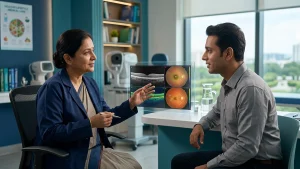
In the field of diagnosis we start with the exposure history. The ophthalmologist will ask what the patient saw which may have been an eclipse or through an optical device, how long the exposure was to that which caused the issue, when visual changes began and if the issue is with one or both eyes.
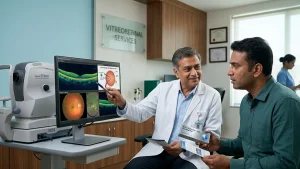
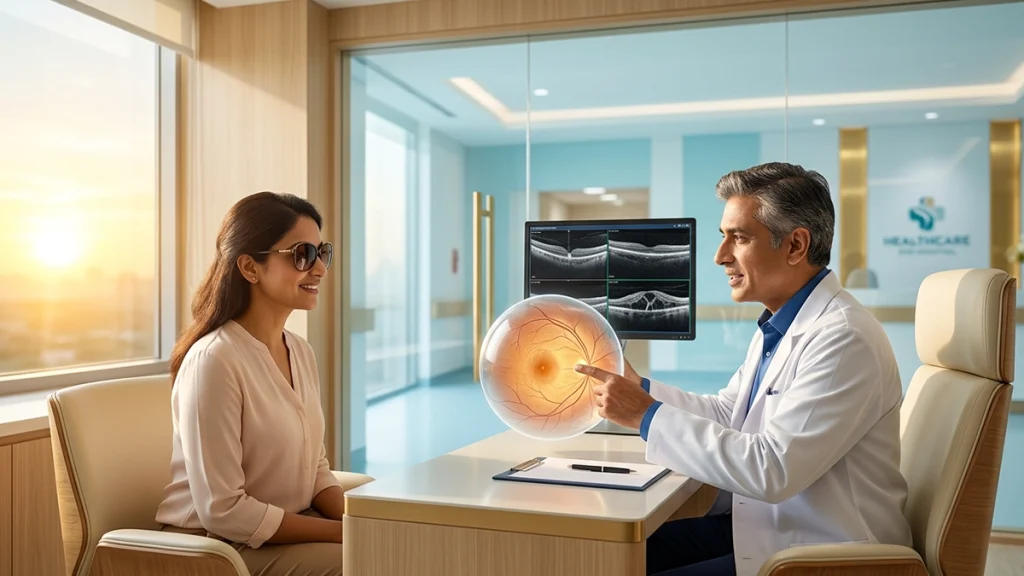
Visual function including acuity and color perception, pupil response and use of the Amsler grid is assessed. We also do pupil dilation which in turn allows us to study the retina and macula. At times early changes may be very subtle so we use optical coherence tomography or OCT which is very valuable. OCT produces cross sectional retinal images which may show foveal disruption that supports the diagnosis.
| Assessment | Purpose | Possible finding |
| Visual acuity | Measures central visual clarity | Reduced reading or distance vision |
| Amsler grid | Tests whether straight lines remain straight | Wavy, blurred or missing areas among solar retinopathy symptoms |
| Dilated retinal examination | Reviews the macula and surrounding retina | A subtle central lesion |
| OCT scan | Images individual retinal layers | Outer retinal disruption after solar exposure |
| Follow-up testing | Tracks recovery over time | Improvement or persistent central change |
Treatment and Expected Recovery
There is not a single medicine that has been proven to reverse solar retinopathy. Management usually includes prevention of further exposure, documentation of vision, monitoring the macula and allowing for retinal healing. A recent review reported that many patients do improve within a few weeks to 6 months but some are left with a central blind spot, distortion or reduced visual quality.
Steroids in some reports, however the proof is weak and their use is not a proven do it yourself treatment. Unsupervised use of them also adds to risk. An ophthalmologist is the one to determine if it is into which a patient’s care will go, that may include further evaluation or other methods.
Recovery from condition is a result of the degree and length of exposure as well as the extent of retinal sun damage. While better visual acuity may present it isn’t a given that every minor blind spot or distortion has gone. Thus follow up is still useful in which day to day vision improves.
Preventing Solar Retinopathy
Prevention starts with a simple rule: Never look at the Sun during the day, a partial eclipse, an annular eclipse or the partial phases before and after totality. For eye protection from sunlight at the time of the eclipse use only specially made eclipse glasses or a solar viewer which meets the ISO 12312-2 standard. Before each use check the device’s condition, if it is torn, punctured or scratched do not use it. Children must be supervised very closely.
Regular sunglasses, polarized glasses, exposed film, X ray plates, CDs and smoked glass do not protect against acute solar injury from direct view. As for cameras, telescopes or binoculars, a filter which is meant for the equipment must be placed securely over the front which faces the Sun. Also do not use unfiltered optics which are meant for the eclipse while wearing eclipse glasses as that can damage what you are viewing and your eye.
Indirect projection is a safe option. At a solar eclipse for instance we use a pinhole projector which throws the Sun’s image onto a screen while the viewer has their back to the Sun. What the person sees is the projection and nothing more which also includes looking into the pinhole. This approach can prevent retinal sun damage during a supervised school or family event.
In the average day out setting eye protection from sunlight is provided by wearing sunglasses that are labeled to block 99 to 100 percent of UVA and UVB radiation which also includes UV400 labeled products. Also wearers of wraparound frames will have reduced side entry of light and a broad brimmed hat which gives extra shade. The National Eye Institute and CDC put forth UV blocking sunglasses as a recommendation for every day eye health.
Everyday Sunglasses and Eclipse Glasses Are Different
Very very dark or expensive sunglasses do not prevent retinal injury from direct solar view. Typical sunglasses reduce glare and everyday UV exposure. For eclipse viewing we use gear which is thousands of times darker and is that which is designed specifically for looking at the bright Sun. Do not use regular sunglasses for this purpose.
Good every day UV protection still is a must as over time it affects various eye tissues and we see that it also plays a role in cataracts and other eye issues. It should also not be put forth that this is the same as the special protection which is required to prevent acute solar damage.
Protect Your Central Vision
The best defense against solar retinopathy is to prevent it. Do not test a filter out by looking through it, do not rely on regular sunglasses for direct view and do not use unfiltered magnifying optics. Following trusted eclipse guidance and using consistent eye protection from sunlight in daily life can protect short-term sight and long-term eye health.
If you see blurred vision, waviness in vision, color change or a dark spot after looking at the Sun, we ask that you schedule an evaluation at your nearest ASG Eye Hospital. Prompt assessment can identify retinal sun damage, rule out other conditions and guide follow-up based on your individual findings.
Frequently Asked Questions
1. Can Solar Retinopathy Cause Permanent Vision Loss?
Yes. Many report improvement, but in some cases of severe injury there is central blur, distortion or a small blind spot which results. The end result is a function of the degree of exposure and the extent of macular damage.
2. How Quickly Do Solar Retinopathy Symptoms Appear?
Solar retinopathy symptoms commonly emerge within several hours, although timing varies. Delayed changes are a reason which a person should not assume the eyes are safe just because they feel normal immediately after exposure.
3. Can Sunglasses Stop Retinal Sun Damage?
Ordinary sunglasses help with daily UV exposure but cannot stop retinal sun damage caused by looking directly at the Sun. For that you will need special solar filters or an indirect viewing method.
4. Is Solar Retinopathy Painful?
The issue with the retina itself is that it does not have pain sensors which means a retinal injury may go pain free. Light sensitivity or headache may present but in the absence of pain do not dismiss retinal injury.
5. What Is the Safest Eye Protection from Sunlight During an Eclipse?
For partial and annular phases, safe eye protection from sunlight means compliant eclipse glasses, a suitable handheld viewer or indirect projection. During a total eclipse, direct viewing is safe only while the Sun’s bright face is completely covered, and protection must be replaced as soon as bright sunlight reappears.
6. Can the Retina Heal After Sun Exposure?
In some cases improvement is seen within weeks or months, we are however not guaranteed full recovery. In the case of persistent solar retinopathy symptoms an assessment and follow up is required because of the possibility of permanent central changes.
7. What Should I Do After Accidentally Looking at the Sun?
Stop out the exposure and stay away from bright light stimulation. See an ophthalmologist if you notice central blur, distortion, a dark spot or any other visual changes. Do not self-treat. While proper future eye protection from sunlight the sun is a must, it won’t reverse an injury which has taken place.