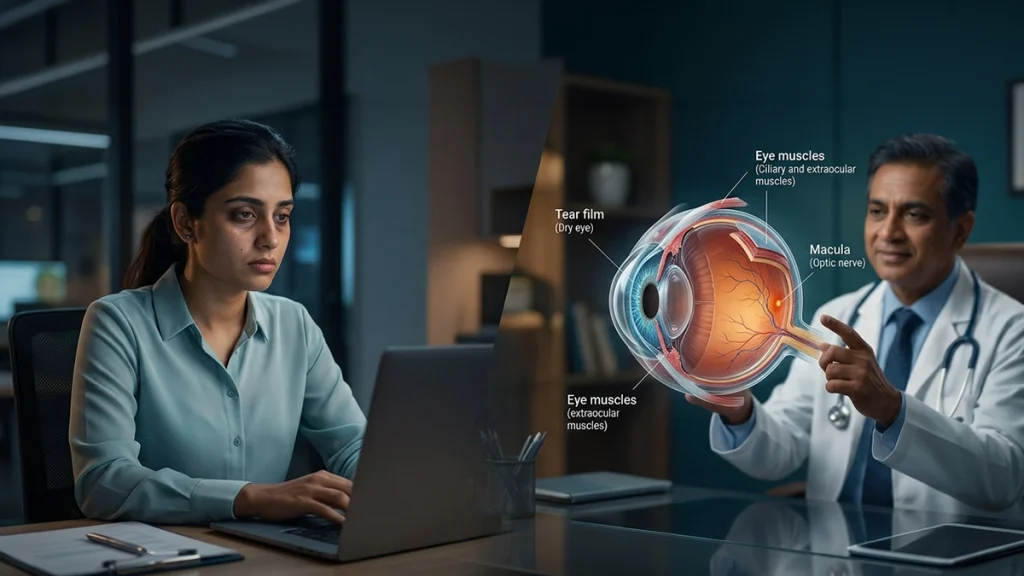
After that very busy week the eyes may feel fatigued, dry, painful or more sensitive than usual. Also some report of temporary difficulty in focus, eye twitching or head ache which present around the brow. These issues make Stress and Eye Health a very relevant issue for people with demanding schedules which include use of digital devices and late nights.
Sleep’s role in eye health is beyond the simple issue of looking tired. It is in fact tied to repair processes and the balance of our tear film. Also a factor is Emotional stress which may increase muscle tension and change blink patterns. In that light Blurred Vision from Stress, Eye Fatigue, and Eye Strain the effects of Sleep Deprivation Effects may present at the same time. While occasional issues may be short term, persistent or sudden visual changes related to Lack of Sleep and Eyes should not be written off as just stress.
Stress and Eye Health: Can Stress and Poor Sleep Damage the Eyes?
In many cases what we see with Stress and Eye Health is an issue of function over structure which is to say the damage is not permanent. What you may notice is that focus is slower, you may get eye lid twitches, the eye surface will dry out and you will feel muscle aches around the eyes. These symptoms improve with better sleep, more water intake, breaks from screens and stress management.
However in many cases poor sleep affects the ocular surface. Research from the US National Library of Medicine reports that sleep deprivation is a cause of reduced tear production and of weak tear film. The National Eye Institute notes that dry eyes may cause burning, redness, light sensitivity and blurry vision. This may help to explain why Lack of Sleep and Eyes issues become a recurrent issue in particular for contact lens wearers and people who put in many hours in air conditioned environments.
Stress and tiredness also bring on cases of lid twitching. For the most part simple twitches do not require treatment, but if the spasm goes on for weeks, causes the eye to fully close or affects the face, seek medical advice. This is an instance of Stress and Eye Health producing symptoms which although not permanent may be persistent.
How Stress and Eye Health Can Affect Vision
During times of stress the body’s alertness goes up and we see muscles tightening. We often don’t notice but we clench our jaws, raise our shoulders and furrow our foreheads. When this is a result of long term computer work or reading which in itself is a near point focus activity,Eye Strain may present more as the eyes are already at that close focus.
Some report that Blurred Vision from Stress is intermittent blur which clears with a blink or improves when you step away from the computer. Dry eye, reduced blinking, migraine, fatigue or difficulty in focusing may play a role. But it is not true that stress is a default go to cause, we must rule out refractive errors, medication side effects, blood sugar changes and eye disease which also present with the same symptoms
Stress is also a factor which has been looked at in relation to central serous chorioretinopathy, a retinal issue that can cause central vision to distort or blur. Reports present stress as a variable in the picture but it is not proven that routine stress plays a role in the development of the condition in all people. In a balanced view of Stress and Eye Health we present a may be connection but do not trade diagnosis for assumption.
How Stress and Eye Health and Poor Sleep Affect the Eye Surface
The ocular surface is dependent on a stable tear film. Tears’ role is to lubricate the cornea which in turn supports clear vision and reduces the friction at the time of blinking. With lack of rest the tear film may become unstable which in turn may make the eyes feel gritty, burning or watery. The connection between Lack of Sleep and Eyes issues may be more visible when also present are screen use, contact lenses, dry air or dehydration.
Clinical reports note that Sleep Deprivation Effects brings about reduced tear production and faster tear film break up. These Sleep Deprivation Effects which in turn aggravate dry eye discomfort and intermittent blurring. A tired person may also reduce his blink rate during concentrated work, rub the eyes more frequently or turn to caffeine which in turn causes Eye Fatigue, repeated Eye Fatigue and Eye Strain.
Common Symptoms and What They May Mean
The chart outlines how Stress and Eye Health, inadequate sleep and screen habits may relate. It is not to be used for diagnosis as one symptom may have many causes.
| Symptom | Possible connection | Sensible next step |
| Intermittent blurring that improves after blinking | Dryness, reduced blinking or Blurred Vision from Stress | Take a screen break and arrange an eye check if it keeps returning |
| Heavy, aching or sore eyes | Eye Fatigue, prolonged near work or an unsuitable prescription | Rest the eyes and confirm that glasses or contact lenses are appropriate |
| Burning, grittiness or watering | Tear-film disturbance linked with Lack of Sleep and Eyes | Reduce direct airflow and seek advice before using medicated drops |
| Eyelid twitching | Stress, caffeine, tiredness or Sleep Deprivation Effects | Improve rest and consult a doctor if it persists or spreads |
| Headache during screen work | Eye Strain, posture, glare or focusing difficulty | Adjust the workstation and schedule an examination if frequent |
| Sudden blur, flashes, a curtain-like shadow or vision loss | An urgent eye problem, not ordinary Stress and Eye Health symptoms | Seek urgent ophthalmic care |
Why Stress and Eye Health Symptoms Should Not Be Self-Diagnosed
It’s a tendency to put Blurred Vision from Stress after a tiring day down to Stress which in turn may improve with rest. But we must note that blurred vision is a symptom and not a diagnosis. The National Eye Institute reports blurred vision and Eye Strain to be symptoms of refractive errors. We also see Dry Eye as a cause for variable visual clarity.
Repeated episodes should at times go unassessed but should still be looked into. An ophthalmologist may check visual acuity, refraction, the tear film, eye pressure and the retina. Blurred Vision from Stress should be a last option which comes into play only after we have ruled out direct ocular causes
Urgency is present in eye blurring which comes on suddenly, affects one eye, or presents with severe pain, redness, flashes, many new floaters, a dark curtain or loss of part of the visual field. The National Eye Institute reports that sudden floaters, flashes and a curtain like shadow may be signs of retinal detachment. These are not typical Sleep Deprivation Effects.
Screens, Late Nights and Stress and Eye Health
Stress and issues with sleep also go hand in hand with heavy screen use. For instance a person may stay up late to meet a deadline and then use their phone in bed which in turn reduces sleep and visual recovery. This in turn can worsen Eye Fatigue and also the relationship between Lack of Sleep and Eyes.
Screen time is not a usual cause of eye degeneration in healthy eyes, but doing close work for long periods may cause issues. The National Eye Institute recommends that you take a break every 20 minutes to look at something 20 feet away for 20 seconds. We call this the 20-20-2 which is a way to break the near focus, it also brings to your attention to blink which in turn may reduce eye strain.
Screen level of brightness, reflection and posture is a issue. A monitor which is too near, too high or which is surrounded by glare may cause strain and muscle tension. When these factors are added to Stress and Eye Health issues discomfort may persist even after a good night’s sleep.
Practical Ways to Support Stress and Eye Health
Most studies report that most adults require at least 7 hours of sleep per night which is what the US Centers for Disease Control and report. Also in to [note that] a regular sleep routine, reduced exposure to bright light in the evening and a cool dark bedroom may improve the quality of your sleep which in turn may decrease the Sleep Deprivation Effects. Also note that by recognizing the early Sleep Deprivation Effects you may be more likely to adopt healthier sleep habits.
| Daily habit | How it may help |
| Keep consistent sleeping and waking times | Supports recovery and may reduce problems linked with Lack of Sleep and Eyes |
| Follow the 20-20-20 approach | Relaxes near focus and reduces Eye Strain |
| Blink fully and frequently | Spreads tears and may ease dryness-related Eye Fatigue |
| Position screens slightly below eye level | May reduce exposed eye surface and muscle tension |
| Avoid direct fan or air-conditioner flow | Slows tear evaporation |
| Use the correct spectacle or contact-lens prescription | Reduces focusing effort that may resemble Blurred Vision from Stress |
| Limit late caffeine | May improve sleep and reduce twitching related to Sleep Deprivation Effects |
| Schedule regular eye examinations | Helps identify conditions mistaken for Stress and Eye Health problems |
Brief walking, slow breaths and stretching of the shoulders and neck may reduce general tension and ease Eye Fatigue. Those that have repeated Eye Fatigue issues may note when symptoms begin, which eye or eyes are affected and what remedies like blink or rest improve them. This record may help an eye doctor identify the root cause.
Avoid use of steroid drops, redness relief products or someone else’s medication without professional advice. When dryness is a factor in Eye Strain our eye care professional can determine if lubricating drops are appropriate and also if further evaluation is needed.
When Stress and Eye Health Symptoms Need an Eye Doctor
Schedule an appointment for a routine exam if you are having issues that last for several days, come back repeatedly, which affect your reading or driving, or do not improve with rest and screen breaks. Also a visit to the eye care professional is a good idea when Lack of Sleep and Eyes strain is reported to cause daily burning, contact lens intolerance or fluctuating vision.
Seek early evaluation for new cases of Blurred Vision from Stress which is one sided, persistent or worsening. Severe pain, marked redness, light sensitivity, double vision, sudden flashes, many new floaters, a curtain-like shadow or sudden loss of vision requires immediate care. These warning signs are not normal results of Sleep Deprivation Effects.
A full eye exam will identify dryness, out of date prescriptions, focusing issues, inflammation, migraine related symptoms or any other condition. At ASG Eye Care we have the official appointment page for you to book in for an eye consultation. We aim to determine the cause not to diagnose each issue as Stress and Eye Health.
Final Takeaway on Stress and Eye Health
The issue of Stress and Eye Health is a real one which we tend to ignore. Stress and lack of rest may cause issues like twitching, dryness, headaches, temporary focus issues and Eye Fatigue. Most of these symptoms will go away once the stressors are removed or improved but if you see persistent or atypical changes you should get that checked out.
Better sleep, regular screen breaks, conscious blinking and proper lighting improve comfort. Understanding Lack of Sleep and Eyes, recognising Blurred Vision from Stress, reduce Sleep Deprivation Effects and to also identify at early stage Eye Strain which in turn will help protect everyday visual comfort but at the same time do not ignore a condition that requires treatment.
Frequently Asked Questions
1. Can stress permanently damage eyesight?
Stress is a cause of transitory symptoms which may not result in permanent vision damage. Also,stress and eye health via sleep disturbance, dry eyes and muscle strain. Unresolved blur, pain or vision changes require a trip to the eye doctor.
2. Why do my eyes become blurry when I am anxious?
Blurred vision from stress may be related to reduced blinking, tear film instability, migraine or focusing difficulty. Also eye disease and refractive errors may present with the same symptoms so any recurring blurriness should be evaluated.
3. Can sleeping late cause dry eyes?
The issue of Lack of Sleep and Eyes health may present as reduced tear production and weaker tear film stability. Burning, grittiness, watering or fluctuating vision which is persistent should be evaluated.
4. How much sleep supports eye comfort?
Most adults aim for 7 hours of sleep which is great, though we all have different requirements. Also, sufficient rest may ease off some of the Sleep Deprivation Effects but it’s also important to look at screen time and health issues which play a role in it.
5. Can stress or poor sleep cause eyelid twitching?
Yes. Both also are common triggers. This is a well known example of Stress and Eye Health. See advice when twitching persists, affects the eye or spreads to other facial muscles.
6. What helps tired eyes quickly?
Step away from close work, go to the distance, do some slow blinks and relax the shoulder muscles. Persistent Eye Fatigue may be a sign of dryness, difficulty in focusing or that your prescription is out of date.