When patients hear of cataracts and glaucoma they tend to think that which is which doesn’t really matter because both present with vision issues. In fact the comparison between glaucoma vs cataracts is an important one to make as these two eye diseases affect different parts of the eye and require very different treatments. A cataract causes the natural lens of the eye to become cloudy, while glaucoma is characterized by damage to the optic nerve which in most cases is a result of pressure changes within the eye.
Understanding that difference between glaucoma and cataract can help patients that the importance of early eye exams. For cataracts what we see is a progressive dimming, glare and dullness of colors and in many cases the vision lost to a cataract can be reclaimed with cataract surgery. As for glaucoma instead there may be a silent erosion of side vision that goes unnoticed by the individual until it’s gone, also once vision is lost to glaucoma it is very rarely recovered. So that glaucoma vs cataracts is a far from simple matter of misnamed conditions.
What Are Cataracts?
A cataract is a condition in which the natural lens in the eye becomes opaque. The lens usually is clear which allows light to pass in and focus properly on the retina. As a result of aging, lens proteins start to break down and clump together. This causes the lens to become cloudy, which in turn results in hazy vision, glare, difficulty with night time vision, and also a change in your glasses prescription very often.
In terms of glaucoma vs cataracts, cataracts are to date more of a story of success in treatment because we have the option of cataract surgery which removes the opacified lens and in its place puts in a man made intraocular lens. We see great results in terms of vision improvement for most patients which is great news when no other serious eye disease is present. What also makes difference between glaucoma and cataract relates to cataract caused vision loss is in most cases improved with surgery which in turn is a reversible condition, but in the case of glaucoma we are more focused on life long management of the disease which does not have that same happy ending of a cure.
What Is Glaucoma?
Glaucoma is a collection of eye diseases that affect the optic nerve which transmits visual info from the eye to the brain. In many patients what we see is that the damage to the nerve is associated with high eye pressure, but also glaucoma may present in people which have normal eye pressure. Also referred to as the silent thief of sight which is because in the early stages of the disease it may not cause pain, redness or noticeable vision blur.
When comparing glaucoma vs cataracts, in terms of permanent vision loss glaucoma is a greater concern than cataracts. Cataracts cause the lens to cloud, but with glaucoma it is the eye’s nerve which is affected. Once optic nerve fibers are damaged by glaucoma that damage is usually permanent. Early diagnosis, regular monitoring, glaucoma treatment, and in some cases glaucoma surgery may help to slow or prevent further damage.
Glaucoma vs Cataracts at a Glance
| Factor | Cataract | Glaucoma |
| Main part affected | Natural lens of the eye | Optic nerve |
| Common cause | Age-related clouding of the lens | Optic nerve damage, often linked to eye pressure |
| Vision effect | Blurry, cloudy, or glare-filled vision | Loss of side vision, later central vision loss |
| Pain | Usually painless | Usually painless in open-angle glaucoma; acute glaucoma may be painful |
| Reversibility | Vision often improves after cataract surgery | Lost vision usually cannot be restored |
| Main treatment | Cataract surgery | Eye drops, laser, glaucoma treatment, or glaucoma surgery |
| Urgency | Usually planned based on visual need | Early detection is essential to prevent permanent loss |
The Main Difference Between the Two Conditions
The biggest difference between glaucoma and cataract is the structure involved. Symptoms, urgency, treatment, recovery, and long term follow up. As for what is practical, glaucoma vs cataracts may be seen as such: a cataract breaks up the path which light takes into the eye, and a glaucoma breaks the cable that sends visual info to the brain. If the lens is going cloudy, we can put in a new one that improves vision. If the nerve is damaged in glaucoma we can stop the damage from getting worse but we usually can’t reverse what has gone by that point.
Symptoms of Cataracts
Cataracts tend to develop gradually. What may be noticed is that vision is foggy, lights appear too bright, colors are dulled, and night driving is a challenge. Also some report that their glasses which had the right prescription no longer worked. Reading which was easy before may now be a struggle, in low light in particular this is noticeable and the headlight glare can be very disturbing.
When explaining glaucoma vs cataracts to patients, doctors often point out that cataract symptoms are usually more noticeable in daily life. A patient can often describe the exact problem: blurry vision, glare, or poor night vision. This is one important difference between glaucoma and cataract because glaucoma may progress quietly without obvious symptoms until advanced damage has occurred.
Symptoms of Glaucoma
Open angle glaucoma which is the most prevalent type does not always present with symptoms in the early stage. Vision may look normal as the central vision stays intact for a large time. As the disease progresses peripheral vision, which is the side vision, degenerates slowly and at that stage the patient may report hitting objects, missing steps, or feel less confident while walking in unknown settings.
Acute angle closure glaucoma is a different condition which may present with sudden eye pain, a headache, nausea, redness in the eye, blurry vision, and halos around lights. This is an emergency that requires immediate eye care. In the glaucoma vs cataracts comparison, that is a key point, also it is rare that cataracts will produce such a sudden attack of pain, on the other hand there are types of glaucoma which will.
Can Cataracts and Glaucoma Occur Together?
Yes that is to say we see it in the same person which is true of older adults. A patient may present with a cloudy lens and also with signs of optic nerve damage. This makes for a more in depth diagnosis and treatment plan as the doctor has to determine what part of the vision issue is from the cataract and what is from the glaucoma.
This is the point at which we see the difference between glaucoma and cataract in a clinical setting. If the issue is mainly cataract, we may see large improvements in vision after surgery. However with late stage glaucoma surgery for cataract will remove the lens, but it may not change much else as the optic nerve damage has already done its work. This is why an in depth eye exam rather than just what the patient reports should always be performed for glaucoma vs cataracts.
Symptoms and Treatment Differences
| Area | Cataract | Glaucoma |
| Early symptoms | Blurred vision, glare, faded colours | Often no symptoms |
| Advanced symptoms | Severe clouding and poor vision | Tunnel vision and irreversible vision loss |
| Diagnosis | Slit-lamp examination and vision testing | Eye pressure check, optic nerve exam, visual field test, OCT |
| Treatment goal | Restore clear vision | Preserve remaining vision |
| Common treatment | Cataract surgery | Glaucoma treatment with drops, laser, or surgery |
| Follow-up need | Short-term after surgery unless other issues exist | Lifelong monitoring is usually needed |
Diagnosis: How Doctors Identify the Problem
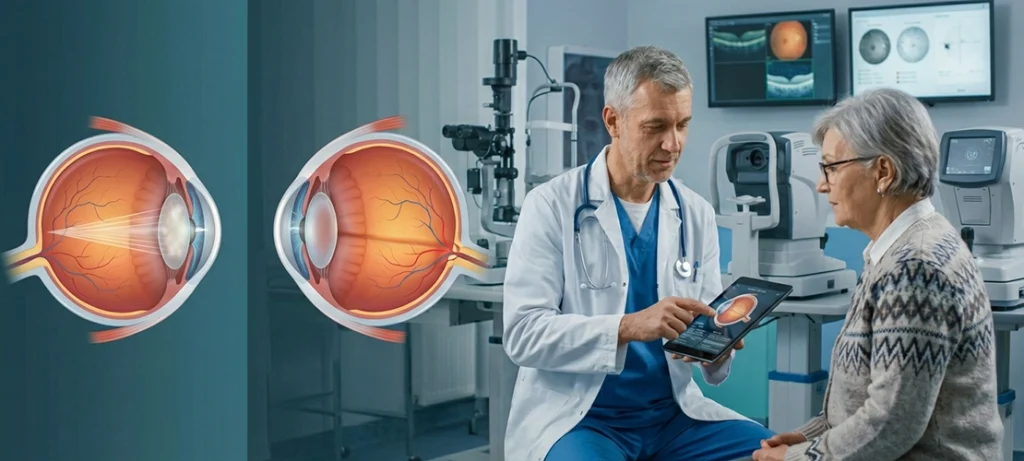
A full eye exam is performed to determine what is causing vision changes which may be due to cataract, glaucoma or both. For cataracts we check visual acuity and use a slit lamp to look at the lens. For glaucoma the doctor will measure intraocular pressure, look at the optic nerve, evaluate the drainage angle if required, also we may suggest visual field testing or OCT scans.
In the topic of glaucoma vs cataracts it is known that diagnosis is not found only in symptom reports. Some patients with advanced cataracts may also have glaucoma which is present behind the cloudy lens. Also we see that in early glaucoma patients may have almost normal vision. That is why at ASG Eye Hospital we recommend regular eye exams for people over 40, diabetics, those with a family history of glaucoma, and patients which already have cataracts.
Treatment for Cataracts
Cataract treatment based on the degree to which the cloudy lens is affecting daily life. In early stages better lighting, updated glasses and glare protection may help. Once cataract begins to interfere with reading, driving, work, or routine tasks, cataract surgery is the only proven treatment. During cataract surgery the cloudy lens is removed and an artificial lens is put in.
The difference between glaucoma and cataract is very important during treatment planning. Cataract surgery aims to improve vision by clearing the visual pathway. Glaucoma treatment aims to protect the optic nerve from further damage. When both conditions are present, the doctor may plan cataract surgery alone or combine it with a glaucoma procedure, depending on the stage of disease and eye pressure control.
Treatment for Glaucoma
Glaucoma treatment is aimed at reducing eye pressure and preserving the optic nerve. This may include the use of prescription eye drops, laser procedures, regular check ups and in some cases glaucoma surgery. We do not see a reversal of present damage as a goal but we do try to prevent that which is yet to happen.
This is what we see with glaucoma vs cataracts. Many patients expect that any eye issue will improve post surgery, which isn’t the case for glaucoma. If damage to the optic nerve is present, we can use glaucoma treatment to maintain what vision is left, we just can’t restore what is lost. In very late stage or out of control cases of glaucoma surgery which is to create a better outflow path and to reduce intraocular pressure.
Which Is More Serious: Cataract or Glaucoma?
Both have medical interventions available, but which do to a greater extent is glaucoma which may lead to permanent vision loss if left undetected and untreated. Cataracts also greatly reduce the quality of health in which a person is living but with which we can improve vision through surgery. Once at an advanced stage glaucoma will very much put a dent in one’s independence and daily functions.
The difference between glaucoma and cataract should be clearly defined to patients as they present different outcomes from delay. With cataract delayed, vision may deteriorate as well as the surgery become a greater issue at a later time, but with glaucoma treatment delayed we see permanent nerve damage. In this regard glaucoma vs cataracts not that the former is more serious in name but rather that it may quietly rob you of your sight.
Eye Care at ASG Eye Hospital
At our ASG Eye Hospital we see patients who have reported blurred vision, light sensitivity, high eye pressure or who may be at early stages of optic nerve damage. Our team performs in depth eye exams to determine if the issue is due to cataracts, glaucoma or a mix of the two. It does matter that we identify the exact cause of vision loss which in turn helps us to design the best possible treatment plan for each patient.
For that which eye issue we are to put in comparison, glaucoma vs cataracts, at ASG Eye Hospital we do diagnoses, cataract surgery, glaucoma treatment, and glaucoma surgery and which ever we present best we also will do glaucoma surgery. The doctor will suggest cataract surgery, long term pressure control for glaucoma, or a mixed approach if both are present. We are focused always on what is best for the patient’s vision, which is to improve clarity where we can and to prevent that which is avoidable vision loss.
Key Takeaway
The simple way to understand glaucoma vs cataracts is this: Cataract is the issue of the lens, while glaucoma is of the optic nerve. In most cases we see cataracts cause cloudy vision which is in large part treated by cataract surgery. Glaucoma at early stages may present no symptoms but should be of concern as it is to cause permanent vision loss without proper treatment.
The course of treatment for glaucoma vs cataracts is also different, out of which the difference between glaucoma and cataract care we see to it that we restore clarity which may have been lost and in glaucoma we focus on what we can do to preserve what vision is left. If you have blurred vision, light sensitivity, high eye pressure reports, side vision loss, or a family past of glaucoma, a full eye exam is key in early detection.
Frequently Asked Questions
1 What is the main difference between cataract and glaucoma?
The main difference between glaucoma and cataract In terms of what they affect in the eye, glaucoma and cataract are different. Cataract goes after the lens of the eye which in turn causes what may be described as cloudy or blurred vision and that issue is usually put right with cataract surgery. Glaucoma on the other hand affects the optic nerve and also leads to damage which we see in terms of progressive vision loss which is what the ongoing glaucoma treatment is aimed at preventing.
2 Which is more dangerous, glaucoma or cataract?
When comparing the two conditions, glaucoma is in fact more dangerous as it causes permanent vision loss before any symptoms present. Cataracts may cause very poor vision, but also very often vision improvement is seen with surgery. Early diagnosis and regular treatment is key in glaucoma as once optic nerve function is lost it usually does not return.
3 Can cataracts turn into glaucoma?
Cataracts typically do not develop into glaucoma. What we see is that while there may be cases where cataracts may cause raised intraocular pressure issues as they progress, both conditions also do present in the same individual at an old age. This is why the difference between glaucoma and cataract is important to have a specialist ophthalmologist determine the issue at hand as opposed to jumping to the conclusion that all vision impairment is a result of cataract.
4 Can glaucoma be cured like cataract?
No. Cataract can usually be corrected with cataract surgery, but glaucoma cannot be cured in the same way. Glaucoma treatment can control eye pressure and reduce the risk of further optic nerve damage. Some patients may need glaucoma surgery if drops or laser treatment are not enough.