Eye alignment is at the core of what enables us to see clearly and comfortably. When the eyes do not properly align and direct themselves in different directions the condition is called strabismus or squint. Early diagnosis is of great importance because left untreated eye misalignment may impair vision development, depth perception and total visual function.
Of the basic and very common methods used for the detection of eye misalignment the Hirschberg test is preeminent. This clinical assessment which is very simple and very basic helps eye care professionals to determine if the eyes are working well together and also if in depth investigation is required.
The Hirschberg test is used in large scale in both the pediatric and adult populations, in particular when strabismus is suspected. Also because it is a non-invasive, pain free and easy Hirschberg test procedure it is very much the first test performed in an eye assessment.
What Is the Hirschberg Test?
The Hirschberg test is a very basic eye alignment assessment which looks at the location of the light reflex on the cornea. By which eye the light reflects off of in each eye the ophthalmologist is able to tell if the eyes are properly aligned.
The Hirschberg test was put together by German ophthalmologist Julius Hirschberg and still is a very important element in modern eye care. In the Hirschberg test a small light is shone at the patient’s eyes as they look at a target. If the eyes are aligned right you will see the light reflect in the same spot in each pupil.
Any difference in the reflection indicates strabismus or some other eye alignment issue. Also because of its ease of use the Hirschberg test is very popular in pediatrics where we may have a hard time getting young children to participate in more in-depth exams.
Why Is the Hirschberg Test Important?
The Hirschberg test is a good screening device for identification of eye misalignment at an early stage.
Early diagnosis of strabismus is important as untreated eye deviation may cause:
- Amblyopia (lazy eye)
- Reduced depth perception
- Difficulty with binocular vision
- Visual development problems in children
- Eye strain and visual discomfort
Hirschberg test is a quick tool which ophthalmologists use to identify alignment problems in eyes also to determine if more in depth tests or squint treatment is needed.
How Does the Hirschberg Test Work?
In that which the Hirschberg test is based on is simple. We shine light into the eye and what we see is a small reflection on the cornea.
In a person with normal eye alignment:
- The corneal light reflex appears symmetrical.
- The reflection is located at approximately the same position in both eyes.
In a person with strabismus:
- The corneal reflex appears displaced in one eye.
- The position of the reflex helps estimate the degree of eye deviation.
The Hirschberg test reports which direction an eye is turning in, out, up, down.
Hirschberg Test Procedure: Step-by-Step Guide
The Hirschberg test procedure is quick and painless, typically taking only a few minutes.
Step 1: Patient Positioning
The patient is seated comfortably and asked to focus on a distant target or directly at a light source.
Step 2: Light Source Examination
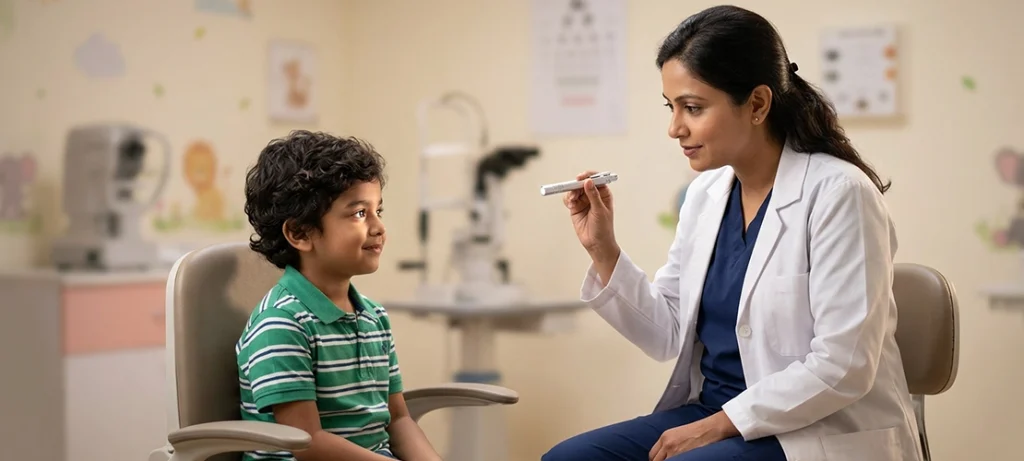
The examiner shines a penlight toward the patient’s eyes from approximately 50–100 centimeters away.
Step 3: Observation of Corneal Reflex
During the Hirschberg test procedure, the ophthalmologist carefully observes the position of the light reflection on both corneas.
Step 4: Comparison of Reflex Position
The location of the reflections is compared between the two eyes.
Step 5: Interpretation
During the course of the Hirschberg test we may see asymmetry which in turn may indicate eye misalignment and which will in turn guide further evaluation. Also what is great about the Hirschberg test is that it requires minimal cooperation from the patient which makes it very useful in infants and young children.
Who Needs a Hirschberg Test?
An eye specialist may recommend a Hirschberg test for patients who show signs of eye misalignment.
Common Situations Include:
| Condition | Why the Hirschberg Test Is Used |
| Suspected strabismus | Detects eye deviation |
| Lazy eye (amblyopia) screening | Identifies associated alignment issues |
| Pediatric eye examinations | Useful for young children |
| Double vision complaints | Evaluates binocular alignment |
| Neurological conditions | Assesses ocular motor function |
The Hirschberg test is often part of routine pediatric eye care assessments.
What Can the Hirschberg Test Detect?
The Hirschberg test can help identify several forms of strabismus.
| Type of Eye Misalignment | Description |
| Esotropia | Eye turns inward |
| Exotropia | Eye turns outward |
| Hypertropia | Eye turns upward |
| Hypotropia | Eye turns downward |
Although the Hirschberg test is primarily a screening examination, it provides important clues regarding the nature and severity of the eye deviation.
Advantages of the Hirschberg Test
The Hirschberg test remains widely used because of its practical benefits.
Key Advantages
| Benefit | Explanation |
| Non-invasive | No instruments touch the eye |
| Quick | Usually completed within minutes |
| Child-friendly | Suitable for infants and toddlers |
| Cost-effective | Requires minimal equipment |
| Reliable screening tool | Useful for initial assessment |
The Hirschberg test is often the first step before recommending more advanced eye treatments for strabismus.
Limitations of the Hirschberg Test
While the Hirschberg test is highly valuable, it does have limitations.
- It provides an estimate rather than an exact measurement.
- Small deviations may require additional testing.
- Results depend on proper patient fixation.
- It should be combined with comprehensive eye examinations.
Because of these limitations, the Hirschberg test procedure is frequently followed by tests such as the cover-uncover test or prism testing when needed.
Hirschberg Test in Children
In the case of the Hirschberg test we see that children are the greatest beneficiaries.
Many young patients do not report vision issues well.
What the Hirschberg test does is it allows eye specialists to identify eye alignment issues which in turn may be at the base of vision development problems.
In today’s practice of pediatrics which includes ophthalmology, early diagnosis of strabismus has great improvement in terms of results. The Hirschberg test also is very useful in infancy and preschool years which are the most critical for visual development.
What Happens After an Abnormal Hirschberg Test?
An abnormal Hirschberg test does not automatically mean a serious eye condition is present. However, it does indicate that further evaluation may be necessary.
Additional investigations may include:
- Cover test
- Alternate cover test
- Prism measurements
- Visual acuity testing
- Dilated eye examination
Depending on the findings, the ophthalmologist may recommend squint eye treatment options such as glasses, vision therapy, patching, or surgery.
Eye Alignment Evaluation at ASG Eye Hospital
At ASG Eye Hospital we provide in depth strabismus evaluation that includes our state of the art diagnostic tools along with the Hirschberg test.
Our specialists have at their disposal modern diagnostic equipment which they use to check eye alignment in both pediatric and adult patients.
Through early detection which is a result of these exams we are able to put together very personalized treatment plans which in turn improve the patient’s long term visual results.
It may be that a patient will require close observation, corrective wear, or advanced squint treatment but what we find key is that timely diagnosis which in the end proves to be the basis of successful care.
Key Takeaways
| Point | Summary |
| Purpose | The Hirschberg test evaluates eye alignment |
| Method | Uses corneal light reflex assessment |
| Suitable For | Children and adults |
| Benefits | Quick, painless, and non-invasive |
| Next Steps | May lead to further testing and treatment |
The Hirschberg test continues to be one of the most effective initial screening tools for identifying strabismus and guiding appropriate eye treatments.
Frequently Asked Questions
1. What is the Hirschberg test used for?
The Hirschberg test is done to check eye alignment and identify strabismus which is done by looking at the position of the corneal light reflex.
2. Is the Hirschberg test painful?
No. The Hirschberg test procedure is free of pain and is not invasive.
3. How accurate is the Hirschberg test?
The Hirschberg test is great as a screening tool although in depth assessment may be required for precise results.
4. Can the Hirschberg test be performed on infants?
Yes. The Hirschberg test is a common tool in pediatric ophthalmic care as it requires little cooperation.
5. What happens if the Hirschberg test result is abnormal?
An abnormal result may point to strabismus or another alignment issue which will require more in depth evaluation and possible treatment of the squint.
6. How long does the Hirschberg test procedure take?
The Hirschberg test procedure usually lasts only a few minutes which is also done within a routine eye exam.