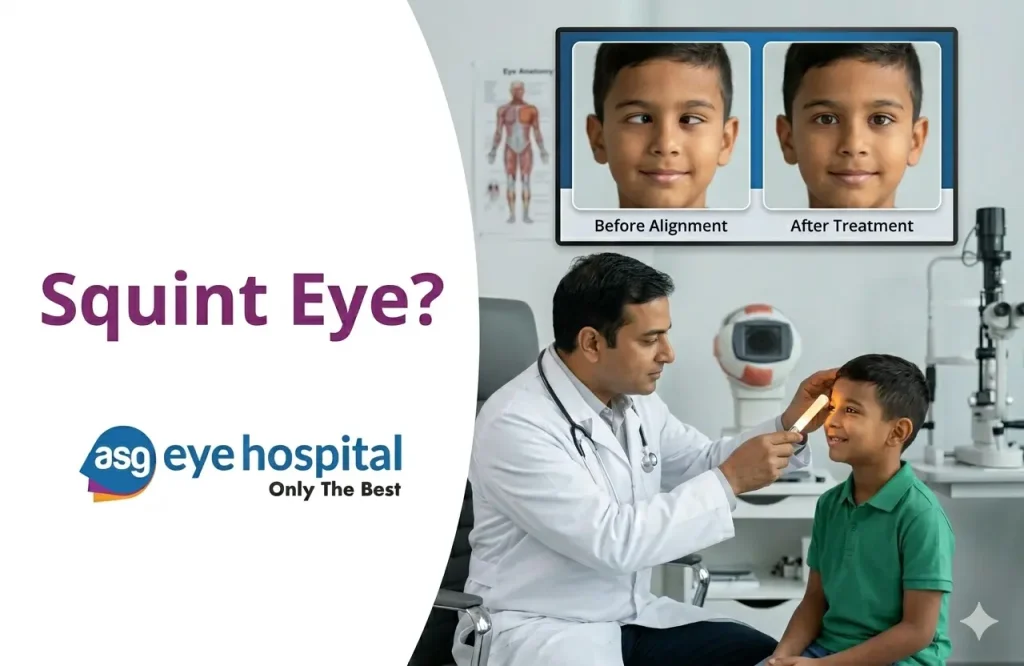
Squint eye, medically called strabismus, is a condition where the two eyes do not point in the same direction. One eye may turn inward, outward, upward, or downward while the other looks straight. It affects approximately 4% of the population and is among the most common eye conditions in children, though adults develop it too.
The concern with strabismus goes beyond appearance. In children, unaddressed eye misalignment can cause amblyopia -reduced vision in the misaligned eye -during the critical years of visual development. In adults, it causes double vision, eye strain, and difficulty with driving, reading, and depth perception.
Squint Eye Causes: What Drives the Misalignment
Eye alignment depends on six muscles attached to each eye working together under precise nervous system control. Strabismus arises when this balance breaks down. The most common causes include:
- Refractive error -particularly significant long-sightedness (hyperopia) in children, where the extra focusing effort required can cause one eye to turn inward. Correcting the refractive error with glasses can sometimes resolve the squint entirely.
- Muscle imbalance -weakness or tightness in one or more extraocular muscles causes the eye to deviate. This can be present from birth (congenital) or develop later.
- Neurological conditions -squint in adults is frequently caused by neurological events, including stroke, cranial nerve palsy, head trauma, or conditions such as thyroid eye disease and myasthenia gravis.
- Family history -strabismus has a genetic component; a close family member with squint increases the risk.
- Premature birth or low birth weight is associated with higher rates of strabismus and amblyopia.
Is squint eye always visible?
No. Some forms of strabismus are intermittent and only apparent when the child is tired, unwell, or concentrating on something. Others are small-angle deviations that are subtle. Both forms require assessment and treatment.
Strabismus Symptoms in Children and Adults
In children, the most noticeable signs are a visible turn in one or both eyes, squinting or closing one eye in bright light, tilting the head to see comfortably, and difficulty with depth perception. Children rarely report double vision -the brain suppresses the misaligned eye’s image, which is how amblyopia develops silently.
In adults, strabismus typically presents with double vision (diplopia), eye strain and headaches, difficulty reading or working on screens, and an awareness of misalignment. Adults who develop crossed eyes after a neurological event need urgent evaluation to identify the underlying cause.
Squint Eye Treatment Options
Squint eye treatment depends on the cause, the direction and degree of misalignment, the age of the patient, and whether amblyopia is present. The goal is not only cosmetic -it is to restore or preserve binocular vision and depth perception.
Glasses: When refractive error is the primary driver, corrective glasses alone can straighten the eyes in a significant proportion of children. This is typically the first intervention and must be tried before surgery is considered.
Patching and penalisation: when amblyopia has developed in the weaker eye, the stronger eye is patched or blurred with drops to force the brain to use the amblyopic eye. This improves vision in the weaker eye and is most effective in younger children.
Prism glasses: prisms in the lenses bend light to compensate for the angle of misalignment, relieving double vision. They are useful for small-angle strabismus in adults and as a temporising measure while awaiting surgery.
Squint surgery: when non-surgical measures are insufficient, surgery on the extraocular muscles corrects the eye misalignment directly. The surgeon loosens, tightens, or repositions one or more muscles to change the eye’s resting position. It is performed under general anaesthesia in children. In adults, squint surgery restores binocular vision, expands peripheral visual fields, and improves quality of life -its benefits are functional, not only cosmetic.
Also read: Squint Eye Treatment: Procedure, Recovery & Cost Guide
When a Squint Needs Urgent Assessment
Any persistent squint in a child -even a subtle one -needs prompt assessment. The window for treating amblyopia is narrow: visual development is largely complete by age seven to eight, and patching becomes progressively less effective after that. A childhood squint should not be watched and waited.
In adults, new-onset strabismus or sudden onset of double vision needs urgent neurological and ophthalmological evaluation to exclude stroke, intracranial aneurysm, tumour, or cranial nerve palsy. These cannot be assumed to be benign.
Final Thoughts on Squint Eye and Strabismus Treatment
Squint eye is common, and outcomes from treatment are good when intervention happens early. In children, early correction preserves vision. When surgery is needed, the results restore binocular function, improve depth perception, and address the meaningful psychosocial impact of misaligned eyes.
ASG Eye Hospital, with centres in Indore, Lucknow, Varanasi, Kanpur, and more, has dedicated paediatric ophthalmologists and strabismus specialists at each centre. Both surgical and non-surgical squint eye treatment options are available. Assessment for any suspected squint -in a child or an adult -can be arranged at the nearest ASG centre.
FAQs
1. At what age should squint eye be treated?
As early as possible. The visual system is most responsive to treatment before age seven or eight. A squint noticed in a young child should be assessed promptly -not watched to see if it improves.
2. Can squint eye be corrected without surgery?
Yes, in many cases. Glasses correct squint driven by refractive error. Patching treats the associated amblyopia. Prisms manage double vision in adults. Surgery is needed when these measures are insufficient or when the angle of deviation is large.
3. Is squint surgery safe for children?
Yes. Squint surgery is one of the most commonly performed paediatric eye operations and has a strong safety record. It is typically done under general anaesthesia, and most children return to normal activity within a day or two.
4. Can adults have squint surgery?
Yes. Squint surgery is effective and increasingly performed in adults. The goals are functional -to restore binocular vision, eliminate double vision, expand visual fields, and improve quality of life -as well as cosmetic.
5. What is the difference between strabismus and amblyopia?
Strabismus is the misalignment of the eyes. Amblyopia is reduced vision in one eye that develops when the brain suppresses it due to strabismus or another cause. They are related but different: strabismus can cause amblyopia, and both may need separate treatment.
6. Squint eye (strabismus) kya hota hai?
Squint eye ek condition hai jisme dono aankhen ek direction me focus nahi karti. Ek eye seedhi hoti hai aur dusri andar, bahar ya upar-niche turn ho sakti hai.
7. Kya squint eye bachchon me dangerous ho sakta hai?
Haan, agar time par treatment na mile to ye lazy eye (amblyopia) aur permanent vision loss ka reason ban sakta hai.
8. Squint eye ke early signs kya hote hain?
Aankhon ka misalignment, ek eye band karna, head tilt karna, ya bright light me discomfort common early signs hain
9. Kya squint eye bina surgery theek ho sakta hai?
Haan, kai cases me glasses, patching ya prism se treatment ho sakta hai. Surgery tab hoti hai jab condition severe ho.
10. Squint eye ka treatment kab shuru karna chahiye?
Jitna jaldi ho sake utna better hai. Early treatment se vision loss ka risk kam hota hai aur results bhi better milte hain.