Is it really an improvement over routine LASIK, or is it just a repackaged version of the same process? That depends on the person’s degree of eye power, corneal shape, lifestyle requirements, and what they hope to achieve post surgery.
Traditional LASIK changes the prescription in your glasses by reshaping the cornea. Contoura Lasik takes it a step further in that it studies the unique surface topography of the cornea and designs very personal treatment plans. We aim not only to reduce your dependence on specs but also to improve the quality, sharpness and comfort of vision in which the eye is a good candidate.
What Is This Advanced Procedure?
Contoura LASIK is a highly advanced laser corrective eye procedure that first performs a detailed analysis of the cornea. The cornea is the clear outer surface of the eye which at what may appear to be a healthy level may in fact have very small scale imperfections. These little defects at times do affect sharpness, contrast, glare, halos, and night vision.
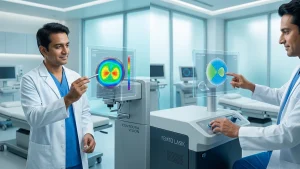
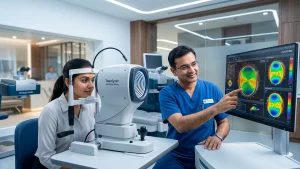
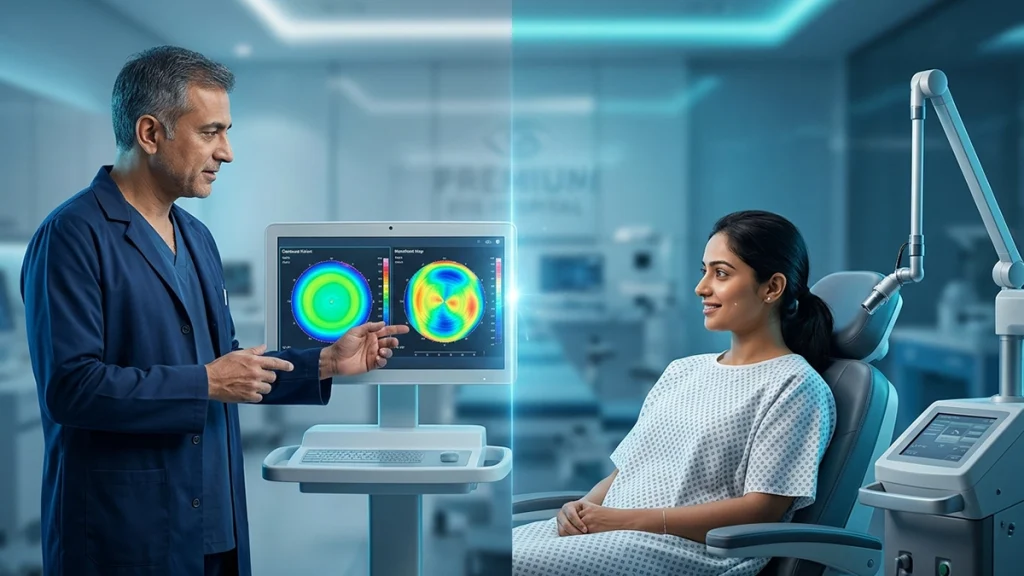
In the case of Contoura Lasik the eye is scanned with special equipment which produces in depth data of the cornea’s surface. That info is then used to tailor the laser treatment. Also for this reason Contoura Vision is a choice for patients which desire a more precise approach than what is offered by standard LASIK and also in cases where the patient’s corneal shape and eye health are best suited for this procedure.
It is very much so that we present to you that this treatment does not suit all that are seeking to be free of their glasses. As with any refractive procedure what we do is a full evaluation which includes corneal thickness, corneal topography, tear film health, pupil size, prescription stability, and retinal exam. At a specialized eye hospital we do not go by power alone; we study the total picture of the eye before we make a decision.
How Is It Different from Traditional LASIK?
In terms of what different traditional LASIK and Contoura Lasik have is that personalization. With Standard LASIK we see mainly correction of refractive errors like myopia, hyperopia, and astigmatism. In other words it is focused on the numbers in your glasses. As for Contoura Lasik, which instead looks at the fine scale surface irregularities of the cornea which basic LASIK may not correct.
This is the role of Topography-Guided LASIK. It uses the corneal map as a guide which in turn allows the surgeon to plan treatment according to the individual shape of the cornea. For the right candidate this may support better visual clarity and improved contrast sensitivity.
| Feature | Traditional LASIK | Contoura Lasik |
| Main focus | Corrects spectacle power | Corrects spectacle power and corneal surface irregularities |
| Planning method | Based mainly on refractive error | Based on refractive error and detailed corneal topography |
| Visual quality goal | Clear distance vision | Clearer, sharper, and more customised vision |
| Technology type | Standard laser reshaping | Corneal-map-based laser planning |
| Best suited for | Suitable candidates with regular corneas | Suitable candidates who need more personalised correction |
Both these procedures are types of Laser Vision Correction and they do very well when the patient is a proper candidate. But what Contoura Lasik may have to offer is a benefit in certain eyes as it customizes treatment of the cornea.
How Does the Procedure Work?
The first step is a thorough pre-operative evaluation. Your doctor will test your eye power, corneal thickness, dry eye status, pupil size, and retina. We also do a corneal topography which creates a detailed map of the corneal surface. This scan is what sets Contoura Lasik apart from traditional LASIK.
On the day of the procedure an anesthetic is put into the eye. A thin corneal flap is created which is similar to in LASIK we do that and the laser treatment is done as per the planned correction. The flap is then put back in place which tends to settle in.
Most of the time patients are awake for the procedure and usually what they feel is pressure not pain. After Contoura LASIK vision often improves right away, that said we may see some mild watering, light sensitivity, dryness, or a foreign body sensation which is temporary. Follow up visits are very important; they in fact allow the doctor to check on the healing, dryness and visual stability.
Benefits of Advanced LASIK Treatment
The primary benefit of Contoura LASIK is that it provides for better and more precise visual quality in appropriate patients. Many people are not just interested in reading the smallest letter on the chart; they want comfortable vision for computers, while driving, in outdoor work, at night while traveling, and for daily activities. This is the reason for a custom designed procedure.
Because of the use of corneal mapping in the treatment we are able to address very fine surface defects which in turn may improve visual quality. For some patients this may result in better contrast, reduced glare, and improved results post op. At the same time it is important to note that results still depend on eye health, surgeon’s experience, the technology used, healing response and proper post op care.
| Benefit | Why It Matters for Patients |
| Personalised correction | Treatment is planned according to the patient’s corneal map |
| Better visual quality potential | May improve sharpness, clarity, and contrast in suitable eyes |
| Advanced planning | Uses detailed surface data before laser reshaping |
| Useful for selected irregularities | May help when minor corneal surface variations are present |
| Reduced spectacle dependence | Like LASIK, the goal is to reduce the need for glasses or contact lenses |
This process is not a shortcut or a perfect vision solution. We have an advanced tool here which does produce best results when the right technology is put to use for the right patient. In some cases of unstable power, unhealthy cornea, severe dry eye, thin cornea or certain retinal conditions that patient may not be a good fit for this treatment.
Who Should Consider This Procedure?
A large group of patients that do well with Contoura Lasik are adults which report stable prescription, have sufficient corneal thickness, healthy tear film, and no present eye disease which may interfere with the healing process or visual results. It may be used for myopia, astigmatism, and in some cases corneal surface irregularities at the doctor’s discretion.
People who work at computers for many hours, drive a great deal, or are looking for high quality unaided vision may go to their eye doctor to ask if this treatment is for them. But the response should always be after a full eye exam. Also at times standard LASIK, SMILE, PRK or some other refractive option may be better suited.
For in the patient population which is evaluating advanced LASIK options the primary question should be not “Which is the latest? but “Which is the safe and best fit for my eyes? A responsible surgeon will go over the benefits, risks, expected results, side effects and recovery plan in detail before putting forth any recommendation.
Who May Not Be Suitable?
Not all patients are good candidates for Contoura Lasik. Patients with thin corneas, keratoconus, unstable prescriptions, uncontrolled dry eye, active eye infections, severe allergic eye issues, uncontrolled diabetes, pregnancy related power changes, or unrealistic expectations may be told they are not good candidates for the procedure or asked to wait until the eye condition is stable.
The FDA and National Eye Institute report that it is of great importance to properly evaluate patients and to inform them of the benefits, risks, and limitations before they undergo LASIK. That which we present also applies to more advanced procedures. It is a health care decision not a cosmetic solution which we rush into, and it must be a very careful process.
Recovery After the Procedure
Recovery from Contoura LASIK is that which is fast for the great majority of suitable patients. Within a day or two many see much clearer and sharper vision but the eyes do take a few weeks to fully adjust. At first some may experience dryness, glare, light sensitivity, or that vision which is a little variable which is a normal part of the healing process. We manage these issues with the use of prescription eye drops and follow up care.
Patients are generally told that they should not rub the eyes, to avoid swimming for a few days, also to use the prescribed eye drops which may have been given and to present at the follow up appointments. Gradual return to screen use as per how the patient feels is seen to be the best in the first few days frequent blinking and use of lubricating drops are also recommended.
The results of the procedure are not only a function of the laser. We see post operative care as very much a key element. As for dryness, dropping out of the treatment, or missing follow up appointments which are a must do this is what can impact comfort and which also affects recovery. That is to say that we put the same importance in the pre chosen center’s post intervention program as to the initial procedure.
Is It Better Than LASIK?
For some patients Contoura Lasik may present a more tailored and refined solution as compared to traditional LASIK. It is also useful when the doctor wants to go beyond correction of the eye power and address fine scale irregularities of the cornea. That said, what may be a better option for some is not necessarily the best choice for all.
Traditional LASIK is still a proven and effective choice for many patients. In Topography-Guided LASIK we add another level of treatment plan but in the end the decision is based on corneal health, prescription, lifestyle and safety. A patient with a simple prescription and healthy cornea may do very well with standard LASIK, while another may benefit more from the advanced mapping which is used in Contoura Vision.
The best approach is to have a full refractive workup. From there your surgeon can discuss with you which option is best for your eyes that may be standard LASIK, SMILE, PRK or some other choice. The aim should always be safe, stable and comfortable vision, not just the latest procedure.
Advanced LASIK at ASG Eye Care
At ASG Eye Care our choice of Contoura Lasik is based on in depth evaluation and counseling. We look at the patient’s spectacle power, corneal thickness, corneal topography, eye surface health, and in general the state of the eyes. This is to determine if the patient is a right candidate and if we can achieve the visual results expected.
Patients are walked through the full process from prep, through the procedure itself, recovery, possible side effects, to long term results. At ASG Eye Hospital we do patient specific decision making which is key as each cornea is unique and also each patient’s vision requirements are different.
If the time is right we go over the treatment plan in detail. Should another type of Laser Vision Correction be a better option we bring that to the table as well. We don’t just present the latest technology out there, we look to put our patients in the best care for their eyes.
Key Takeaway
Contoura LASIK is an advanced personalized version of LASIK which uses detailed corneal mapping to guide the treatment. It may provide better visual results in certain patients which we have determined through careful analysis especially when there is issue of fine scale corneal surface irregularities. Also it is not for all and does not suit all eyes.
The best strategy is to see an experienced refractive surgeon, get the required scans, weigh the risks and benefits, and at the end pick the safest option. As for which it is — LASIK, PRK, SMILE or some other procedure which is put forth the aim should always be to achieve long term visual comfort and eye safety.
Frequently Asked Questions
1. Is this procedure better than normal LASIK?
It may work best for some patients as we use a detailed map of the cornea to customize the laser treatment. It may help to improve visual sharpness and quality in appropriate eyes. At the same time, traditional LASIK is still very effective for many patients, and which is better is a matter of your corneal health and eye power.
2. What is the difference between Contoura Vision and LASIK?
Contoura Vision is an advanced form of LASIK that uses topography-based planning. Standard LASIK mainly corrects the spectacle number, while this method also studies the corneal surface pattern and guides the laser accordingly.
3. Is Topography-Guided LASIK safe?
This procedure is safe for appropriate candidates which we see when they’ve had a thorough pre op evaluation by a very experienced ophthalmic surgeon. Like all laser eye surgeries this one does have side effects of dry eye, light sensitivity, halos and in some cases under treatment, which is why we are so particular about how we choose our patients.
4. Who is not suitable for this treatment?
Patients that have thin corneas, unstable power, keratoconus, severe dry eye, active eye infection, uncontrolled health issues, or unrealistic expectations may not be suitable. We require a detailed eye exam before we decide.
5. Is Laser Vision Correction permanent?
The process which is permanent also affects the cornea, but as we age we may see natural eye changes also. At reading age presbyopia may set in and also at a later date some people may require more eye care for other issues.
6. How long does recovery take?
Most of our patients see an improvement within a day or two but full comfort and stability may take a few weeks. We prescribe drops, ask that you avoid rubbing your eyes and that you attend all follow up visits which support smooth recovery.