Glaucoma is labeled as a silent eye disease for it begins slowly and may at first present no symptoms at all. By the time many people are aware there is a problem some nerve damage may have already occurred. We treat it to prevent further vision loss rather than to restore what has been lost. That is why it is so important to catch and treat this disease at the right time.
Many of my patients put forth the question of which is better between glaucoma surgery and laser treatment. Also, they want to know if they should continue with the eye drops for many years which in turn leaves no room for the said procedure. What we find is that the answer to this is based on what type of glaucoma it is, the level of intraocular pressure, stage of optic nerve damage, the patient’s age, general health, and how the eye responded to former treatments. In short we use both laser and traditional methods which do very well but they are for different scenarios.
Understanding Glaucoma and Why Treatment Is Needed
Glaucoma which results in damage to the optic nerve usually is a result of eye pressure that is higher than what the nerve can safely bear. Eye pressure increases when the internal fluid of the eye does not drain well. We treat by improving fluid outflow, reducing fluid production, or we create a new drainage path which in turn exposes the nerve to less pressure over time.
In the early to moderate stages of open angle glaucoma doctors may start out with eye drops or laser glaucoma treatment. In more advanced stages, or when pressure does not respond to medications and lasers, we may recommend glaucoma surgery. The aim of each treatment is to achieve long term pressure control and protection of the optic nerve and not a short term drop in numbers.
What Is Laser Treatment for Glaucoma?
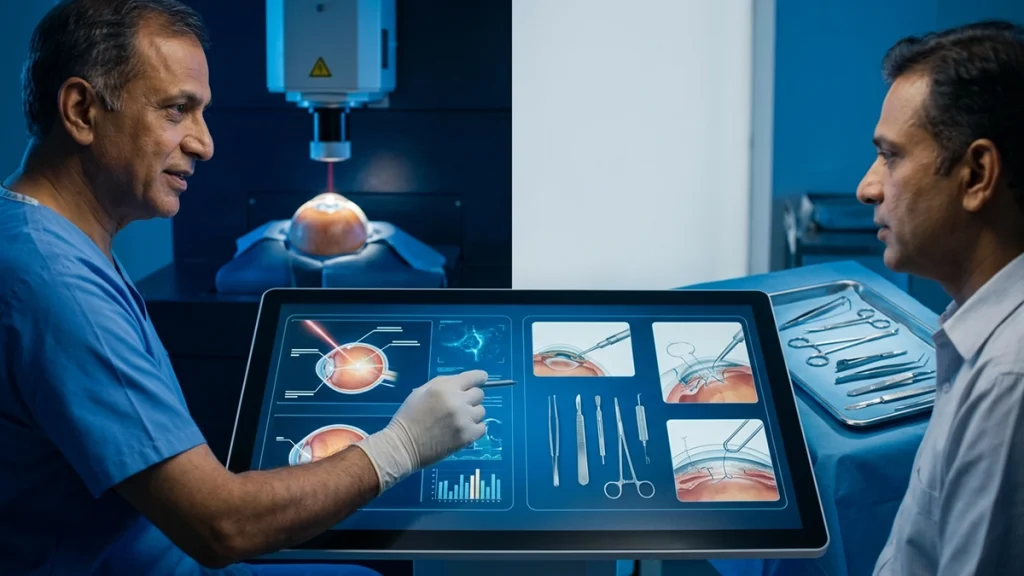
Laser treatment is a very precise, non-invasive procedure which helps to improve flow of fluid in the eye or opens a blocked passageway based on what type of glaucoma is present. In open angle glaucoma we see that selective laser trabeculoplasty is the common approach which is used to zero in on the eye’s drain and to help fluid pass through more easily. In the case of angle closure risk we may perform laser peripheral iridotomy which is to make a small hole in the iris which in turn allows for better movement of fluid within the eye.
For many patients laser glaucoma treatment is a very appealing option which is performed as an outpatient procedure, of short duration, and which does not require a large incision. It may put an end to the use of many eye drops although some people do still require medication post procedure. This is the reason why glaucoma laser surgery is put forth as a middle ground between eye drop use and traditional in-operations procedures.
What Is Traditional Glaucoma Surgery?
Traditional glaucoma surgery includes procedures like trabeculectomy, glaucoma drainage implants, or other filtering surgeries which create a new outflow path for fluid in the eye. These interventions we usually turn to when eye pressure is resistant to control with the use of drops, laser, or less invasive options
A standard glaucoma procedure is a more complex process than laser treatment. It is usually done in the operating room, requires more post op care, and has close follow up to monitor healing, pressure changes, infection risk, and the function of the new drainage pathway. Also in the case of advanced glaucoma or very high eye pressure glaucoma surgery does not do as well a job as a stand alone laser.
Laser vs Traditional Glaucoma Surgery: Main Differences
Both of these treatments work but they are not the same. In the early stages of the disease, in which the patient is experiencing drops or is a candidate for a less invasive option, we see the laser treatment as a preferred choice. For greater and more constant results which only traditional glaucoma surgery can provide, that is what we will put forward.
| Factor | Laser Treatment | Traditional Surgery |
| Procedure type | Non-cutting laser procedure | Incisional surgical procedure |
| Common examples | SLT, laser peripheral iridotomy | Trabeculectomy, tube shunt surgery |
| Usual setting | Outpatient laser room | Operation theatre |
| Recovery | Usually quick, with mild irritation | Longer recovery with closer follow-up |
| Pressure-lowering effect | Mild to moderate in many cases | Often stronger in advanced cases |
| Best suited for | Early to moderate glaucoma or selected angle problems | Advanced glaucoma or uncontrolled pressure |
| Need for drops after treatment | May reduce drops but may not stop them completely | May reduce or stop drops in some patients |
In many cases the table shows that glaucoma surgery and laser treatment should not be put forward as alternatives. In others, delay in treatment may cause more damage to the optic nerve which in turn makes traditional procedure the better choice in the long term.
Which Treatment Gives Better Results?
The best results we see in terms of safety and sustainability are which achieve the target eye pressure and maintain it over time. In the case of early open angle glaucoma, laser glaucoma treatment does very well and we see that particularly at the stage of the disease they are appropriate. Also it may reduce the use of daily eye drops and improve patient compliance which in turn may be a solution for those that have issues with medication memory or which develop side effects.
Traditional glaucoma surgery reports to do a better job at pressure reduction in advanced glaucoma, rapidly progressing disease, or what has not responded well to drops and laser. Results may be more dramatic but the procedure also requires more healing time and more careful follow up. That said it would be a misstatement to say one treatment is always better than the other. What is right for the eye in question is what counts.
When Laser May Be the Better Choice
Laser is a good choice for glaucoma that is mild to moderate in which the drainage angle is open and also when the patient has trouble with eye drop regimens. Also at times the doctor may want to use it as a first choice procedure instead of going right to a more invasive operation. Glaucoma laser surgery is also useful when the goal is to improve pressure control while keeping recovery simple.
Patients which are elderly, have many health issues, or are unable to make it to post-operative visits may at times see benefit from laser which we use first. But the results of the laser may wear off in some cases and some patients may require repeat procedures, eye drops, or even glaucoma surgery.
When Traditional Surgery May Be the Better Choice
Traditionally at which point of advanced glaucoma surgery, very high eye pressure, worsening vision despite treatment, or the optic nerve requires a lower pressure than what laser can achieve, we may turn to surgery. Also it may be put forward if the patient is on many medications and still not achieving safe pressure.
A traditional glaucoma operation may be very effective but the patient must know that follow up is of great importance. The surgeon has to watch over the post op site, pressure levels, healing response, and also for any signs of infection or inflammation. For good results we also see to it that post op care is done very well.
Benefits and Limitations of Each Option
| Treatment Option | Benefits | Limitations |
| Laser treatment | Quick procedure, usually less invasive, faster recovery, may reduce drop burden | Effect may reduce with time, may not lower pressure enough in advanced disease |
| Traditional surgery | Stronger pressure reduction, useful in advanced glaucoma, may reduce need for drops | Longer recovery, more follow-up, higher surgical risk than laser |
| Eye drops with monitoring | Non-surgical, useful in early cases, easy to adjust | Requires daily compliance, side effects possible, may not be enough long term |
| Combined approach | Allows stepwise care based on disease stage | Requires regular monitoring and patient cooperation |
In truth we do not see patients tied to a regimen of laser or surgery for life. Most patients progress through stages of glaucoma management which may begin with drop use, then laser, and eventually surgery if required. The doctor’s role is to choose the which is the most safe step before we lose more vision.
Recovery and Aftercare
Recovery from laser procedures is usually quick. Some patients may experience mild redness, irritation, light sensitivity, or what is termed as transient pressure changes. We may prescribe eye drops for a few days and will check your eye pressure post procedure. You will be back to normal activities in a short while as your doctor advises.
Recovery post glaucoma surgery is a more in depth process. Patients may have to use of antibiotics and steroids, follow certain activities’ restrictions, have repeat pressure checks and do in office visits to see how the healing is going. Also vision may present as blurry for a while after the surgery which also is a normal part of the healing process. This is not a sign of a failed procedure, the eye is just going through a more extensive repair.
Can Laser Replace Traditional Surgery?
In some patients we see that laser treatment puts off or lessens the need for conventional glaucoma surgery, in particular at the early signs of glaucoma. At the same time though laser does not play the role of the primary treatment in each case. When the optic nerve is damaged beyond repair, or the pressure within the eye remains high, other approaches are used.
That is why routine exams are important. Pressure of the eye is not the only thing which we look at, our doctors also do a look at the look of your optic nerve, how visual fields are changing, cornea thickness, drainage angle, and perform retinal nerve fibre layer scans.These details help decide whether glaucoma laser surgery is enough or whether a more definitive operation is needed.
Glaucoma Treatment at ASG Eye Care
At ASG Eye Care we base our treatment decisions on the stage of glaucoma, the pressure target, health of the optic nerve, and what will best meet the patient’s daily life needs. We are focused on creating a care plan which will protect vision in the long term as opposed to just choosing the quickest solution.
For some patients laser treatment may play an early role. In the case of more severe damage or uncontrolled pressure, glaucoma surgery may provide better protection. ASG Eye Care focuses on careful diagnosis, clear counselling, advanced surgical planning, and continued follow-up because glaucoma management requires lifelong attention.
Key Takeaway
Laser and traditional glaucoma surgery play key roles. Laser is usually a less invasive option which does well in early disease stages, on the other hand traditional surgery is better for advanced or uncontrolled glaucoma. The best treatment is that which safely achieves the target pressure and protects the optic nerve in the long term.
Patients don’t put off care for with glaucoma related vision loss which is usually permanent. We see that early diagnosis, regular follow up, and timely glaucoma surgery or laser treatment when indicated does make a large difference in what we are able to preserve useful vision. Our approach to glaucoma surgery is based on disease stage, pressure target and the long term health of the optic nerve.
Frequently Asked Questions
1 Which is better: laser treatment or traditional glaucoma surgery?
There is no one size fits all solution. For early to moderate glaucoma which we aim to treat via reduction of intraocular pressure with a more minor procedure laser is a good option. For very high pressure, very advanced glaucoma surgery or after other treatments have failed traditional surgery may be the best choice.
2 Is glaucoma surgery painful?
Most of the anesthetic is used in glaucoma procedures which is to ensure that the patient does not feel pain during the glaucoma surgery. Post op you may see some discomfort, watering, redness, or blurred vision for a few days to weeks which varies by the type of procedure. Severe pain or sudden vision loss report it right away.
3 Is laser glaucoma treatment permanent?
The laser results may last for years in some patients, we should note that is not always permanent. Also some people may require repeat laser, eye drops, or at a later time glaucoma surgery if pressure increases again. Regular follow up is very important to determine if the treatment is still effective.
4 Can glaucoma be cured with surgery?
Glaucoma is not usually a curable disease but we do see that treatments which we have at present are able to slow down or prevent further damage in many cases. Glaucoma surgery lowers eye pressure to protect the optic nerve, but patients still need lifelong monitoring because glaucoma is a chronic condition.
5 When is glaucoma surgery required?
Surgery is a choice when medical treatment and lasers do not reduce eye pressure as much as enough, when the nerve in the back of the eye which carries visual info is damaged, or when we feel that delay of glaucoma surgery may cause permanent vision loss.
6 What is the role of management after surgery?
Although at the time of surgery the problem is fixed, ongoing care is a key component with pressure checks, nerve assessment, visual field testing, and adjusting medicines as necessary. While surgery is a big step, it is the long term care that really protects vision.