Most parents notice it in a photograph first. One pupil glows white instead of showing the usual red flash reflex. For most children, it turns out to be nothing. But for a small number, that one odd-looking photo is the earliest clue to retinoblastoma – the most common eye cancer found in children.
Retinoblastoma is rare, yet it remains one of the most urgent paediatric eye diagnoses in India. Early detection changes everything, both for saving the child’s life and for preserving vision.
What Is Retinoblastoma?
Retinoblastoma is a cancerous tumour that develops in the retina – the light-sensitive tissue lining the back of the eye. It almost always appears in children under five, with most cases diagnosed before age three. The cancer can affect one eye (unilateral) or, in about one in three cases, both eyes (bilateral). Globally, it occurs in roughly 1 in every 15,000 to 20,000 live births and belongs to the broader group of retina diseases that demand specialist attention from day one.
What Are Retinoblastoma Causes?
Retinoblastoma causes trace back to a single genetic problem, a mutation in the RB1 gene on chromosome 13. This gene normally keeps retinal cell growth in check. When both copies fail, retinal cells start dividing uncontrollably and a tumour forms.
There are two distinct forms:
- Hereditary retinoblastoma – around 40% of cases. The mutation is passed down or occurs at conception, appearing in every cell. These children usually develop tumours in both eyes at a younger age.
- Sporadic retinoblastoma – around 60% of cases. The mutation happens randomly in a single retinal cell during early development. Tumours are usually in one eye only, with no family history.
Genetic testing is now a standard part of diagnosis for both forms and helps guide screening for siblings.
What Are Retinoblastoma Symptoms That Parents Notice First?
The most common early warning sign is leukocoria, a white or cloudy reflection in the pupil that shows up clearly in flash photographs. A healthy pupil reflects red. A retinoblastoma-affected eye reflects a white or yellowish appearance.
Other retinoblastoma symptoms include:
- Strabismus (squint or crossed eyes), where one eye drifts independently
- A different colour in each iris, known as heterochromia
- Redness, swelling, or pain without a clear cause
- Poor vision, bumping into objects, or holding items unusually close
- A pupil that stays enlarged and does not respond to light
- An eye that looks larger than the other or bulges forward
Very young children cannot describe blurred vision, so parents are often the first to spot that something is off. Any of these signs warrants prompt evaluation by a paediatric ophthalmology specialist.
Stages of Retinoblastoma
Stages of retinoblastoma follow the International Intraocular Retinoblastoma Classification (IIRC), which groups tumours A to E based on size, location, and spread:
- Group A – Small tumours (3 mm or less), confined to the retina and away from critical structures. Excellent prognosis.
- Group B – Larger tumours still limited to the retina, sitting closer to the macula or optic disc.
- Group C – Tumours with localised seeding into the vitreous or under the retina, near the main mass.
- Group D – Widespread seeding through the vitreous or retina, often with retinal detachment.
- Group E – Advanced disease: very large tumours, bleeding inside the eye, secondary glaucoma, or risk of spread beyond the eye.
If the cancer extends beyond the eyeball into the optic nerve, bone marrow, or central nervous system, it is classified as extraocular (metastatic) retinoblastoma and needs aggressive systemic treatment.
Retinoblastoma Treatment
Retinoblastoma treatment has advanced remarkably over the last two decades. The goals, in order: save the child’s life, preserve the eye where possible, and protect vision. The plan depends on the stage and whether one or both eyes are involved.
Common retinoblastoma treatment options include:
- Systemic chemotherapy – IV drugs to shrink tumours. Often first line for Groups B, C, and D.
- Intra-arterial chemotherapy – Delivered directly into the artery supplying the eye, giving higher tumour concentration with fewer whole-body side effects.
- Laser therapy – Used on small Group A and B tumours to destroy their blood supply.
- Cryotherapy – A freezing probe is applied to small peripheral tumours.
- Plaque radiotherapy – A tiny radioactive disc placed near the tumour for localised radiation.
- Enucleation – Surgical removal of the eye, reserved for Group E or when no useful vision remains.
Treatment is delivered by a multidisciplinary team of ocular oncologists, retina specialists, paediatric oncologists, and genetic counsellors.
Is Retinoblastoma Curable?
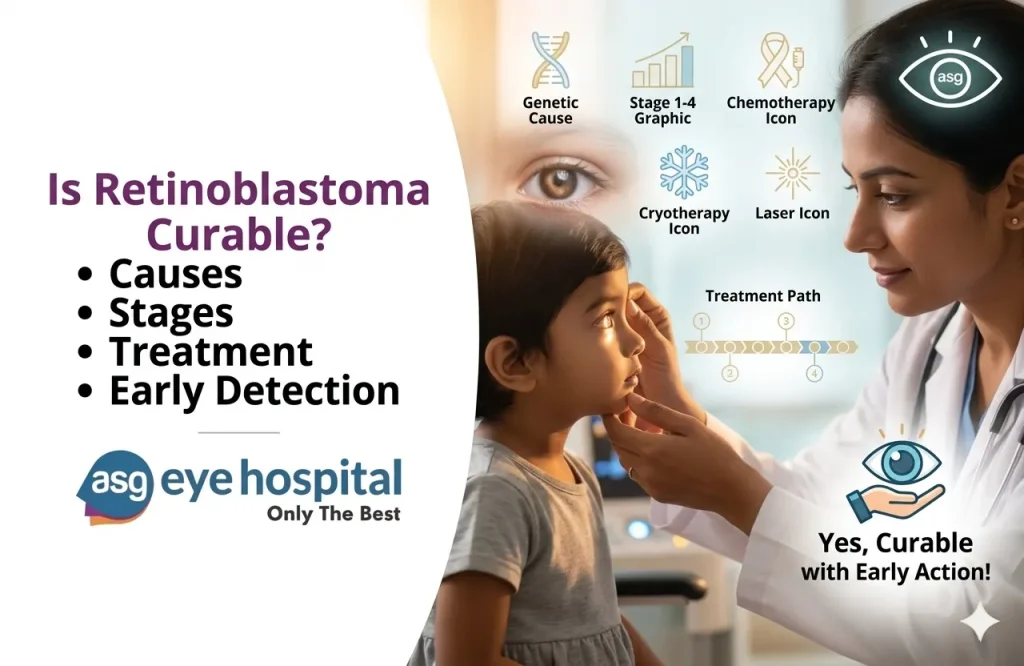
Is retinoblastoma curable? Yes, and the answer is one of the most hopeful in paediatric oncology. When the tumour is caught early and still confined to the eye, the cure rate crosses 95% in centres with modern care. The five-year survival rate for early-stage disease sits close to 99%.
Timing is the real challenge. Outcomes drop once the cancer spreads beyond the eye. In advanced stages, treatment becomes much harder, but not impossible – newer combination therapies have improved prognosis even in metastatic cases.
When to See an Eye Specialist
Any of the following should prompt an immediate paediatric eye examination:
- A white pupil in photographs, especially if it repeats
- A squint or an eye that drifts in any direction
- Visible changes in eye colour, size, or shape
- Persistent redness or discomfort in one eye
- A family history of retinoblastoma
At ASG Eye Hospital, paediatric ophthalmology services are available across Mumbai, Delhi, Jaipur, Pune, and other major cities.
Final Thoughts
Retinoblastoma is rare, but it is also one of the few childhood cancers where early detection transforms the outlook almost entirely. A white reflex in a single photo, a drifting eye, or a parent’s gut feeling that something is off; these small observations have saved countless children’s lives and eyes. If you have any concerns about your child’s eyes, a specialist exam takes only minutes.
FAQs
1. What is the first sign of retinoblastoma?
The earliest and most common sign is leukocoria – a white or yellowish reflection in the pupil that appears instead of the normal red-eye effect in flash photographs. A visible squint is the second most frequent early sign.
2. At what age does retinoblastoma usually appear?
Most cases are diagnosed in children under five, and the majority before age three. Hereditary forms appear earlier, often in infancy, and usually affect both eyes.
3. Is retinoblastoma hereditary?
Around 40% of cases are hereditary and caused by an inherited RB1 gene mutation. The remaining 60% are sporadic, from random mutations with no family history. Genetic testing is recommended for every confirmed case.
4. Can a child with retinoblastoma live a normal life?
Yes. With early diagnosis and modern retinoblastoma treatment, most children survive and lead healthy, active lives. Those who undergo eye removal adapt well to a prosthetic eye, and vision-sparing therapies often preserve sight.
5. Does retinoblastoma always mean losing an eye?
No. Enucleation is reserved for advanced Group E disease or when no useful vision remains. In earlier stages, laser, chemotherapy, cryotherapy, and plaque radiotherapy can eliminate the tumour while preserving the eye.