Sudden vision loss is one of those symptoms that should never be explained away or left for the next available appointment. Unlike most eye complaints that build gradually and allow time to think, a sudden vision change, whether it lasts seconds, minutes, or hours is the body’s most urgent signal that something in the visual pathway has gone wrong.
What is considered as sudden vision loss
Sudden vision loss does not always mean complete darkness. It includes any rapid, unexpected change in the quality, clarity, or extent of vision that was not there moments before. This covers:
- A complete blackout in one eye that lasts seconds or longer
- A significant patch or curtain of missing vision in one or both eyes
- Blurring that appeared instantly rather than building over days or weeks
- A sudden dense fog or grey-out across part or all of the visual field
- A sudden increase in floaters, flashes of light, or a veil dropping across part of the visual field
Each of these patterns points to a different underlying cause. The location one eye or both, central or peripheral, complete or partial is often the most useful initial clue.
Sudden vision loss causes and what is happening in each case
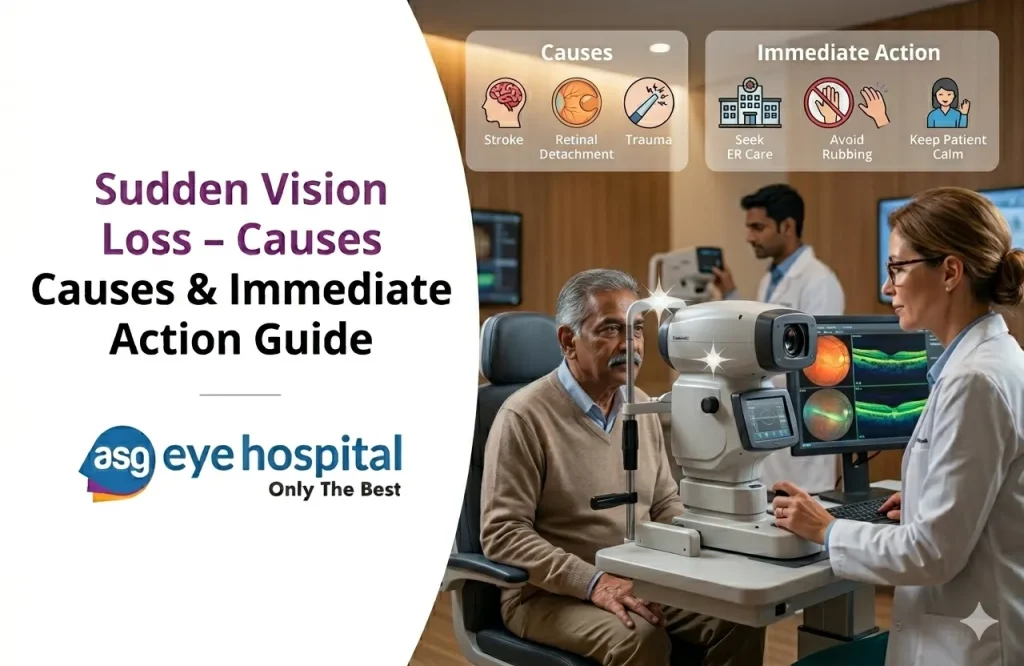
The sudden vision loss causes that matter most are those involving the retinal blood supply, the optic nerve, or the visual pathway to the brain. These are the situations where the window for meaningful intervention is measured in hours.
Central retinal artery occlusion (CRAO) is the eye equivalent of a brain stroke. A clot or embolus blocks the artery supplying the entire retina, producing sudden, painless, profound vision loss in one eye. Without treatment within the first few hours, retinal tissue becomes permanently damaged.
It is strongly associated with cardiovascular risk factors: hypertension, high cholesterol, atrial fibrillation, and diabetes.
Retinal detachment occurs when the light-sensitive retinal layer separates from the underlying tissue. The warning signs are a sudden increase in floaters, flashes of light, and then a shadow or curtain from the periphery moving toward the centre. It is painless.
Without surgical repair within 24 hours when the macula is at risk, vision loss becomes permanent.
Vitreous haemorrhage occurs when blood leaks into the vitreous cavity, blocking the path of light to the retina. It produces a sudden shower of floaters, dark spots, or a reddish haze across vision. It is most common in people with diabetic retinopathy.
Vision may partially recover as blood absorbs, but the underlying cause needs urgent assessment.
Optic neuritis is inflammation of the optic nerve, commonly associated with multiple sclerosis. It typically produces vision loss in one eye that may be moderate to severe, often with pain on eye movement. It can develop over hours to days and tends to affect younger adults.
Anterior ischaemic optic neuropathy (AION) is reduced blood flow to the optic nerve, producing sudden painless vision loss -often described as a shade across the inferior visual field. The aorto-arteritic form, from giant cell arteritis in patients over 50, can cause permanent blindness without immediate steroid treatment.
Loss of vision in one eye: why it matters differently
Loss of vision in one eye is the pattern that most frequently indicates a local ocular or retinal cause -a retinal artery occlusion, retinal detachment, vitreous haemorrhage, or optic neuritis. This is the pattern that demands the fastest eye-specific response.
Sudden monocular vision loss that recovers on its own is often amaurosis fugax -a TIA of the eye. The curtain drops over one eye and returns within minutes. Because vision returns, many people dismiss it.
If my vision came back on its own, does that mean it was nothing serious?
No. Transient vision loss in one eye that recovers is a TIA of the eye, a significant warning that a stroke may follow. It requires same-day assessment, not reassurance and waiting.
Also read: Glaucoma: Early Signs, Causes & Best Treatment Options
Eye stroke symptoms and why this term is clinically accurate
Eye stroke symptoms are:
- Sudden, painless, severe vision loss in one eye -typically occurring within seconds
- No associated redness, discharge, or surface discomfort
- Vision that may be completely absent or reduced to just light perception
- On examination: a pale, whitened retina with a cherry-red spot at the fovea
Is there any treatment for a retinal artery occlusion?
The treatment window is narrow -ideally within 4 to 6 hours of onset. Options include ocular massage, pressure-lowering drops, paracentesis, and in some centres, thrombolysis or hyperbaric oxygen. The most important step is reaching an emergency eye unit immediately, not waiting to see if it improves.
Emergency vision problem: the immediate action guide
Sudden blindness reasons all share one thing: they are not conditions to manage with home remedies or to wait and see about. The guidance is simple and applies across all sudden vision loss presentations.
Call for help immediately and go to the nearest emergency eye unit if:
- Vision in one or both eyes disappeared suddenly, partially or completely
- A curtain, shadow, or veil appeared across part of the visual field
- There was a sudden, dramatic increase in floaters with or without flashes of light
- Vision loss in one eye resolved on its own. This is not reassuring; it is a TIA
- Vision loss is accompanied by severe headache, facial pain, jaw pain, or scalp tenderness -this pattern suggests giant cell arteritis
- There is vision loss alongside weakness, numbness, speech difficulty, or confusion -this is a stroke until proven otherwise
Do not attempt to treat at home. Do not wait until the next morning or the next available appointment. The phrase emergency vision problem exists for a reason. The window for preserving vision in most of these conditions closes faster than most people realise.
Final thoughts on sudden vision loss
ASG Eye Hospital, with centres in Ahmedabad, Surat, Indore, and more, is equipped to assess and manage sudden vision loss presentations across its network. Every centre has slit-lamp examination, fundus evaluation, and tonometry capability, with appropriate urgent referral pathways for conditions requiring surgical or vascular management.
FAQs
1. What are the most common sudden vision loss causes?
Retinal artery occlusion, retinal detachment, vitreous haemorrhage, optic neuritis, and ischaemic optic neuropathy are the most significant. Migraine aura and transient ischaemic attacks also produce sudden, temporary vision loss that warrants prompt evaluation.
2. Is temporary vision loss in one eye an emergency?
Yes. Even if it recovers completely, transient monocular vision loss is a TIA of the eye and a warning sign for stroke. It requires a same-day medical assessment, not watchful waiting.
3. What are the symptoms of an eye stroke?
Sudden, painless, severe vision loss in one eye occurring within seconds, with no redness or surface discomfort. It is associated with cardiovascular risk factors and has a narrow treatment window of 4 to 6 hours.
4. Can retinal detachment be fixed if caught early?
Yes. Surgical repair -laser, cryotherapy, or vitrectomy, depending on the type -is effective when performed before the detachment reaches the macula. Once the macula detaches, vision recovery is significantly reduced even after successful repair.