When a patient is diagnosed with a thinning or conical cornea the first reaction is worry. Many think of it as just a matter of updating glasses prescription, others that they will go blind. The reality is in between. keratoconus is a progressive eye disease but with early diagnosis and the right care many patients do very well and are able to maintain good vision for years.
The cornea is the clear dome which is the front part of the eye. It helps with proper focus of light which in turn allows us to see clearly. When the cornea weakens and begins to bulge out the shape of the eye changes which in turn distorts vision. This is why timely evaluation is of great import, in particular for teens, young adults, or any person that is seeing a change in their prescription very often.
What Is Keratoconus?
Keratoconus is a disease which sees the cornea gradually thin out and bulge into a conical shape. Instead of the round smooth surface which we see in a healthy eye the cornea becomes irregular. This irregularity interferes with sharp focus of light on the retina which in turn causes blurred or distorted vision.
This condition does not at all resemble a refractive error. In the early stages glasses may still be of some use but as the cornea becomes more irregular clear vision may break down even with the latest in spectacle technology. That is why we see to it that we do very regular corneal scans when we have a patient in which the corneal shape is unstable or there is irregular astigmatism.
In large measure the condition does in fact affect both eyes but at the same time it is not uncommon for one eye to be more affected than the other. We see some patients which are stable for very long periods of time, others which progress very quickly. As the condition may present with no symptoms at all in the early stages, early testing is the best way to determine the stage of the disease which in turn will help decide between a monitoring or an active treatment approach.
Causes and Risk Factors
The cause of keratoconus development is not always made out. It is put forth that it is a mix of genetic tendency, eye rubbing, allergies, and weak corneal structure. A family history reports in to that may be but many patients do not have a known family background.
One of the key preventable causes is frequent eye rubbing. In the case of allergic eye disease we see that people rub their eyes which is a response to itchy, watery or irritated eyes. Over time what we see is that this repeated action does in fact make the cornea’s weakness worse. Thus treatment of eye allergy and also avoidance of rubbing are very much a part of the prevention and care.
This condition is included in the group of cornea disease as it affects the structure and health of the cornea which in turn changes the corneal tissue’s strength and shape. The primary issue is that of corneal thinning, which in turn causes the cornea to be unstable and more prone to bulge forward.
| Risk Factor | How It Can Affect the Eye |
| Family history | May increase the chance of inherited corneal weakness |
| Frequent eye rubbing | Can add mechanical stress to the cornea and worsen progression |
| Eye allergy | Itching may lead to repeated rubbing and irritation |
| Young age | Earlier onset may allow more years for progression |
| Connective tissue disorders | May be associated with weaker collagen support |
| Poor ocular surface health | Can increase discomfort and rubbing tendency |
Common keratoconus symptoms
Early symptoms may go unnoticed as they present very much like normal fluctuation in vision. We see patients report that their glasses which were fine at first no longer correct the issue. Also some patients note that one eye does not see as well as the other or that they have issues with lights which may appear stretched out, double, or surrounded by a halo of glare.
Early symptoms may go unnoticed as they present very much like normal fluctuation in vision. We see patients report that their glasses which were fine at first no longer correct the issue. Also some patients note that one eye does not see as well as the other or that they have issues with lights which may appear stretched out, double, or surrounded by a halo of glare.
Parents should note when a child or teen reports that they are frequently changing glasses, that they tilt their head while reading, that there is glare, or that they are in the habit of rubbing their eyes. While these symptoms don’t in themselves prove a diagnosis, they are reason enough to get a full corneal exam.
| Stage | Patient Experience | Clinical Concern |
| Early | Mild blur, glare, repeated power changes | Early irregular astigmatism |
| Moderate | Distorted vision, poor night vision, glasses less effective | Progressing cone shape and corneal thinning |
| Advanced | Reduced clarity, contact lens difficulty, visible distortion | Corneal scarring or severe irregularity |
| Complicated | Sudden cloudy vision or pain in rare cases | Hydrops or significant corneal swelling |
How Doctors Diagnose the Condition
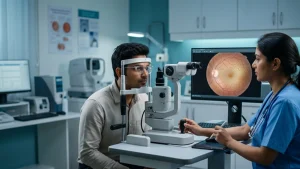
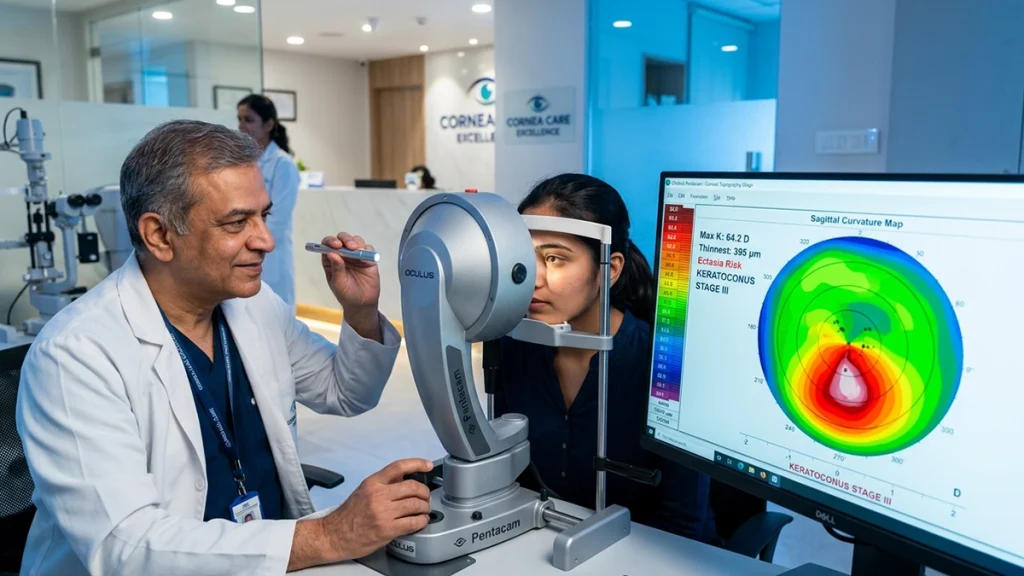
During a routine eye check up the issue may present itself but for diagnosis in depth corneal testing is required. We may perform refraction, slit lamp examination, corneal topography, corneal tomography and pachymetry. These tests measure the shape, curve, thickness and stability of the cornea.
Corneal topography provides a map of the front cornea surface which is different from tomography which studies deeper structural changes. Pachymetry measures corneal thickness which in turn helps the doctor determine if the thinning is mild, moderate or severe. Also these scans are useful during follow up to see if the condition is stable or is progressing.
Early identification of keratoconus is key which in turn presents a wider range of treatment options before the cornea scars or becomes very thin. If the disease is diagnosed at a later stage the patient may require more in depth care including specialty lenses or corneal surgery.
Latest keratoconus treatment Options
In each case the right approach to keratoconus treatment is very much based on the stage of the disease, the age of the patient, the quality of his or her vision at present, and if the disease is in a progressive stage. We do not have a one size fits all plan. In which some patients at the very early stage may do fine with the use of glasses and close monitoring, while a patient with a progressive disease may require cross linking or specialty lenses.
At first it was seen that glasses and soft contact lenses improved vision. As the cornea becomes more irregular we find that rigid gas permeable lenses or scleral lenses do a better job of presenting a more even surface for vision. They do improve vision but it is to be noted that they do not stop the disease from progressing.
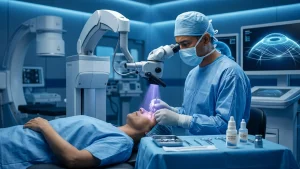
Corneal collagen cross linking is a major breakthrough in keratoconus treatment. We use riboflavin eye drops and controlled ultraviolet-A light to do it out. Also it is done to put the break on or to stop progression which is mainly in young people or in those whose conditions are getting worse. In some cases we also see to it that we use topography guided treatment, intracorneal ring segments, or corneal transplant in the more advanced stages.
Can It Be Cured Completely?
There at present are no simple eye drops or pills which will permanently cure keratoconus. But we do have modern treatments which in many cases will stabilize the disease and preserve useable vision. We aim at early identification of progression, corneal strengthening as required, and use of the best optical and surgical options.
This is what we see in terms of the value of follow up care which may go past the time that vision has improved. A patient may report feeling better in wearing glasses or contact lenses but we still at each visit check the structure of the cornea. If we see any changes early we can put in a treatment plan to address them before they progress into something more serious like scar tissue or severe distortion.
Why Early Care Matters
The greatest error patients make is to wait until the vision has deteriorated. Repeated changes in glasses, glare, and blurred night vision should not be paid out. These may be early warning signs of keratoconus, which is also true for younger patients.
Early intervention which in turn reduces risk of severe thinning, corneal scarring, and contact lens intolerance. Also it enables patients to do better at work, in their studies, and with daily tasks. As this condition often presents at a young age, timely management plays a great role in improving the long term quality of life.
Eye Care at ASG Eye Care
At ASG Eye Care we have in depth eye exams and advanced corneal imaging for all patients which present with signs of keratoconus We aim at not only confirming if the condition is present but also at determining if it is stable or progressive.
The care plan may present glasses, specialty contact lenses, cross linking, or advanced surgical options as appropriate for the stage. We also tell patients to manage their allergies, to avoid eye rub and to have regular follow up. For any patient that has this cornea disease, we are focused on preservation of vision, improvement in comfort, and reduction in risk of future complications.
Key Takeaway
Keratoconus is a progressive disease in which the cornea becomes thin, weak and irregular in shape. It may affect daily activities such as reading, studying, driving, and computer work, but early diagnosis and appropriate treatment may help preserve vision.
Patients must pay attention to repeat changes in the clarity of their vision, glare, night vision issues, or which are which present distorted images. These are keratoconus symptoms which may in fact be a sign that a detailed scan of the cornea is required. With proper monitoring and the right treatment at the right time many patients are able to maintain good functional vision.
Frequently Asked Questions
1. What is keratoconus?
Keratoconus is a condition where the cornea is thin and it protrudes out in a conical form. This changes the way light enters and produces blurred or distorted vision.
2. Is this condition serious?
It can progress to a more severe form which is very serious. Mild cases may do fine with just monitoring but in case of advanced stages vision may be affected for which we may have to do cross linking, special lenses, or surgery
3. What are the early signs?
Early symptoms include that your glasses prescription is constantly changing, blurred vision, glare, halos around lights, poor night vision, and in some cases one eye which is more affected than the other.
4. What is the best treatment?
The best treatment is based on the stage. We see in practice that glasses, specialty lenses, corneal cross-linking, ring segments, and corneal transplant are used which is in function of how advanced the condition is.
5. Can this condition cause blindness?
It usually doesn’t cause total blindness. But in the case of advanced stages which go untreated vision may be greatly reduced and it will affect daily life.
6. Can eye rubbing make it worse?
Yes. Frequent and forceful eye rubbing will make the issue worse. As for people with allergies we should see to it that they get appropriate treatment which in turn will decrease itchiness and rubbing.
7. Can teenagers develop keratoconus?
Yes. The disease usually presents in the teen or young adult years. In younger patients we see more rapid progress which is why we must monitor them very closely.
8. Does every patient need surgery?
No. Many patients present with the use of glasses, contact lenses, and cross linking. Surgery is reserved for late stage cases with severe distortion, scarring, or poor vision which does not improve with other options.