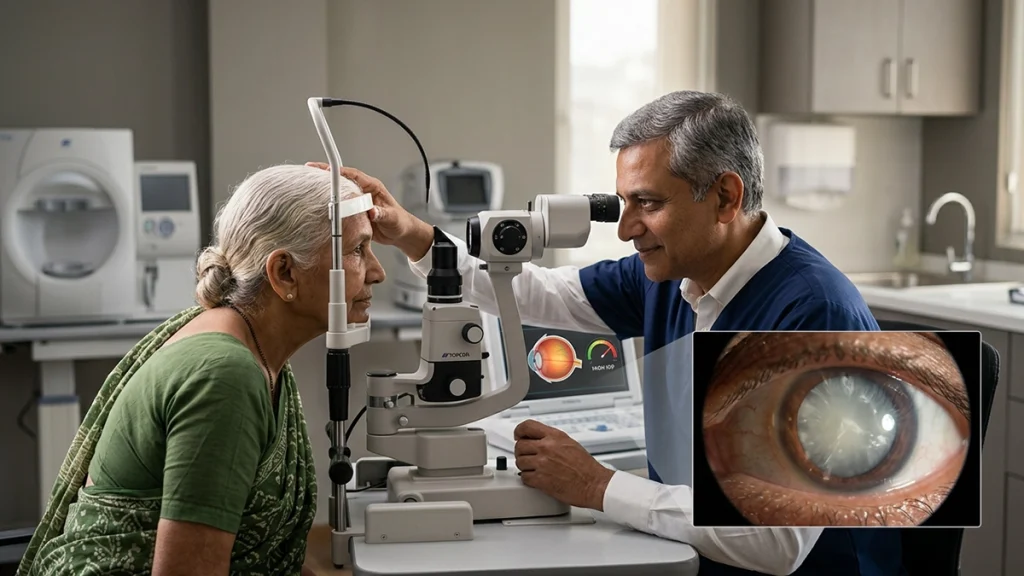
Phacolytic glaucoma is a serious eye issue which does occur when a mature or hypermature cataract is left untreated for a long time. It is a different entity from primary glaucoma but what we see is that it may acutely increase eye pressure and lead to vision loss if treated in a delayed fashion. It is in the emergency department that many patients present with acute symptoms of eye pain, redness, blurred vision and also of a patient which is at stage of a very advanced cataract which has got progressively worse over time.
Phrased simply, phacolytic glaucoma is a type of glaucoma caused by cataract. As the cataract matures past the point of no return lens proteins may let out into the eye’s front section. Those proteins can in turn block the eye’s natural drain which in turn causes pressure within the eye to increase. This is a key cataract complications which requires prompt attention from an ophthalmologist.
What Happens in Phacolytic Glaucoma?
To grasp the concept of phacolytic glaucoma you must first look at how the eye as a body part functions in regards to outflow of fluid. The eye is a constant producer of clear fluid which is known as aqueous humour. This fluid for the most part exits the eye through a small structure which we call the trabecular meshwork. In some cases that outflow is blocked which in turn causes the pressure within the eye to go up.
In the case of phacolytic glaucoma what we see is a very advanced cataract. The cataract which has become so advanced that it’s tissue elements are breaking through the lens capsule into the eye. These protein elements along with inflammatory cells may accumulate in the drainage angle and impede fluid outflow. As a result of the increased pressure the patient may present with acute glaucoma symptoms which include pain, redness, watering, headache, nausea, and decreased vision.
This form of glaucoma caused by cataract is a diagnosis we see in people that have neglected cataract symptoms for months or years. In many cases vision was already poor from the cataract but the sudden pressure increase made the eye very painful and to go to the emergency.
Symptoms and Warning Signs
Phacolytic glaucoma may present acutely even as the cataract is developing slowly. In a patient this may present as an eye which had been doing poorly to begin with which then becomes painful, red, and light sensitive. Vision may also present as foggy and there may be headache or vomiting if the pressure in the eye rises very high.
| Symptom | What It May Indicate |
| Severe eye pain | High eye pressure or inflammation |
| Redness and watering | Irritation inside the eye |
| Sudden worsening of blurred vision | Advanced cataract with pressure rise |
| Headache, nausea, or vomiting | Very high intraocular pressure |
| White or cloudy pupil | Mature or hypermature cataract |
These glaucoma symptoms should never be ignored at all, in eyes which have a dense cataract glaucoma damage is a greater risk and other complications of cataract may present themselves.
Why Does a Cataract Cause Glaucoma?
Not at all does every cataract cause glaucoma. Most cataracts are of a benign nature which may be treated with the help of planned cataract surgery. That said, as a cataract matures into a very advanced or hypermature stage it can at times bring about inflammation or pressure issues.
Phacolytic glaucoma we see happens when lens proteins from the very mature cataract go into the eye and plug up the drainage system. This is as opposed to phacomorphic glaucoma in which the cataractous lens swells up and in turn closes the drainage angle. Both are serious in their own way but the cause is different.
| Condition | Main Cause | Eye Pressure Problem |
| Phacolytic glaucoma | Leakage of lens proteins from a mature cataract | Drainage blockage by proteins and inflammatory cells |
| Phacomorphic glaucoma | Swollen cataractous lens | Angle narrowing or angle closure |
| Regular age-related cataract | Lens clouding | Usually no major pressure rise |
This is why early cataract evaluation is important. When cataract is treated at the right time, many serious cataract complications can be avoided.
Who Is at Risk?
People that go without treatment for extended periods of time report a greater risk for phacolytic glaucoma. It is a bigger issue in the elderly which we see also when delay in cataract surgery is had because of fear, lack of info, medical issues, or access to eye care is an issue.
Patients with very poor vision in one eye from cataract shouldn’t assume that there is nothing which can be done. Even when the cataract has been present for a while an eye exam can determine if the eye is treatable and if urgent care is required.
Diagnosis of phacolytic glaucoma
An ophthalmologist reports on cases of phacolytic glaucoma at in depth eye exam. We see to it that visual acuity is checked, eye pressure is noted, the cornea’s clarity is assessed, we look at internal eye inflammation and the stage of the cataract. Also the drain angle is studied which in turn gives us info if the pressure increase is of open angle or angle closure variety.
The doctor at times will look at the optic nerve if the view is allowed. In many cases the cataract is very dense which in turn causes the back of the eye to not show up proper. Once the pressure is sorted out and cataract surgery is to be performed we may recommend more tests to determine visual potential.
Treatment for phacolytic glaucoma
In this disease we see that the first aim of glaucoma treatment is to reduce eye pressure and inflammation. We may use pressure lowering eye drops, anti inflammatory medicines and at times may also use oral or IV medicines based on the degree of raised pressure. Also we pay very close attention to pain and corneal swelling.
However we find that medicine does not in itself treat phacolytic glaucoma. We determine that the root issue is the mature cataract, which is why once the eye has stabilized we proceed to cataract removal. For that surgery what we do is remove the affected lens which is the source of the leak, which in turn also clears the cause of the inflammation and also restores normal flow of fluid in the eye.
In certain patients which is to say if the pressure has been high for a great while we may look at other glaucoma procedures. The exact glaucoma treatment is based on the pressure level, the state of the optic nerve, corneal clarity, and the health of the eye as a whole.
Can Vision Recover After Treatment?
Vision recovery post phacolytic glaucoma is a function of how quickly the patient gets to the hospital. If the optic nerve and retina are still in good health, cataract surgery may greatly improve vision. If pressure has been very high for a long time some nerve damage may be permanent.
This is the case to not wait for severe pain before getting help. A mature cataract is a warning sign. If the eye becomes painful, red, or suddenly gets worse, seek emergency care.
Eye Care at ASG Eye Care
At ASG Eye Care, patients with advanced cataracts and pressure-related symptoms are evaluated carefully to detect conditions such as phacolytic glaucoma at the right time. We don’t just concentrate on the removal of the cataract but also in the protection of the optic nerve, in the control of eye pressure, and in the reduction of inflammation before and also after the procedure.
If a patient has had cataracts for a while, sudden eye pain, redness, or quick vision loss, in which case early evaluation can help prevent severe vision damage. Also timely cataract surgery and proper follow up care can reduce the risk of glaucoma caused by cataract and other avoidable complications
Key Takeaway
Phacolytic glaucoma is a serious but treatable issue which develops out of an ignored mature or hypermature cataract. It causes sudden pressure increase, pain, redness, and vision loss. Early diagnosis, pressure control, and cataract surgery are the key elements of treatment. To best prevent phacolytic glaucoma is to not delay cataract care until the cataract becomes overripe.
Frequently Asked Questions
1 What is phacolytic glaucoma?
Phacolytic glaucoma is a sort of secondary glaucoma which presents when proteins escape from a mature or hypermature cataract and plug the eye’s drainage system. This causes elevation in eye pressure which in turn may cause pain, redness, and vision loss.
2 Is phacolytic glaucoma dangerous?
Yes, phacolytic glaucoma may present with serious consequences if left untreated. High eye pressure is a which will go after the optic nerve and result in permanent vision loss. The early intervention of ophthalmic care can do much in terms of preserving sight.
3 Can cataract cause glaucoma?
Yes in some cases. A very developed glaucoma caused by cataract as when lens proteins spill out or the swollen lens which in turn impairs fluid outflow in the eye.
4 What are the common symptoms?
Common symptoms are severe eye pain, redness, watering, cloudy vision, headache, nausea, and sudden worsening of sight. These are important glaucoma symptoms which should be brought to medical attention right away.
5 What is the treatment for phacolytic glaucoma?
Treatment usually starts with medicines to lower eye pressure and control inflammation. Once the eye is stable we usually do cataract surgery to remove the cause of phacolytic glaucoma.