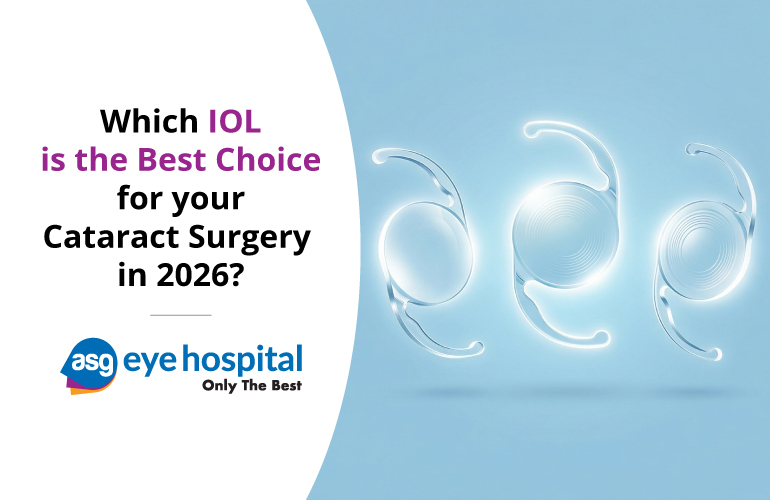
Over the last ten years, there have been many different advances made regarding cataract surgery and its lens selection, including new lens designs and techniques to perform the surgery with more precision. When selecting an intraocular lens (IOL) for cataract surgery in 2026, you should expect to choose from IOLs designed for the restoration of function only, those designed for restoring function according to your specific needs and habits, and possibly more than one IOL type! In all cases, you will need to consider the type of lens selected and how it affects clinical outcomes when deciding on which type of lens to use in your cataract surgery.
Understanding Intraocular Lenses (IOLs)
An intraocular lens is an artificial lens implanted in the eye to replace the natural lens that has become opaque due to cataract formation. Modern IOLs are designed to restore vision clarity and correct multiple refractive vision disorders, including myopia, hyperopia, astigmatism and presbyopia.
Patients now have access to advanced IOL technology, which provides them with more options that will help them reduce their need for glasses after surgery.
Classification of IOLs in 2026
The selection process begins with a clear understanding of the available types of IOL lenses. The system establishes two main groups for categorisation which will separate the products according to their optical design and their operational features.
1. Monofocal IOLs
Monofocal lenses provide clear vision at a single focal point, typically optimized for distance vision. Patients still need to use corrective glasses because they need assistance for activities that require close or intermediate vision, which includes reading and computer work.
The lenses continue to receive extensive usage because they deliver dependable performance at low costs while showing expected results. The study results show that monofocal lenses produce fewer visual disturbances, which include glare and halo effects, when compared to multifocal IOL lenses.
Clinical Consideration:
The solution works for patients who want to see clearly at long distances but prefer to use glasses for activities that require close vision.
2. Multifocal IOLs
Multifocal lenses use multiple focal zones to enable users to see objects that are near and at intermediate distances and at far distances. The purpose of these lenses is to help users achieve better vision without needing to use spectacles.
The condition causes people to experience visual disturbances, which include glare and they experience difficulties seeing in dimly lit environments.
Clinical Consideration:
This treatment suits patients who want to stop using glasses and who lack major eye diseases that affect their retinal and corneal structures.
3. Extended Depth of Focus (EDOF) IOLs
The development of EDOF lenses stands as a major technological breakthrough for advanced IOL technology. The lenses enable users to see in all directions because of their design, which improves their ability to see things at intermediate distances while they still keep their ability to see distant objects.
EDOF lenses provide a better visual experience to users because they experience less visual disturbance compared to multifocal lenses.
4. Toric IOLs
The design of toric lenses enables them to correct corneal astigmatism while providing a solution for patients who require cataract surgery. The lenses have three design options, which include monofocal, multifocal and EDOF.
Clinical Consideration:
The treatment shows effectiveness for patients who already have astigmatism because it enhances their uncorrected vision and decreases their need for cylindrical glasses.
5. Accommodating IOLs
The lenses try to duplicate natural human eye accommodation through their ability to shift position and transform their shape when ciliary muscles contract.
The design exists as a specialized type of premium intraocular lens, which is used less frequently than other available designs.
Clinical Consideration:
The treatment, which shows potential advantages for specific patients, produces different results based on their eye structure.
Factors Influencing IOL Selection
An eye examination needs to be performed to find out which IOL lens is most suitable for the patient. The decision is influenced by multiple clinical and lifestyle factors.
1. Visual Requirements
Patients who need to read and use screens and drive at night require specific lens designs to meet their high visual demands. People who want to stop using glasses should consider multifocal or EDOF lenses as their best option.
2. Ocular Health
Pre-existing conditions that include glaucoma, macular degeneration, diabetic retinopathy and corneal irregularities will determine which lenses are suitable for use.
Multifocal lenses should not be used by patients who have compromised retinal function because their contrast sensitivity will decrease.
3. Age and Lifestyle
Younger active people prefer premium intraocular lens options, which provide them with multiple visual options. The older population needs stable solutions that function without complex operation.
4. Budget Considerations
The standard surgical package provides coverage for monofocal lenses, but advanced lenses, including multifocal, toric and EDOF lenses, require payment because they belong to the premium intraocular lens category.
Monofocal vs Multifocal IOL: Clinical Comparison
The debate around monofocal vs multifocal IOLs remains central to cataract surgery planning.
| Parameter | Monofocal IOL | Multifocal IOL |
| Vision Range | Single distance | Multiple distances |
| Spectacle Dependence | Higher | Lower |
| Visual Disturbances | Minimal | Possible (glare/halos) |
| Contrast Sensitivity | Better | Slightly reduced |
| Cost | Lower | Higher |
The choice ultimately depends on patient expectations and clinical suitability.
Role of Advanced IOL Technology in 2026
Cataract surgery now functions as a refractive procedure because of the implementation of advanced IOL technology. The following innovations have been developed:
- Enhanced optical designs that provide better visual depth of focus
- Blue light filtering lenses, which protect the retina from harmful radiation
- Aspheric lenses, which improve users’ ability to detect light at different levels of brightness
- The development of precision-guided implantation techniques for medical procedures
The developed advancements enable doctors to create personalised visual solutions while enhancing patient satisfaction with their results.
How to Determine the Best IOL Lens for Cataract Surgery
There is no universally applicable answer to the question of the best IOL lens for cataract surgery. The decision must be individualised.
The complete preoperative evaluation process requires testing visual acuity through various methods, conducting corneal topography and optical biometry and retinal assessment and tear-film evaluation.
The ophthalmologist selects the best choice from the available types of IOL lenses based on the results of the examination.
Conclusion
The process of selecting which IOL lens is best requires medical professionals to conduct systematic procedures for patient examination while they deliver complete educational material to their patients. The combination of multiple types of IOL lenses and the progress made in advanced IOL technology enables cataract surgeons to achieve customizable surgical outcomes in 2026.
Patients need to visit an ophthalmologist for visual expectation evaluations before their surgical procedure. Patients who receive their diagnosis early and who choose their lens type correctly will experience better results during their recovery period.
The ASG Eye Hospital network provides complete cataract testing services, which it combines with advanced surgical procedures at all its clinic locations. The ASG Eye Hospital network provides expert consultation services through its multiple locations, which include ASG Eye Hospital in Mumbai, ASG Eye Hospital in Jaipur, ASG Eye Hospital in Delhi, ASG Eye Hospital in Srinagar, ASG Eye Hospital in Gujarat, ASG Eye Hospital in Indore, ASG Eye Hospital in Patna and ASG Eye Hospital in Uttar Pradesh. The centers provide specialized ophthalmic services which enable precise diagnosis and proper IOL selection for patients.
Patients need eye examinations at regular intervals because they require instant access to surgical treatment to achieve their best vision. The presence of significant corneal astigmatism in patients creates suitability for toric IOLs. The procedure requires both accurate biometry data and precise corneal mapping data to produce successful results.
Frequently Asked Questions
1. How can I choose an adequate intraocular lens (IOL) for cataract surgery?
To determine the best IOL for you depends on your evaluation by an ophthalmologist (physician) and how your cataract affects your vision and eye health.
2. What types of IOL lenses will be offered in the year 2026?
There will be five main categories of IOLs, which include monofocal, multifocal, toric, extended-depth-of-focus (EDOF), and accommodating lenses. Each category of IOLs is designed for specific visual needs.
3. Are there differences between monofocal and multifocal IOL lenses?
A monofocal IOL lens provides clear distance vision at only one distance away; however, a multifocal IOL lens provides clear distance vision at multiple distances and can sometimes decrease the need for glasses.
4. Do all patients benefit from premium IOL options?
Premium IOL lenses are beneficial to patients who want decreased use of glasses and an increased visual range after surgery, depending on their eye doctor’s clinical decision about their appropriate use.
5. What types of advancements in IOL technology have occurred leading to better outcomes for cataract surgery?
Advancements in IOL technology and lens design have resulted in significant improvements in clarity of vision, (greater accuracy at correcting for some refractive errors) higher clarity of depth of focus resulting from refractive technology, and a higher level of accuracy leading to more tailored outcomes associated with cataract surgery.