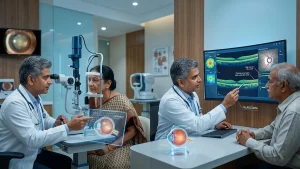
For a lot of people blurred vision sets in gradually. They have trouble with reading, night time driving is uncomfortable for them, colors appear dim, and getting different glasses doesn’t help like it used to. In many of these cases what we are seeing is the onset of cataract which is a result of the natural lens in the eye becoming cloudy. Once this clouding starts to impact day to day life cataract surgery is by far the best and proven solution.
In India what we see is that cataract surgery has come a long way in recent years. In the past patients did not do well to go through long stays in the hospital, large incisions and also had to deal with very slow recovery. Now that has changed with the introduction of new technologies, better surgical techniques, the use of which includes high tech microscopes, a wider variety of IOL lenses, and fine tuned processes like phaco surgery. Also in terms of official medical advice from within India, they are to support what was once again, small incision cataract surgery, phacoemulsification that includes the use of foldable intraocular lenses, and the also the use of what are known as premium foldable intraocular lens options where it is appropriate.
What Is Cataract and When Is Surgery Needed?
A cataract is what forms when the usually clear lens in the eye becomes opaque. This in turn causes light which should go to the retina to not pass through as it should which results in blurry, hazy, or dim vision. While cataracts are very much a part of the aging process which most people develop, also at risk are diabetics, those who have had an eye injury, users of steroids, which may be for asthma for example, which also had previous eye surgery, which had radiation exposure, or were born with it. Cataract treatment is based on the stage of the cataract and how it is affecting the person’s day to day life.
In the beginning a person may get by with better lighting, improved glasses, or regular checkups. But when cataract begins to affect reading, driving, work, mobility, or independence cataract surgery is usually recommended. We not only remove the cloudy lens but also to restore usable clear vision with an artificial lens implant.
During the process of cataract surgery, the clouded natural lens is taken out and it is put in an artificial intra ocular lens which stays in forever. In most routine cases of cataract surgery we do a day care procedure which means the patient goes home the same day and does not have to stay in the hospital for an extended period.
Latest Cataract Surgery Technologies in India
In India the technology used for cataract surgery is based on the patient’s eye health, the stage of cataract, surgeon’s evaluation, hospital resources and what is affordable. At present the most common modern approach is phaco surgery, also known as phacoemulsification. In this procedure ultrasound energy is used to break up the cataract into small pieces which are then removed via a small incision. Also an intraocular lens is put in.
Phaco surgery is the preferred method which we see play out in its small incisions, quick recovery time which is usual, and that also in most instances does away with the need for stitches. The government has put out technical specs which detail phacoemulsification systems as devices that use ultrasonic energy to remove cataractous lenses.
In another option we have small incision cataract surgery which is also known as SICS. This method is used when the cataract is very hard, when the eye anatomy requires a different approach, or when it is what the patient prefers. Also SICS may produce great results when performed by a skilled surgeon. In some advanced centers femtosecond laser assisted cataract surgery is used. At AIIMS they have included advanced phacoemulsification surgery and femtosecond laser assisted cataract surgery into what they provide as cataract services.
| Technology | How It Works | Common Benefit |
| Small-incision cataract surgery | The cataract is removed through a controlled manual incision and an intraocular lens is placed | Useful for dense cataracts and many routine cases |
| Phaco surgery | Ultrasound energy breaks the cataract into small pieces before removal | Small incision, faster healing, usually no stitches |
| Femtosecond laser-assisted cataract surgery | Laser helps with selected steps of the procedure before lens removal | High precision in selected cases |
| Premium lens-based planning | Lens selection is customised according to lifestyle and eye measurements | Better visual planning after surgery |
Understanding Cataract Lens Options
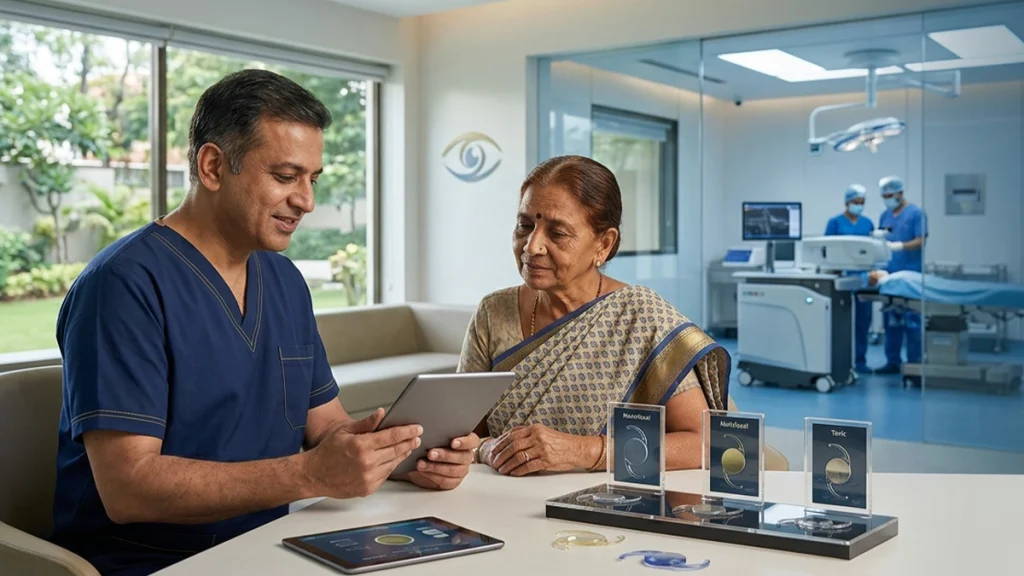
Selecting the proper lens is what really makes the difference in cataract surgery. Many patients are under the impression that the surgery is a simple out and out removal of the cataract, what they don’t realize is that the intraocular lens which is put in plays a large role in the end results. That is why doctors take the time to go over the different lens options with patients prior to the procedure.
In cataract surgery we use an artificial lens which is also known as an intraocular lens. We have different IOL lenses which are designed for various visual requirements. A base monofocal lens usually provides clear vision at a set distance, which is typically distance vision. Patients may still require reading glasses post surgery. Toric lenses may be recommended for those that have a large degree of astigmatism. Multifocal, trifocal, or extended depth of focus lenses may reduce the need for glasses in some cases although not all patients are good candidates.
AIIMS reports that we use premium intraocular lenses which include toric, multifocal, and extended-depth-of-focus lenses for individualized visual rehabilitation and to reduce spectacle dependence in appropriate cases. This is to say that cataract lens options should be made after in depth eye measurement, corneal assessment, retina evaluation, and a discussion of the patient’s lifestyle.
| Lens Type | Suitable For | Important Point |
| Monofocal lens | Patients who want clear vision at one main distance | Reading glasses may still be needed |
| Toric lens | Patients with cataract and astigmatism | Helps correct cylindrical power |
| Multifocal lens | Selected patients wanting less dependence on glasses | May not suit all eyes or all lifestyles |
| Trifocal lens | Patients needing distance, intermediate, and near support | Requires careful patient selection |
| Extended-depth-of-focus lens | Patients wanting improved range of vision | May reduce dependence on glasses in selected cases |
How the Cataract Surgery Procedure Is Planned
Before cataract surgery the doctor does an in depth eye exam. This may include visual acuity testing, slit lamp examination, eye pressure assessment, retina exam, corneal evaluation, and biometry. Biometry which in turn helps to determine the power of the intraocular lens that will be put in the eye. Also in the Delhi Government’s hospital service list A-scan biometry is mentioned as a test which measures eye length and which in turn determines intraocular lens power before cataract surgery.
The doctor also looks for signs of diabetes related eye disease, glaucoma, dry eye, corneal issues, and retinal conditions. This is important as it is not enough to look at the cloudy lens for cataract treatment. The general health of the eye determines how much improvement in vision post surgery.
On the day of cataract surgery the anesthetic is applied as eye drops or local anesthetics. The surgeon removes the clouded lens with the planned approach and puts in the chosen artificial lens. The procedure itself is of a short duration but patients are watched over pre and post op for safety. Most patients go home the same day with care instructions, eye drops, and follow up information.
Recovery After Cataract Surgery
Recovery from cataract surgery is for the most part smooth for all patients which does require some discipline. Within a few days vision may begin to improve although full recovery takes a few weeks. While for some the first few post op days may bring in watering, irritation, glare or a foreign body sensation these symptoms are usually improved with the use of the prescribed eye drops.
Patients are told not to rub out the eye, to stay away from dusty environments, to take medicines as prescribed and to come in for follow up. Also to avoid heavy lifting, swimming, and infection until the doctor says healing has taken place. While cataract treatment may start in the operating theater, that is only the beginning for a healthy and stable outcome which also includes proper post op care.
In some instances vision may not return fully in the presence of other eye conditions like diabetic retinopathy, glaucoma, macular degeneration, corneal opacity, and optic nerve damage. That’s why preoperative counseling is important before cataract surgery.
Cataract Surgery Cost in India
Cataract surgery costs in India are very variable. It is based on the city, type of hospital, surgeon’s experience, technology used, room category, diagnostic tests, medicines and the chosen lens. Basic surgery which includes a standard lens has lower cost, whereas advanced procedures which include premium IOL lenses have higher cost.
In India’s Department of Health Research’s Health Technology Assessment report it is noted that cataract is a very common surgery in public health care settings which also includes a wide range of reimbursement packages for cataract which in turn includes phacoemulsification with foldable IOL. Also they note that the type of lens used and the surgical approach do play a role in the structure of the package.
Patients should not base their choice of cataract surgery on price alone. A very low price may not include the cost of investigations, premium lens options, medicines, follow up visits, or treatment of other eye conditions. It is better to ask what is included in what is being offered and whether the recommended cataract lens options are the best for the patient’s eye and lifestyle.
Cataract Surgery at ASG Eye Care
At ASG Eye Care we take a patient first approach to cataract surgery. We do more than just remove the cataract, we also spend time getting to know the patient’s visual requirements, daily routine, medical history and what they expect from the surgery. Not all patients require a premium lens and not all patients are a good fit for each technology. Our careful exam is to determine what is safe, practical, and best for the patient.
The team looks at cataract grade, corneal health, retina health, eye pressure, ocular surface, and lens condition before putting forth a recommendation for cataract treatment. We also go over with the patient what we see regarding cataract lens options, what to expect in terms of recovery, what to watch out for, and follow up care. For some patients a standard monofocal lens is the best option. For others we may suggest advanced IOL lenses which may reduce the need for glasses post op.
At ASG Eye Hospital we aim to perform cataract surgery which in turn will restore usable vision and get our patients back to their daily routines with more confidence. We do routine surgery, phaco surgery, and advanced lens work. What we do is always based on what is best for the health of the eye and what will bring about long term visual comfort.
Key Takeaway
Cataract surgery in India has seen great advancement which has brought in safer procedures, better pre operative planning, use of modern equipment, and a large choice of lens options. But we see the best results from patients who have the surgery at the right time, with the right technology and the right lens for their particular eye health. Phaco surgery we use for the greater part of our routine cases, we also however use other methods which may be appropriate based on the degree of cataract hardening and the health of the eye.
Patients are to know that cataract treatment does not fit into a single solution. What works best is based on lifestyle, eye measures, retina health, budget, and what they expect. We do in depth consultations which also see to it that patients cataract lens options out there and we determine with them what between standard or premium IOL lenses is the best for them.
Frequently Asked Questions
1. Which is the latest technology for cataract surgery in India?
The present tech trends include advanced phaco surgery, femtosecond laser assisted cataract surgery in some centers, improved biometry, and premium intraocular lens planning. What is best for the patient depends on the cataract type, eye health, and visual needs.
2. Is cataract surgery painful?
In most cases patients don’t report pain during cataract surgery which is when we use anesthetic drops or local anesthetic. May experience some pressure or mild discomfort but for the large part the procedure is very much tolerated.
3. Which lens is best for cataract surgery?
There is not a single best lens for all patients. What works best for you will depend on your specific eye measurements, astigmatism, retina health, what you do in your daily life, and how much you are willing to spend. As for common cataract lens choices we see monofocal, toric, multifocal, trifocal, and also extended depth of focus lenses.
4. What is phaco surgery?
Phaco surgery, which is also a very current method of treating cataracts, uses ultrasound energy to break the cloudy lens into small pieces. The pieces are then removed via a small incision and at the same time an artificial lens is put in.
5. How long does recovery take after cataract surgery?
Many of our patients see improvement in a few days post cataract surgery, but full healing may take a few weeks. What we find is that recovery is based on age of the patient, state of eye health, type of surgery, and how well post op instructions are followed.
6. Can cataracts come back after surgery?
The cataract which is removed does not grow back. Also some patients may develop clouding of the thin membrane which is behind the lens known as posterior capsule opacification. This usually is treated with a simple laser procedure when it does occur.
7. What is the cost of cataract surgery in India?
The cost varies by hospital, city, surgeon, technology, and lens type. We see that standard lenses are less expensive, on the other hand premium IOL lenses and advanced tech may raise the total cost. It is of note that patients should check what is included before booking in for surgery.