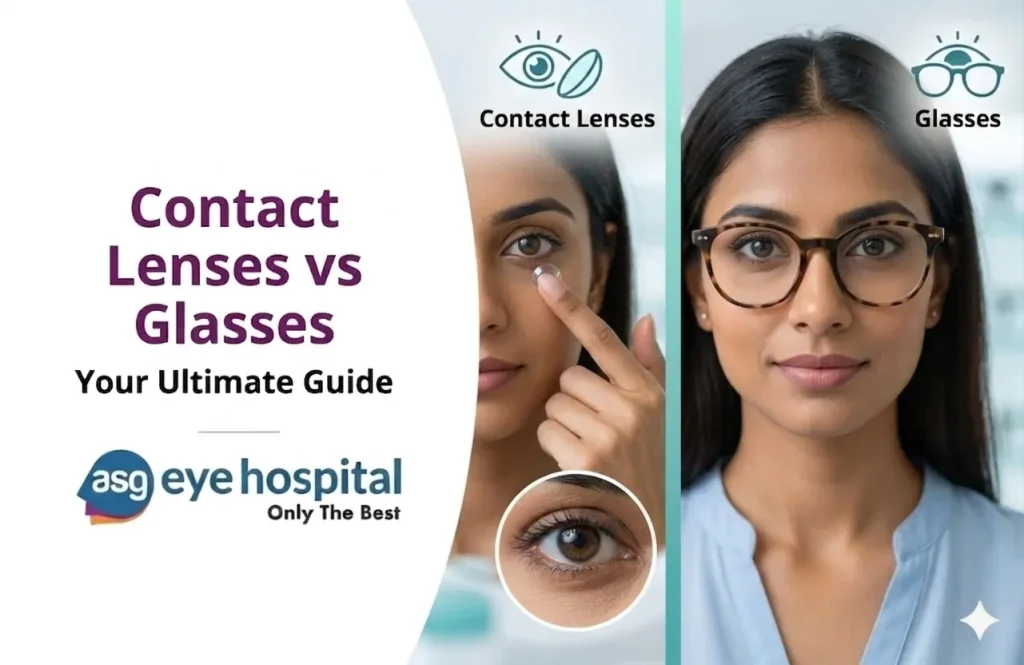
Most people with a refractive error end up using both at different points -glasses at home, lenses for sport or social occasions, then back again. The question of which is better rarely has a single answer. What it has is a set of practical considerations that are worth understanding clearly.
Eyeglasses Benefits
Glasses require no handling of the eye, no cleaning routine beyond the lenses, and no risk of eye infection from wear. Eyeglasses benefits extend to versatility: frames with photochromic or anti-reflective coatings provide UV protection and reduce screen glare in the same pair. They are also the lower-maintenance option -the cost of ownership over time is predictable, and there is no daily compliance requirement.
For people with dry eye, glasses are usually the more comfortable daily option. Lenses reduce oxygen supply to the cornea and can worsen surface dryness, particularly in air-conditioned environments. Glasses sidestep this entirely. They are also the safer choice for anyone with a history of corneal conditions or recurrent eye infections.
Contact Lenses Benefits
The primary contact lenses benefits are freedom of movement, unobstructed peripheral vision, and no fogging in humidity or with masks. For people who play sports, are physically active, or find glasses limiting in their work, lenses provide a meaningful practical advantage. They also eliminate the visual distortion that some people experience with high-prescription glasses, since the lens sits directly on the eye.
Soft daily disposable lenses are the most convenient format -no cleaning, no case, replaced each day. Monthly lenses are more economical with proper care. Speciality lenses such as toric lenses for astigmatism and multifocal lenses for presbyopia are now widely available with good results for most wearers.
Also read: Is it Safe to Wear Contact Lenses Every Day? Know Its Disadvantages
Glasses vs. Lenses: The Honest Comparison
The glasses vs lenses debate is genuinely situational. Glasses win on simplicity, eye health safety, dry eye comfort, and long-term cost. Lenses win on visual freedom, sport and activity suitability, and cosmetic preference. Neither is inherently superior -which is better, glasses or lenses, depends on the individual’s prescription, lifestyle, ocular surface health, and willingness to follow a hygiene routine.
Can I switch between glasses and contact lenses freely?
Yes, and most eye care practitioners recommend this. Using lenses daily for long hours every day without breaks increases the cumulative risk of corneal hypoxia and surface irritation. Alternating between glasses and lenses throughout the week distributes that load.
Contact Lenses Side Effects and When They Matter
Contact lenses side effects are most often linked to poor hygiene, overwearing, or sleeping in lenses not designed for overnight use. The most significant risk is microbial keratitis -a corneal infection that can cause permanent scarring. The risk is low with correct use but rises sharply when lenses are worn while swimming, in the shower, or overnight.
Less serious but more common side effects include dryness and end-of-day irritation, giant papillary conjunctivitis from lens deposits, and reduced corneal sensitivity with long-term extended wear. People with significant dry eye, irregular corneas, or a history of corneal infections should be assessed by an eye specialist before starting lens wear, rather than making their own decision based on general convenience.
Situations Where Glasses Are the Clearer Choice
Glasses are generally the better option when dry eye is present and poorly controlled, when the prescription includes significant astigmatism that makes fitting lenses complicated, when there is a history of recurrent conjunctivitis or corneal disease, or when the person is unwilling or unable to follow the hygiene routine that lenses require. Children under the care of an optometrist for myopia management are usually better managed in glasses or specifically designed orthokeratology lenses, not standard soft lenses.
Final Thoughts on Contact Lenses vs Glasses
For most people with a straightforward refractive error and healthy eyes, both options are safe and the choice is personal. For people with dry eye, corneal conditions, or high prescriptions, the decision benefits from a conversation with an eye specialist rather than a trial-and-error approach.
ASG Eye Hospital, with centres in Jaipur, Amritsar, Jodhpur, and more, provides contact lens assessments, spectacle prescriptions, and specialist evaluation for people with conditions affecting their suitability for lens wear.
FAQs
1. Which is better -glasses or contact lenses?
Neither is universally better. Glasses are simpler, safer for dry eyes, and lower maintenance. Contact lenses offer visual freedom and peripheral vision. Most people benefit from using both depending on the situation.
2. What are the main contact lenses benefits over glasses?
Unrestricted peripheral vision, no fogging or glare, better suitability for sport and active lifestyles, and no visual distortion from high-prescription frames.
3. What are the eyeglasses benefits over contact lenses?
No handling of the eye surface, no infection risk from wear, better for dry eye, lower long-term maintenance, and safe to use with no daily compliance routine.
4. What are the most common contact lenses side effects?
Dryness and end-of-day irritation are the most frequent. Microbial keratitis -a corneal infection -is the most serious risk and is strongly associated with poor hygiene, swimming in lenses, or overnight wear.
5. Can I wear contact lenses if I have dry eye?
Possibly, depending on severity. Mild dry eye can often be managed alongside daily disposable lens wear using preservative-free lubricating drops. Moderate to severe dry eye generally makes glasses the more comfortable and safer daily option.