Have you recently received an eye prescription that mentions CYL or cylindrical power? If you’re wondering what it means and whether it’s a serious eye condition, you’re not alone. Many people are surprised to learn they have cylindrical power during a routine eye examination.
Cylindrical power is associated with astigmatism, a common refractive error that causes blurred or distorted vision due to an irregularly shaped cornea or lens. The condition can affect people of all ages and often occurs alongside nearsightedness (myopia) or farsightedness (hyperopia).
The good news is that cylindrical power can usually be managed effectively with prescription glasses, contact lenses, or vision correction procedures such as LASIK or SMILE, depending on your eye health and eligibility.
This guide explains everything you need to know about cylindrical power, including its causes, symptoms, diagnosis, and treatment options.
What Is Cylindrical Power?
Cylindrical power refers to the amount of correction required to treat astigmatism. In a normal eye, the cornea is round like a basketball, allowing light rays to focus precisely on the retina. In astigmatism, the cornea or lens has an uneven curvature, more like the shape of a rugby ball, causing light to focus at multiple points instead of one.
As a result, vision becomes blurred, distorted, or stretched at both near and far distances.
The “CYL” value in your eye prescription measures the degree of astigmatism and is expressed in diopters (D).
What Causes Cylindrical Power?
Several factors can contribute to astigmatism and cylindrical power.
Common causes include:
- Genetic or inherited eye shape
- Irregular corneal curvature
- Lens abnormalities
- Eye injuries
- Previous eye surgery
- Keratoconus (progressive corneal thinning)
- Corneal scarring following infection or trauma
Most people are born with some degree of astigmatism, although it may change gradually over time.
Symptoms of Cylindrical Power
The symptoms depend on the severity of astigmatism.
Common signs include:
- Blurred vision
- Distorted vision
- Difficulty reading small text
- Eye strain
- Frequent headaches
- Squinting to see clearly
- Difficulty driving at night
- Halos or glare around lights
- Reduced contrast sensitivity
Children with uncorrected cylindrical power may experience learning difficulties because of blurred vision.
How Is Cylindrical Power Diagnosed?
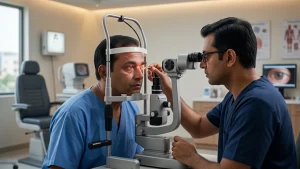
An ophthalmologist performs a comprehensive eye examination that may include:
- Visual acuity testing
- Refraction assessment
- Keratometry
- Corneal topography
- Slit-lamp examination
- Dilated retinal evaluation (when required)
These tests help determine the exact cylindrical power and identify any associated eye conditions.
Understanding Your Eye Prescription
Your prescription may include:
SPH (Sphere):
Corrects nearsightedness or farsightedness.
CYL (Cylinder):
Measures the amount of astigmatism.
AXIS:
Shows the direction of the astigmatism and ranges from 1° to 180°.
Example:
OD: -2.00 SPH / -1.25 CYL × 90°
This means the right eye has myopia with 1.25 diopters of astigmatism at an axis of 90 degrees.
Treatment Options for Cylindrical Power
Treatment depends on your age, lifestyle, prescription, and overall eye health.
1. Prescription Glasses
Glasses are the most common and effective treatment for cylindrical power.
Special cylindrical lenses compensate for the irregular curvature of the cornea, providing clearer and sharper vision.
Glasses are suitable for children and adults and require regular prescription updates.
2. Toric Contact Lenses
People who prefer contact lenses may benefit from specially designed toric lenses.
Unlike regular contact lenses, toric lenses correct both spherical and cylindrical power while maintaining proper alignment on the eye.
Daily, monthly, and rigid gas-permeable options are available depending on your eye condition.
3. LASIK Surgery
LASIK is a popular laser vision correction procedure for eligible patients with stable cylindrical power.
The procedure reshapes the cornea so that light focuses correctly on the retina, reducing or eliminating the need for glasses or contact lenses.
Your ophthalmologist will evaluate corneal thickness, eye health, and prescription stability before recommending LASIK.
4. SMILE Laser Surgery
SMILE (Small Incision Lenticule Extraction) is a minimally invasive laser procedure used to treat myopia and selected cases of astigmatism.
Benefits include:
- Small incision
- Faster recovery
- Less dry eye symptoms
- Excellent visual outcomes
Not every patient is a suitable candidate, so a detailed evaluation is essential.
5. Implantable Collamer Lens (ICL)
Patients with very high power or thin corneas who are not suitable for laser procedures may benefit from Implantable Collamer Lens (ICL) surgery.
This procedure places a specially designed lens inside the eye without removing the natural lens.
Can Cylindrical Power Increase Over Time?
Yes.
In some individuals, cylindrical power may gradually change due to:
- Natural eye growth
- Aging
- Keratoconus
- Eye injury
- Previous eye surgery
Routine eye examinations help monitor changes and ensure the correct prescription.
Can Eye Exercises Reduce Cylindrical Power?
Many online sources claim that eye exercises can cure astigmatism.
However, there is no scientific evidence that exercises can permanently eliminate cylindrical power caused by the shape of the cornea or lens.
Eye exercises may help reduce eye fatigue or improve focusing ability in some people, but they cannot replace glasses, contact lenses, or medically recommended treatment.
Tips to Protect Your Vision
- Schedule regular eye examinations.
- Wear your prescribed glasses or contact lenses.
- Follow proper contact lens hygiene.
- Take regular breaks from digital screens using the 20-20-20 rule.
- Eat foods rich in Vitamin A, Vitamin C, Omega-3 fatty acids, lutein, and zinc.
- Wear UV-protective sunglasses outdoors.
- Manage diabetes and other health conditions that can affect vision.
When Should You Visit an Eye Specialist?
Consult an ophthalmologist if you notice:
- Persistent blurred vision
- Frequent headaches
- Difficulty seeing while driving
- Double vision
- Eye strain
- Rapid changes in vision
- Children squinting or sitting very close to screens
Early diagnosis allows timely treatment and better visual outcomes.
Why Choose ASG Eye Hospital?
ASG Eye Hospital offers comprehensive eye examinations and advanced treatment for astigmatism and other refractive errors. Our experienced ophthalmologists use state-of-the-art diagnostic technology to provide accurate prescriptions and personalized treatment plans. Whether you need prescription glasses, toric contact lenses, LASIK, SMILE, or ICL surgery, our team is committed to helping you achieve clear, comfortable vision with world-class eye care.
Conclusion
Cylindrical power is a common refractive error caused by astigmatism and should not be ignored. Fortunately, it can be effectively managed with accurate diagnosis and the right treatment. Modern options such as glasses, toric contact lenses, LASIK, SMILE, and ICL surgery allow many people to enjoy clear vision and an improved quality of life.
If you’re experiencing blurred vision or have recently been diagnosed with cylindrical power, schedule a comprehensive eye examination at ASG Eye Hospital. Early evaluation and personalized treatment can help protect your eyesight and ensure the best possible visual outcomes.
Frequently Asked Questions
1. Is cylindrical power the same as astigmatism?
Yes. Cylindrical power is the prescription used to correct astigmatism.
2. Can cylindrical power be cured naturally?
No. Natural remedies or exercises cannot permanently correct cylindrical power.
3. Is LASIK effective for cylindrical power?
Yes. LASIK can effectively correct astigmatism in eligible patients.
4. Can children have cylindrical power?
Yes. Astigmatism is common in children and should be treated early to prevent vision problems.
5. Does cylindrical power worsen with age?
It can change over time due to aging, eye conditions, or changes in corneal shape. Regular eye check-ups are recommended.