Most people visit an eye doctor when something is already wrong, vision has blurred, a red eye that will not settle, or a headache they cannot explain. The problem with this approach is that several of the most damaging eye conditions produce no early symptoms at all.
Glaucoma, diabetic retinopathy, and age-related macular degeneration can all cause significant and irreversible vision loss before a person notices anything unusual.
A regular eye checkup is not just a vision test. It is a comprehensive health screen for the eyes and, in many cases, for conditions that first show up there. Understanding the importance of eye checkups and how often it actually needs to happen is worth knowing before something goes wrong.
Importance of Eye Checkup: What It Actually Detects
A full eye examination covers more than whether you need glasses. The optic nerve, retinal blood vessels, and anterior segment of the eye can all show signs of systemic disease -diabetes, hypertension, high cholesterol, multiple sclerosis, and certain autoimmune conditions are all discoverable in a comprehensive eye examination, sometimes before the patient or their GP has any other indication.
Beyond systemic disease, a routine eye checkup can detect glaucoma (often entirely asymptomatic until advanced), early cataract, retinal tears before they become detachments, and early macular changes that respond well to intervention at an early stage.
The earlier any of these are identified, the more treatment options remain available and the better the outcome tends to be.
Eye Checkup Frequency: How Often Is Right for You
Eye checkup frequency is not one size fits all. The recommended interval varies by age, existing conditions, and personal or family risk factors.
For adults under 40 with no symptoms or risk factors: a comprehensive eye examination every five to ten years. Ages 40–54: every two to four years. Ages 55–64: every one to three years. Over 65: every one to two years. These are the AAO’s recommended baseline intervals for asymptomatic, low-risk adults.
Higher-frequency examinations are recommended for people with diabetes (annually at a minimum, or as directed by their ophthalmologist), a family history of glaucoma (every one to two years from age 35 or earlier), high myopia (annually, due to elevated retinal risk), or a history of any previous eye condition.
If you wear glasses or contact lenses, your prescription should be reviewed at least every one to two years, even if your vision feels stable.
Does a clear vision test mean my eyes are healthy?
No. A vision test measures the sharpness of vision at a point in time. It does not assess the optic nerve, retinal health, intraocular pressure, or any of the conditions that damage vision silently. Good visual acuity on a chart is compatible with early glaucoma or early diabetic retinopathy.
Also read: Clear Vision, Healthy Eyes: The Essential Benefits of Regular Eye Checkups
What Happens During an Eye Examination
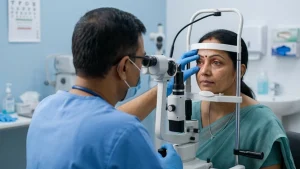
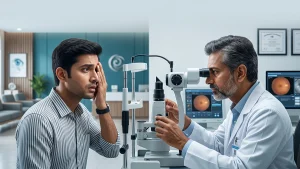
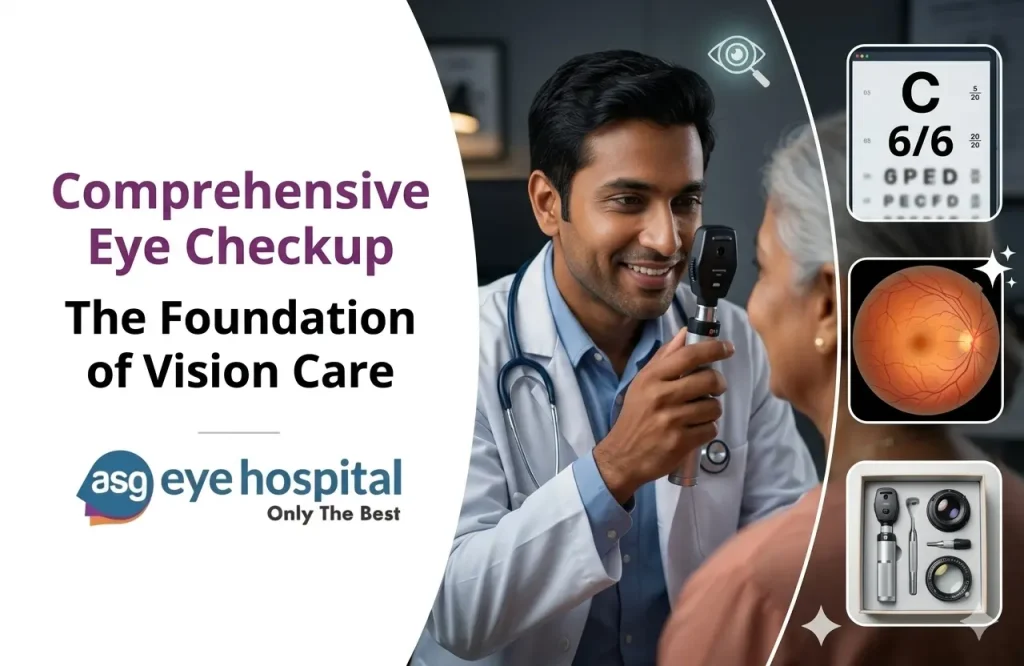
A comprehensive eye examination covers visual acuity testing, refraction, slit-lamp examination of the anterior segment, intraocular pressure measurement, and dilated fundus examination of the retina and optic nerve. The full process takes 30 to 60 minutes.
For patients with specific risk factors or symptoms, additional tests may be added: visual field testing for glaucoma assessment, OCT (optical coherence tomography) imaging for the optic nerve and macula, corneal topography before any refractive procedure, or fundus photography for baseline documentation and follow-up comparison.
When To Book an Eye Test Near Me Without Waiting for a Scheduled Review
Certain symptoms should prompt an immediate eye test rather than waiting for a scheduled review: sudden vision change, new floaters or flashes, a shadow across part of the visual field, significant eye pain, redness not improving after 48 hours, or sudden double vision. Do not defer these.
Children should be assessed at the first sign of any visual complaint, frequent squinting, tilting the head to see, or difficulty with the blackboard. Refractive errors in children are easily corrected but can affect development if undetected. A child who has not had a formal eye examination by the time they start school should have one, even with no reported complaints.
Final Thoughts on Eye Checkup Importance
The case for regular eye examination is not about being cautious -it is about the fact that the conditions most likely to affect long-term vision are the ones least likely to announce themselves early. A two-yearly eye checkup for a healthy adult is a small time commitment relative to what it can catch.
ASG Eye Hospital, with centres in Lucknow, Varanasi, Kanpur, and more, provides comprehensive eye examinations for all ages -from baseline assessments for adults with no symptoms to detailed evaluations for patients with diabetes, family history of eye disease, or existing conditions. If you have been looking for an eye test near me, booking is straightforward at any ASG centre.
FAQs
1. How often should I get an eye checkup?
Every two years for healthy adults under 40 with no symptoms or risk factors. Annually, for people over 60, diabetics, those with a family history of glaucoma, and high myopes. Children should be examined before starting school and whenever a visual concern arises.
2. What is the importance of an eye checkup beyond checking my vision?
A comprehensive eye examination detects glaucoma, diabetic retinopathy, early cataract, retinal changes, and signs of systemic conditions like hypertension and diabetes -often before symptoms appear. It is a health screen, not just a vision test.
3. What does an eye examination involve?
Visual acuity testing, refraction, slit-lamp examination of the anterior eye, intraocular pressure measurement, and dilated fundus examination.