
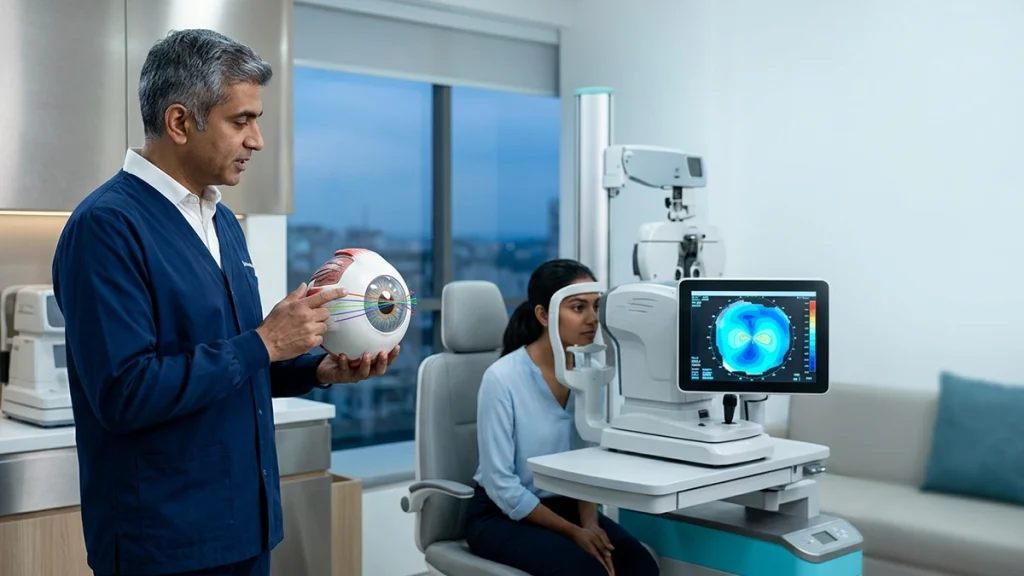
Blurred vision is a symptom that is usually associated with tiredness, screen use or an old spectacle prescription. But when letters appear stretched out, edges of objects look fuzzy or at a large or small scale, your issue may be astigmatism. This common corrective care issue is the result of non-even curvature of the cornea or natural lens which causes light to not hit the retina as a single sharp focus. A full ophthalmic exam will diagnose the issue at hand and to also recommend what is the proper treatment for your case of Astigmatism Treatment.
Some people have mild astigmatism that only requires observation, while in others it benefits from the use of spectacles, contact lenses or refractive procedures. We discuss Astigmatism Symptoms, possible Astigmatism Causes and Cylindrical Power Correction of the cylindrical power which in turn makes the prescription easier to understand for the patient and also helps determine when to seek care.
What Is Astigmatism?
In most cases astigmatism is a result of improper focus rather of an eye infection or retinal disease. In an astigmatic eye one direction of the cornea or lens is more flat or round than the other. Thus light is focused unevenly which in turn may present the image as blurred, distorted or double at the edges.
It may present as a stand alone issue or in conjunction with myopia or hyperopia, also it is known to affect one eye more than the other and to change over time. In mild cases there may be no apparent issue. When vision or comfort is affected we choose the Astigmatism Treatment which is at the discretion of the prescription, age, daily visual requirements and corneal health.
A very dynamic or progressive and out of the ordinary prescription requires close assessment also in the case of keratoconus which changes corneal shape.
How Astigmatism Affects Focus
The cornea is the primary element which does the focusing in the eye. When it has different curvatures in various directions a spectacle prescription may include a spherical value, a cylinder and an axis.
The cylinder measures the degree of Cylindrical Power Correction, which the axis at which it acts in space. An axis of 180 degrees is not of greater strength than an axis of 90 degrees. For accurate measurement and proper lens placement this is very important, reporty that an incorrect cylinder or axis may cause blur, strain or dizziness.
What Causes Astigmatism?
There does not always have to be a black and white answer. Many people are born with astigmatism which then becomes more noticeable as the eyes do develop. There is a hereditary element which may play a role, also within the family you’ll see very different prescriptions. What we see most often as Astigmatism Causes are natural variations in the shape of the cornea or lens.
Astigmatism may also present after an eye injury, corneal scarring, certain eye surgeries or with age related changes in the natural lens. Keratoconus which causes progressive and irregular astigmatism is also a factor. As these Astigmatism Causes vary, an ophthalmologist may perform a detailed cornea exam before recommending Astigmatism Treatment.
Reading in low light, sitting close to the TV or using a mobile phone does not cause astigmatism. These activities may bring out or increase eye strain but reduce screen time is no substitute for an eye exam.
Common Astigmatism Symptoms
Blurred vision which presents at any distance is the most common issue. Fine print may lose its sharpness, road signs may appear smudged and lights at night may cause glare or halos. Also reported are Astigmatism Symptoms of cross eyed vision, headaches, eye strain, visual fatigue and difficulty in concentration during reading or computer work.
Children don’t report blur which they assume is normal. Also they may sit close to screens, tilt their head, avoid reading or have trouble with classroom writing. When Astigmatism Symptoms present in a child timely testing is of great import as prolonged blur may affect visual development.
Symptoms do not always present as the prescription says. As for Astigmatism Treatment the requirement is based on the measured refractive error as well as how it affects daily life.
Regular and Irregular Astigmatism
Regular astigmatism follows a set routine and is usually corrected with glasses or toric contacts. Irregular astigmatism which may result from keratoconus, scarring, injury or past surgery does not fully respond to the use of ordinary glasses.
Specialized rigid and scleral lenses may benefit some irregular corneas. In terms of Astigmatism Treatment the right approach depends on corneal mapping, visual potential, comfort and the base condition.
How Is Astigmatism Diagnosed?
Diagnosis starts with a full eye exam. Visual acuity testing determines clarity and refraction which in turn identifies the sphere, cylinder and axis that give the best vision. Retinoscopy and automated refraction provide an objective estimate which is very useful for children or people that have difficulty with subjective testing.
Keratometry measures the central cornea’s curve. In the case of high, irregular, very fast changing or pre refractive surgery assessment we may recommend Corneal topography or tomography which produces a detailed map. These tests also help to distinguish between routine Astigmatism Causes and those corneal conditions that require more attention. Astigmatism is usually identified through a standard eye exam and refraction test.
| Eye test | What it checks | Why it may be advised |
| Visual acuity | Near and distance clarity | Measures the practical effect of blur |
| Refraction | Sphere, cylinder and axis | Determines spectacle or contact lens power |
| Retinoscopy or autorefraction | Objective refractive estimate | Useful in children and as a starting reading |
| Keratometry | Central corneal curvature | Estimates corneal astigmatism |
| Corneal topography or tomography | Detailed corneal shape | Assesses irregularity and surgical suitability |
| Slit-lamp and dilated examination | Overall eye health | Rules out other reasons for reduced vision |
Understanding Cylindrical Power in Glasses
A prescription usually includes SPH, CYL and AXIS. SPH is for short or long sightedness. CYL is for Cylindrical Power Correction, and AXIS which is the direction it is applied from 1 to 180 degrees. A minus cylinder does not mean the eye is weakening, it is just a way to record astigmatism.
New glasses may at first report floors to be slant or items to be out of shape which is seen especially after a large change. Regarding persistent blur or dizziness it is advised to get checked out because of issues with lens centration, frame alignment and accurate Cylindrical Power Correction which all play a role in comfort.
When Is Astigmatism Treatment Needed?
Very mild astigmatism may not need a correction when vision is clear and comfortable. Treatment becomes useful when blur interferes with reading, driving, school work, night vision or computer tasks. Recurrent headaches or eye strain may also support treatment when it is in association with the examination results.
In kids Astigmatism Treatment may be put forward even if there are not very serious symptoms because clear retinal images support visual development. We must take into account age, stability of prescription, difference between the eyes, corneal shape and lifestyle. The aim of Astigmatism Treatment is to improve what is functionally useful vision safely, not just to change every element in a prescription. Government eye health resources report that primary correction options are glasses, contact lenses and surgery which may not be required in very mild cases.
| Treatment option | How it works | Main considerations |
| Spectacles | Uses a cylinder at a specific axis to redirect light | Non-invasive and suitable for most ages |
| Toric soft contact lenses | Maintains different powers in selected directions | Needs proper fitting and careful hygiene |
| Rigid or scleral lenses | Creates a smoother optical surface | May help selected irregular corneas |
| Laser vision correction | Reshapes the cornea | Requires stable power and suitable corneal health |
| Toric intraocular lens | Corrects astigmatism during selected lens surgery | Requires precise measurements and planning |
| Observation | Monitors mild cases | Suitable only when vision and development are unaffected |
Glasses and Contact Lenses
Spectacles are what we turn to first in Astigmatism Treatment. The cylindrical element in them corrects the light which in turn gives the retina a better image. Also important is proper axis placement which in turn means the frame has to sit right and that the lenses are checked when vision does not improve.
Toric contact lenses have different powers in certain zones and also feature a stable design which keeps them in place. For irregular corneas we may use rigid or scleral lenses. Proper fitment, hand hygiene, and a routine of replacing is required of the contact lens wearers. In case of redness, pain, discharge, or sudden light sensitivity please seek professional care immediately.
A spectacle or contact lens prescription gives Cylindrical Power Correction while the lens is in use; it does not permanently change corneal shape.
Can Laser Surgery Correct Astigmatism?
LASIK or PRK that may alter the cornea and improve certain vision problems like astigmatism. Not all are good candidates. The prescription has to be stable, and we also look at corneal thickness, shape, tear film health and other risk factors.
Before surgery for Astigmatism Treatment, the ophthalmologist will do corneal mapping, thickness measure, pupil evaluation and a dilated exam. In pregnancy there are changes in vision, very dry eye, the risk of keratoconus or some health issues may rule out the procedure. Patients must be aware of the possible side effects, that results may be only partial, and the fact that in some cases they may still leave the surgery wearing glasses. The FDA reports that with LASIK the eye’s focus is changed by precisely reshaping the cornea and also reports to do careful pre op screening for variable refractions, thin corneas, dry eye and other issues.
When Should You Consult an Eye Specialist?
Arrange for an exam when you have blurred vision which affects reading, driving, work or school; when you experience recurring headaches and eye strain; or when your current glasses are no longer comfortable. Also we recommend an appointment when Astigmatism Symptoms present in a child or when the cylinder power keeps changing.
In the early stages it is better to get in for an assessment if you notice that one eye is changing much more than the other, that straight lines appear distorted or that normal glasses no longer improve vision. These may be signs of issues beyond what is typical for Astigmatism Causes.. Also if there is sudden vision loss, severe pain, marked redness, flashes of light, a curtain like shadow or symptoms following an injury seek immediate care as these are urgent eye issues which are not part of routine Astigmatism Treatment.
Astigmatism in Children
A child may have significant astigmatism without that of blurred vision which they are aware of. Parents and teachers report squinting, head tilting, reading difficulty, poor concentration or trouble seeing into the distance.
Early in the course of Astigmatism Treatment we see patients in for properly fit glasses and routine eye exams. If one eye is doing more of the seeing the ophthalmologist will also test for amblyopia. Also of import is the consistent wear of glasses because we see that accurate Cylindrical Power Correction supports immediate clarity of vision and also promotes healthy visual development. Left uncorrected astigmatism in one eye can lead to amblyopia which is yet another reason for early detection.
Can Astigmatism Become Worse?
Astigmatism can stay the same, change slowly over time or present after injury, surgery or changes in the cornea and lens. A minor change is not cause for worry but a sudden increase, growing difference between the eyes’ astigmatism, or reduced vision which doesn’t improve with glasses requires evaluation.
Keratoconus is a put forward reason for progressive irregular astigmatism which in fact is the case for only a few. Corneal mapping is able to tell apart normal refraction variability from the more atypical Astigmatism Causes.
What Happens If Astigmatism Is Not Corrected?
In adults which have gone uncorrected mild astigmatism may cause a bearable amount of blur or fatigue. Greater degrees of it can reduce reading ease, night driving confidence and performance in detailed tasks. In children persistent blur from undiagned astigmatism can interfere with visual development and contribute to amblyopia.
This is that at times we do not put off Astigmatism Treatment in a child which may present no symptoms. Assessment is also very important when one eye is weak or a child has trouble with visual tasks at school.
Managing Astigmatism in Daily Life
Eye exercises, supplements and reduced screen time don’t get rid of astigmatism. Better lighting, frequent breaks, and proper viewing distance may reduce eye fatigue, but they are not a substitute for corrective treatment. For the great majority of people spectacles or contact lenses still are the mainstay of Astigmatism Treatment.
Keep your prescriptions current and have a review when you notice new Astigmatism Symptoms or clarity decreases despite correction. For Best Cylindrical Power Correction accurate testing and proper fitted lenses is key.
Astigmatism Care at ASG Eye Hospital
At our ASG Eye Hospital we do full scale evaluation which includes vision testing, refraction and assessment of overall eye health. Based on what we find we may recommend glasses, contact lens assessment, corneal imaging or a refractive surgery work-up. We choose the best Astigmatism Treatment according to the prescription, age, condition of the cornea and visual goals. On their website ASG Eye Hospital we put forth corrective lenses, contact lenses, corneal assessment and refractive procedures as elements of our vision correction services.
A consultation is also very helpful in cases of Astigmatism Symptoms which report to be an issue in day to day life, the cylinder power which is reported is very variable or in which we see that glasses are not living up to the patient’s expectations. The assessment at this time can determine if the Cylindrical Power Correction is sufficient and also what further corneal tests may be required.
Frequently Asked Questions
1. Is astigmatism a serious eye condition?
Astigmatism is often a very present refractive error which is to say it is not a serious disease. While in large degrees or which are changing quickly astigmatism should be evaluated before we choose Astigmatism Treatment.
2. What are the early signs of astigmatism?
Early signs of Astigmatism Symptoms may present as blurred vision at either near or far, which may also present as a need to squint, headaches, eye strain and trouble seeing fine detail which is also more common at night.
3. What is the main cause of astigmatism?
The primary Astigmatism Causes are differences in the cornea or lens curvature. In most cases the exact reason is unknown and it is present at birth.
4. Can cylindrical power be permanently removed?
Glasses and contact lenses which are worn do the job. Some adults may be a fit for procedures which decrease the use of Cylindrical Power Correction,but eligibility is based on a full exam.
5. Does screen time increase astigmatism?
Screen time may bring out dryness and fatigue but it is not a Astigmatism Causes. Breaks may improve comfort but they do not stand in for Astigmatism Treatment when it is needed.
6. Can contact lenses correct astigmatism?
Yes. Toric soft lenses and some rigid or scleral lenses which we fit professionally will Cylindrical Power Correction
7. When should a child be tested?
Testing advised for squinting, head tilting, reading difficulty, poor concentration, headaches or failed screening. Early identification of Astigmatism Symptoms protects visual development.
8. Is surgery necessary for everyone?
No. Many people do in fact wear glasses or contact lenses to see well, also in some mild cases no correction is required. Surgery is but one option for Astigmatism Treatment which will be determined by a suitably trained professional.