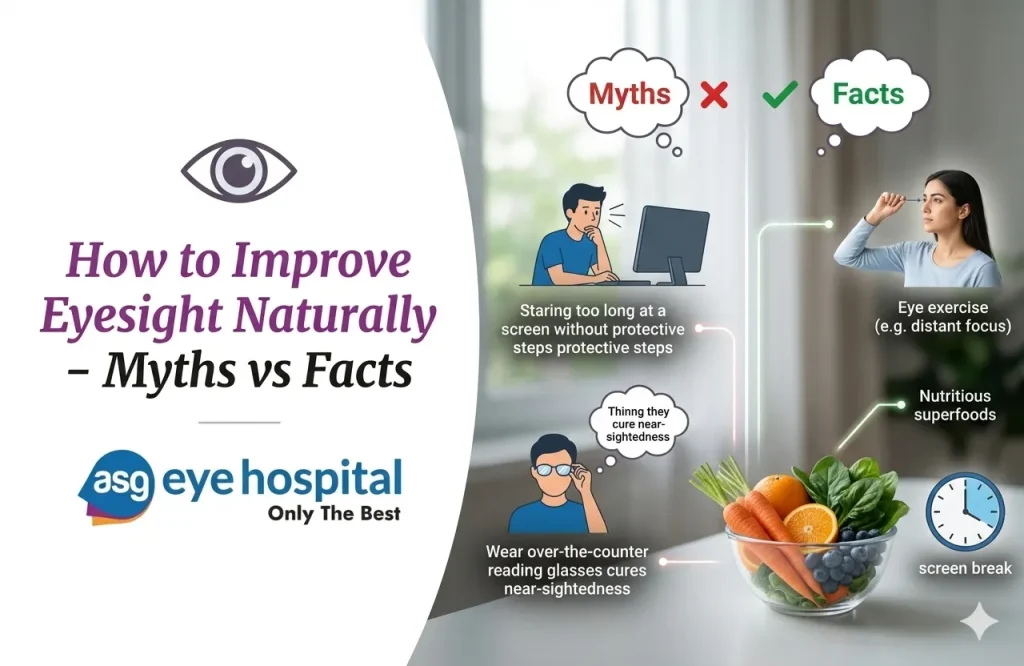
The internet has a lot to say about how to improve eyesight naturally. Eye yoga, carrot juice, sungazing, palming exercises, and herbal drops, the list is long, and the confidence behind most of it is high. Meanwhile, the optometrist’s waiting room keeps filling up.
There is a useful version of this conversation and a misleading one. The misleading version promises to fix refractive errors through habit and discipline. The useful version distinguishes between protecting the eyes you have, supporting long-term eye health, and understanding what can and cannot be reversed without clinical intervention.
Can eyesight be restored through natural methods?
This is the question behind most searches on the topic, and the honest answer is: it depends on what you mean by eyesight and what caused the change.
Refractive errors are caused by the shape of the cornea or the length of the eyeball, structural factors that no exercise, food, or habit can change. Can eyesight be restored naturally? Not for refractive errors. That requires LASIK or lens-based correction.
Where natural approaches make a genuine difference is in conditions driven by deficiency or lifestyle. Night blindness from vitamin A deficiency improves with diet. Dry eye blur improves with screen habits and lubricating drops. Digital eye strain settles with rest. These are real improvements, but not the same as reversing a refractive error.
Also read: 10 Best Juices for Eye Health: Natural Drinks to Support Better Vision
Eye exercises for vision: what the evidence actually says
Eye exercises for vision are one of the most persistent myths in eye health. Various named systems, the Bates method, eye yoga, and focus shifting drills, have accumulated large followings despite a consistent lack of clinical evidence for their core claims.
The American Academy of Ophthalmology is direct: there is no scientific evidence that any eye exercise programme reduces or eliminates the need for glasses. The extraocular muscles are already among the most frequently used in the body. Exercising them further does not change the optical properties that determine focus.
So are eye exercises completely useless?
For refractive correction, yes. For specific diagnosed conditions like convergence insufficiency, where the eyes struggle to work together at near distance, targeted vision therapy under specialist guidance is evidence-based and effective. The distinction matters: exercises prescribed for a diagnosed binocular problem are different from generic eye exercise routines marketed as vision improvement.
Improve vision without glasses: what actually works
The honest answer to how to improve vision without glasses is that corrective lenses, contact lenses, and refractive surgery are the only options that address the structural causes of most vision problems. But there are meaningful ways to optimise the vision you have and protect it from preventable decline.
Addressing dry eye is the most underestimated one. A dry, unstable tear film produces inconsistent, fluctuating blur that many people attribute to their prescription changing. Preservative-free lubricating drops used regularly, reduced screen time, and deliberate blinking throughout the day can meaningfully improve functional clarity without touching the underlying prescription.
Managing screen use is another. The 20-20-20 rule, every 20 minutes, look at something 20 feet away for 20 seconds -reduces ciliary muscle fatigue and the associated temporary blurring that builds through the day. This is not fixing refractive error; it is preventing unnecessary additional strain on an eye that already has one.
Foods for better eyesight and what they actually do
Foods for better eyesight do exist, and the research behind them is legitimate, though what they do is protect and support eye health rather than reverse vision problems.
Lutein and zeaxanthin from leafy greens protect the macula, the central retinal area responsible for sharp detail vision. The AREDS2 study found that a specific combination of these nutrients with vitamins C, E, and zinc slows the progression of age-related macular degeneration by around 25%. They do not restore lost vision, but they slow the rate of decline in at-risk individuals.
Beta-carotene from carrots, sweet potatoes, and leafy vegetables supports retinal photoreceptors for night vision. The carrot-vision link is not wrong -it is overgeneralised. Extra carrots help night vision when the cause is a vitamin A deficiency. Without that deficiency, they do not produce extra visual clarity.
Omega-3 fatty acids from oily fish and flaxseed support the meibomian glands that produce the oily layer of the tear film. Improving tear film stability through diet is one of the most evidence-backed natural ways to fix eyesight problems related to dry eye.
Natural ways to fix eyesight and what that phrase should mean
Natural ways to fix eyesight is a phrase worth unpacking carefully. Fix implies restoration. What most natural approaches realistically offer is support, protection, and optimisation -which is genuinely valuable but different from what many sources claim.
The best-evidenced approaches are unglamorous. Regular moderate exercise reduces intraocular pressure and supports retinal blood flow. Quality UV-protective sunglasses significantly reduce cataract and macular degeneration risk over decades. Not smoking reduces the risk of both. Controlling blood sugar protects against diabetic retinopathy -the leading cause of vision loss in working-age adults.
None of these will sharpen a myopic eye on Monday morning. But they are the habits that determine what the eye looks like at 60 or 70 -and in that sense, they are genuinely the most powerful natural tools available.
The myths worth addressing directly
Several specific claims circulate persistently enough to be worth naming.
- Eye yoga and palming cannot reshape the cornea or change axial length. They may reduce strain and provide temporary comfort, which is worth something, but they will not reduce a glasses prescription.
- Castor oil eye drops do not dissolve cataracts or reduce floaters. Putting non-sterile oil directly on the eye surface introduces infection risk. There is no clinical evidence for any benefit.
- Sungazing -looking directly at the sun -is dangerous and causes photochemical retinal damage. Any practitioner or source recommending this should be disregarded entirely.
- Carrot juice does not cure short-sightedness. Beta-carotene supports specific retinal functions in specific deficiency states. It does not fix structural refractive errors.
Final thoughts on how to improve eyesight naturally
The honest version of this topic is more useful than the popular one. There are things you can do to protect your eyes, slow age-related decline, and optimise the clarity you have. There is no natural way to reverse a structural refractive error without a procedure.
ASG Eye Hospital, with centres in Lucknow, Varanasi, Kanpur, Raipur, and more, sees patients at every stage -those exploring whether their prescription can be reduced, those wanting to understand what diet and lifestyle genuinely contribute, and those ready to consider a refractive procedure. The starting point in every case is an accurate assessment of what is actually happening with the eye.
Understanding the difference between what is supportable through habit and what requires clinical correction is not pessimistic. It is the difference between acting on things that work and spending years on things that do not.
FAQs
1. Can eye exercises actually improve eyesight?
Not for refractive errors. Eye exercises cannot change the shape of the cornea or the length of the eye. For specific binocular conditions like convergence insufficiency, targeted therapy under specialist guidance is evidence-based and helpful -but that is a different thing from generic vision improvement exercises.
2. Which foods are best for better eyesight?
Leafy greens (spinach, kale) for lutein and zeaxanthin, oily fish for omega-3, orange vegetables for beta-carotene, citrus and peppers for vitamin C, and nuts and seeds for vitamin E. These support eye health and reduce the risk of age-related decline, but they do not correct refractive errors.
3. Is it possible to improve vision without glasses?
For structural refractive errors -short-sightedness, long-sightedness, astigmatism -the options are corrective lenses or refractive surgery. What natural habits can do is optimise functional clarity by addressing dry eye, screen fatigue, and nutritional gaps.
4. Do carrots improve eyesight?
Carrots support night vision in people with vitamin A deficiency because beta-carotene is converted to vitamin A, which the retina needs. If there is no deficiency, extra carrots do not produce extra visual clarity or correct a refractive error.
5. Can eyesight get worse without glasses?
For most adults, not wearing glasses does not make the prescription worse. It causes strain and discomfort from the eye working harder to compensate, but the structural cause of the refractive error is unaffected by lens use or non-use.